
 Nanko Park
「historic sites」カテゴリーアーカイブ
Nanko Park
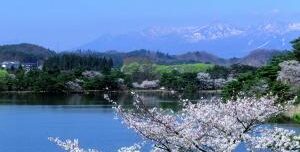
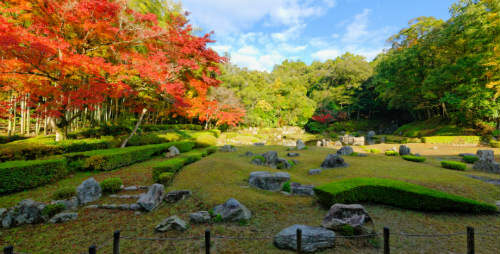
The Japanese park system was established in 1873, at the beginning of the Meiji Era. This park was created prior to that, at the end of the Edo Period, by Matsudaira Sadanobu, the 12th lord of the Shirakawa domain, with an idea of “samurai and commoners sharing a joy” and the public being able to take a rest regardless of their social status. It was constructed in 1801 with elements of gardens and designated as a National Historic Site/Place of Scenic Beauty in 1924.
cultural property : historic sites and places of scenic beauty as natural monuments
type : places of scenic beauty, historic sites
1 hoka, Nanko, Shirakawa-shi, Fukushima-ken 961-0812
Shirakawa-city Construction department Cultural Property Division
Tel:0248-27-2310
Home page : http://www.city.shirakawa.fukushima.jp/page/page001385.html
This park was constructed by Matsudaira Sadanobu, who is known for the Kansei Reforms during the Edo Period. Sadanobu intended to create a place without a wall where anybody can take a rest regardless of their social status and visit anytime. It is said to be the oldest place called “park” in Japan.
There are gently sloping hills in the north of the park and a pond (Nanko) in the south, and both create an expansive view around the park. There are various kinds of trees among lush pine trees on the hills. Visitors can enjoy a wide variety of seasonal flowering plants in the forest.
The island in the middle of the pond is also covered with trees and flowers. There are fish and birds in the pond that are a pleasure to the eyes of visitors.
Among scenic spots that are created for nature outings, there are only a few of them that are landscaped with a pond as a center piece. The park was named after a lakeside park described in the old Chinese book, “Famous Gardens of Luoyang,” as it tried to replicate the essence of the Chinese park.
Kairaku-en
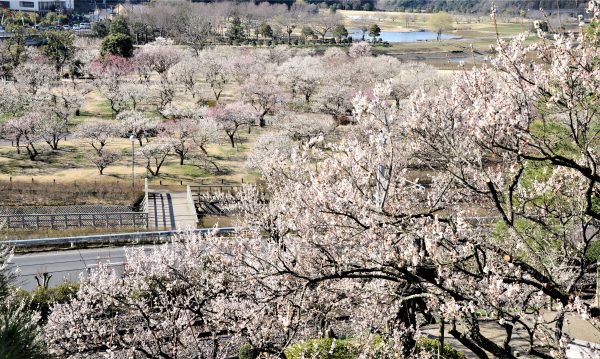
This is one of the Three Great Gardens of Japan along with Kenroku-en in Kanazawa and Koraku-en in Okayama. It was built by the 9th lord of Mito, Tokugawa Nariaki, in 1842. An area of the entire park including Kairaku-en and Senba Park is about 300 hectare and this is the 2nd largest urban park in the world after Central Park in New York City, USA.
cultural property : historic sites and places of scenic beauty as natural monuments, Tangible cultural property
type : places of scenic beauty, historic sites
1-3-3, Tokiwacho, Mito-shi, Ibaraki-ken 310-0033
Tel:029-244-5454
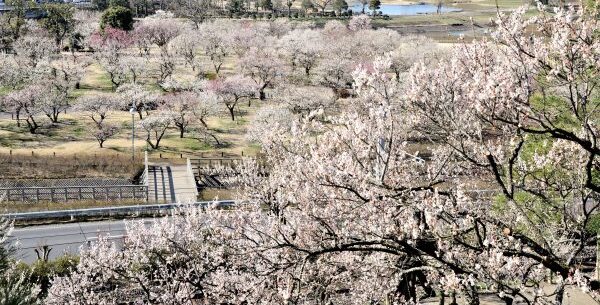
The 9th lord of Mito, Tokugawa Nariaki, built this park to enjoy it with the people in his domain. It is one of the Three Great Gardens of Japan. It is also known as a “plum garden” because there are about 3,000 plum trees of about 100 different varieties.
A vast grove of moso bamboos (Phyllostachys edulis) can be seen when entered from the front gate which is located in the north of the premise. Going down the slope with the large Japanese cedar (Cryptomeria japonica) grove to the right, visitors will find a spring called “Dogyoku-sen.” If they continue to go towards the overlook, they will reach the “Kobun-tei” house. They can see Lake Senba, which is in the southeast of the premise, and surrounding forests from the overlook where the “Kobun-tei” is. The garden is famous for its plum trees but visitors can also enjoy flowers and blossoms all year round as there are azaleas, bush clovers (Lespedeza), and winter cherry blossoms (Cerasus×parvifolia ‘Parvifolia’).
“Kairaku-en” was named after a segment from “The Mencius,” a Chinese classical literature. It reads “elites in ancient times enjoyed with their subjects, therefore their enjoyment was greater.”
Nishiyama-goten-ato historic sites (Seizan-so)
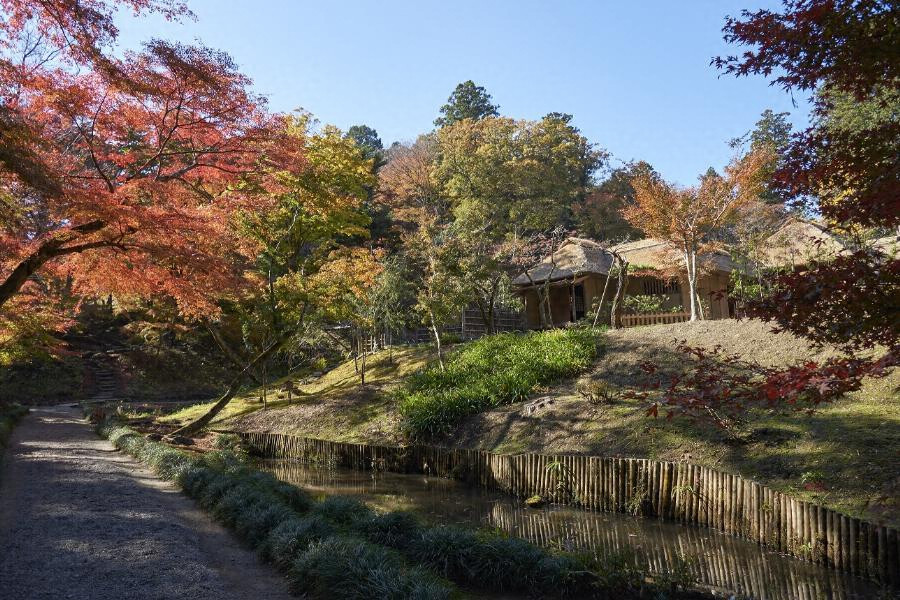
Seizan-so was created inside a residence of the retired 2nd lord of Mito, Tokugawa Mitsukuni, and it is located at the deepest part of the valley of the Genji River in the Kuji River system. It is known that many medicinal plants such as Chinese quince, plum and Veitch’s bamboo were planted according to “Nishiyama-zu” which is a drawing of the entire premise in “Togen-iji” compiled after the death of Mitsukuni.
cultural property : historic sites and places of scenic beauty as natural monuments
type : places of scenic beauty, historic sites
590 Arajukuchō, Hitachiōta-shi, Ibaraki-ken 313-0007
0294-72-1538
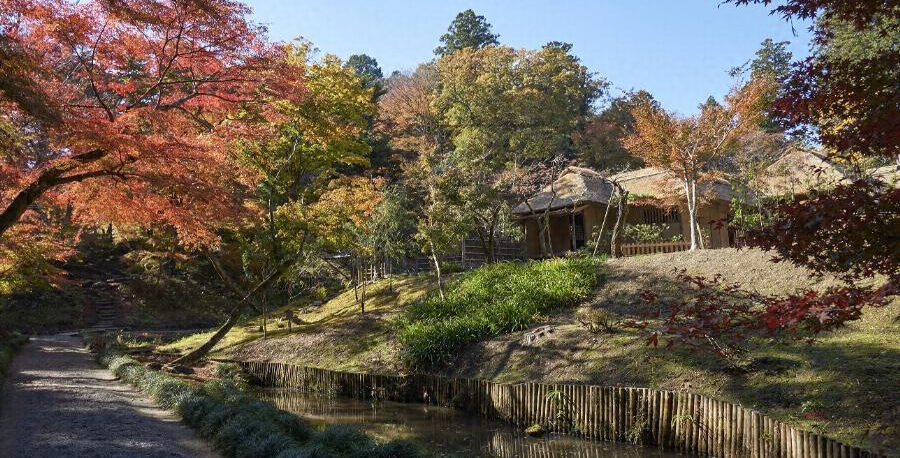
The 2nd lord of Mito, Tokugawa Mitsukuni, retired in 1690 and moved into this mansion. The wooden one-story house is in a Sukiya style with a thatched roof. Roof irises (Iris tectorum) are planted on the ridge of the roof. In old times, roof irises were often planted on the thatched roof because people believed that it would protect the house against the strong wind. According to “Togen-iji”, roof irises were also planted when Mitsukuni resided there.
The garden is located in the south of the mansion. There are the Byakuren-ike pond and the Guren-ike pond and they are connected with a stream. The Byakuren-ike pond is in the southwest part of the mansion and the water flows into the Guren-ike pond which is in the east. There is a remnant of a small waterfall called Ontaki and the water used to flow into the stream between the ponds. A tunnel-shape conduit made of a bored rock was created for Ontaki during the renovation in 1968 and a structure that draws water from Sakurayatsu to the top of the waterfall was confirmed, but currently no water is flowing. A Tsukiyama (artificial hill) called Kangetsuzan is created on the top part of Ontaki and it is said that Mitsukuni held banquets for the moon viewing there.
Mukojima-Hyakka-en
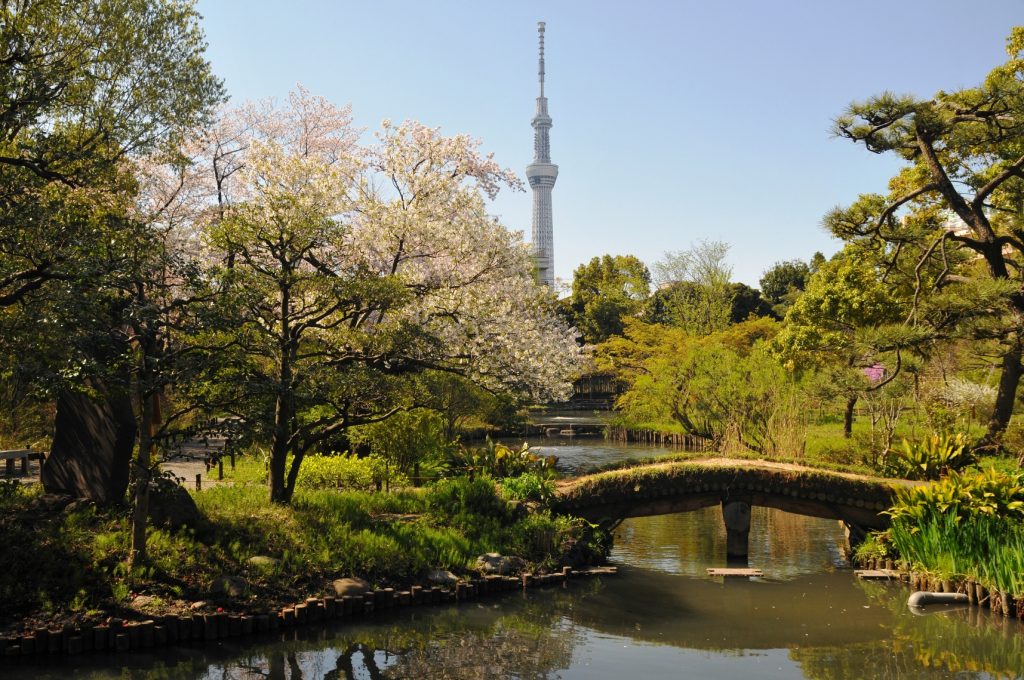
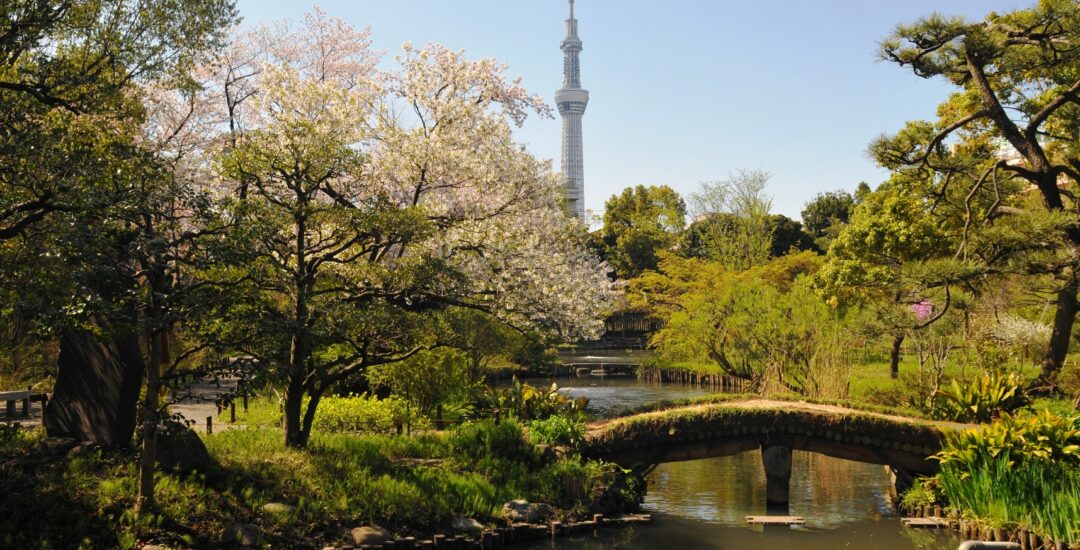
It was created in 1805 during the Bunka Bunsei Era in the Edo Period. The garden mainly constituted of plum trees when it was first opened, but later many herbaceous plants, that were noted in connection with poetries, were planted based on the ideas from the garden owners and intellectuals. This is a folksy garden different from the Daimyo gardens such as Koishikawa Koraku-en and Rikugi-en, yet it also has plenty of tasteful elements from intellectuals’ ideas.
cultural property : historic sites and places of scenic beauty as natural monuments
type : places of scenic beauty, historic sites
3-18-3 Higashimukōjima, Sumida-ku, Tōkyō-to 131-0032
Tel:03-3611-8705
Home page : https://www.tokyo-park.or.jp/park/mukojima-hyakkaen/index.html
Sawara Kiku, who was an antique dealer, created this garden in the house he purchased from a direct retainer of the Shogun in Muko-jima in the Bunka Bunsei Era, when the merchant class culture flourished. It is a privately owned flower garden which was created by common people when they became richer financially and culturally around the end of the Edo Period. It was called the “New plum mansion” because more than 300 plum trees were planted when it was first open. It was also called “Hyakka-en (a garden with a hundred flowers)” because there were always flowers and blossoms all year around. Many herbaceous plants, that were noted in connection with the Manyo-shu and poetries, were planted based on intellectuals’ ideas. The layout that includes the building, pond, paths, and more than 30 stone monuments is remarkable and it is one of a few remnants of intellectuals’ gardens from the Edo Period. The building from the Edo Period burnt down in 1945, but the landscape still has the elegance of the time and it has a different type of beauty from other remaining Daimyo gardens.
Kencho-ji Garden
According to the copper monument dated 1692, the current garden was either created or renovated in the beginning of the Tokugawa Shogunate. There is a garden with a pond shaped like the character for “heart (Kokoro)” in the middle, which is located behind the abbot’s chamber, and the Daikakuike garden in Kaishun-in. The Daikakuike pond was created when the temple was built as a regulating reservoir in order to protect the precincts of the temple from flooding.
cultural property : historic sites and places of scenic beauty as natural monuments
type : places of scenic beauty, historic sites
8 Yamanouchi, Kamakura-shi, Kanagawa-ken 247-0062
Tel:0467-22-0981
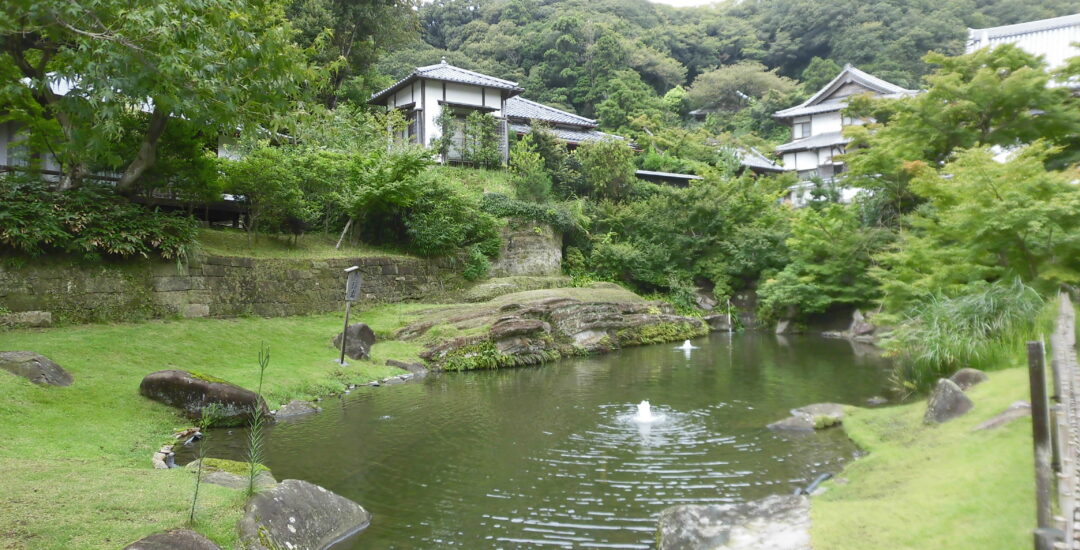
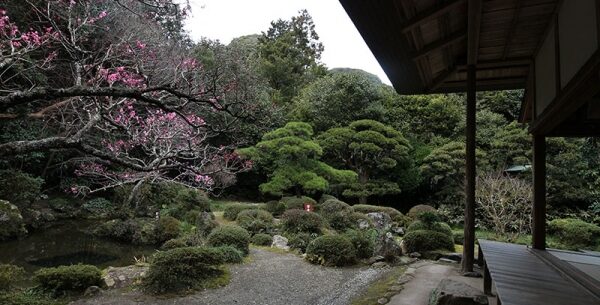
This is the head temple of the Kencho-ji school of the Rinzai sect and founded by Hojo Tokiyori in 1253, the fifth year of the Kencho Era. The precincts are symmetrically arranged and Chinese junipers (Juniperus chinensis) are planted in a row in the garden in front of the Buddhist sanctum. The style of gardens with a study can be seen in drawings from 1678. According to the copper monument dated 1692 in the garden, it is presumed that it was either created or renovated in the beginning of the Edo Period. There is a hill running from the east to the north of the garden and a curved pond is at the bottom of the hill. There is a bridge to walk across to Nakajima (the central island) in the pond. Some stones are arranged on the central island here and there along with a lantern. There are dwarf conifer trees such as pines and yew plum pines (Podocarpus macrophyllus) as well as azaleas. A large Japanese black pine (Pinus thunbergii) is towering in the middle of the garden and lush Japanese zelkova (Zelkova serrata) and maple trees can be seen on top of the hill. The garden is simple yet elegant.
Engaku-ji Garden
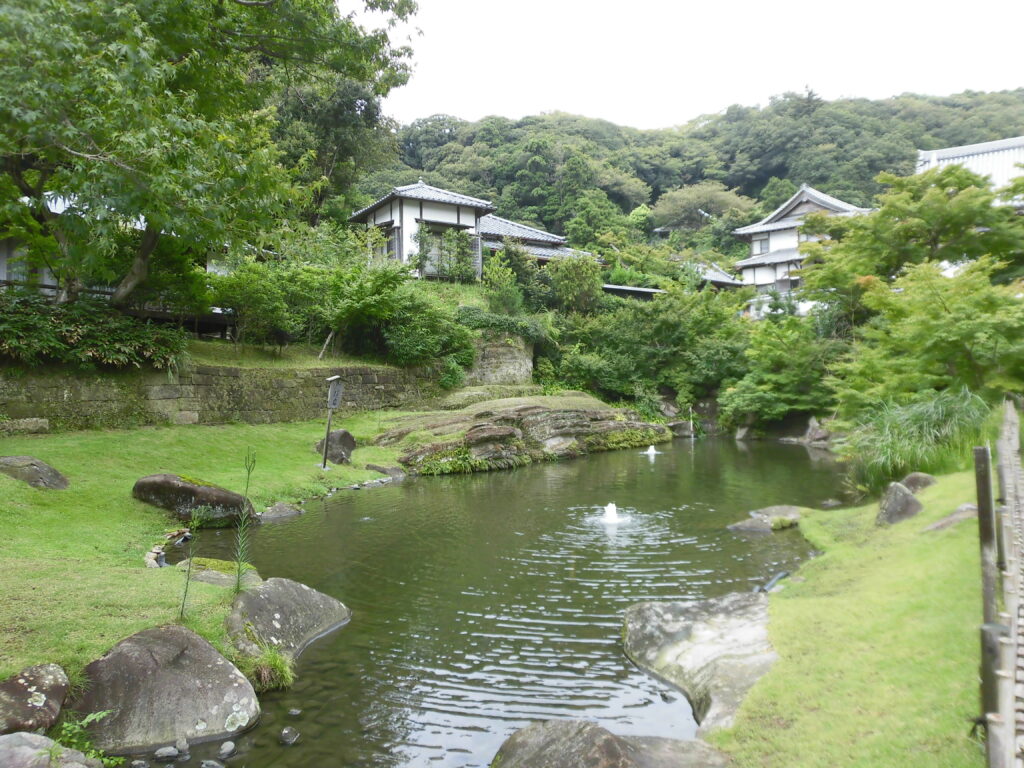
The pond called Byakurochi is on a path leading to the main gate and the natural landscape around the pond changes every season. There is also an old Chinese juniper (Juniperus chinensis) in front of the Buddhist sanctum. There is a garden near the abbot’s chamber and it is centered around a pond called Myokochi, which is shaped like the character for “heart (Kokoro).” All these places were designated as a National Place of Scenic Beauty in 1932.
cultural property : historic sites and places of scenic beauty as natural monuments
type : places of scenic beauty, historic sites
409 Yamanouchi, Kamakura-shi, Kanagawa-ken 247-0062
Tel:0467-22-0478
There is a ceremonial release pond called Myokochi at the bottom of the plateau for the reliquary hall behind the Buddhist sanctum. It is said that the garden with Hojo with a pond in the middle was created by Muso Soseki of the Rinzai sect in 1335.
The pond is made of a bored bedrock. A portion of the rock on the north edge of the pond, towards the mountain, is eroded as though waves carved it and it is called “Kotogan (Tiger head rock).”
The original landscape of the garden was lost when the Yokosuka rail line was built and a prefectural highway opened during the Meiji Era, so the plaza is no longer in a square shape but a symmetrical square pond still remains on the other side of the railway in front of the main gate. This pond is called “Byakurochi” and the stone bridge over the pond is called “Komabashi.” The stone bridge is connected to the straight path leading to the main gate. The path is surrounded by a thick forest of aged Japanese cedars (Cryptomeria japonica) which preserve the appearance of the old days.
Teikan-en
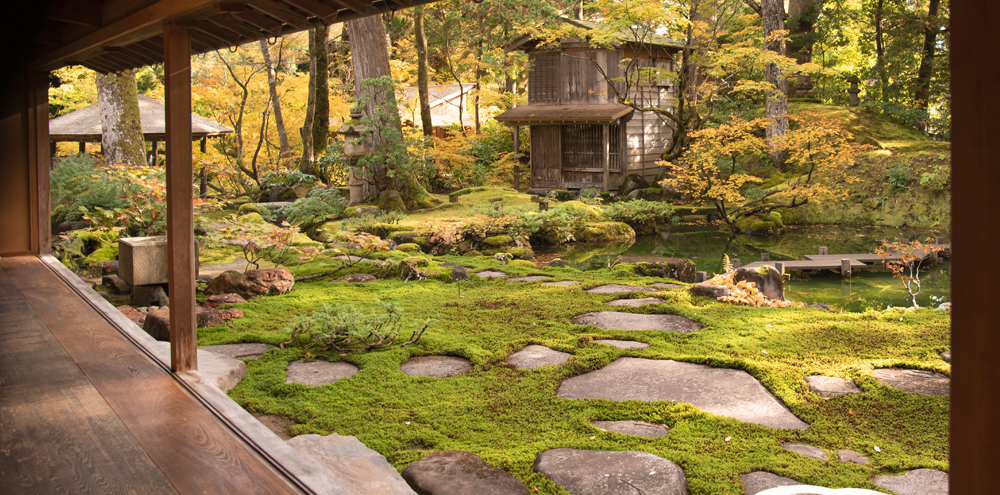
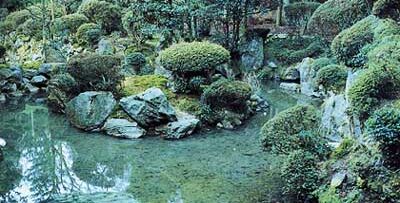
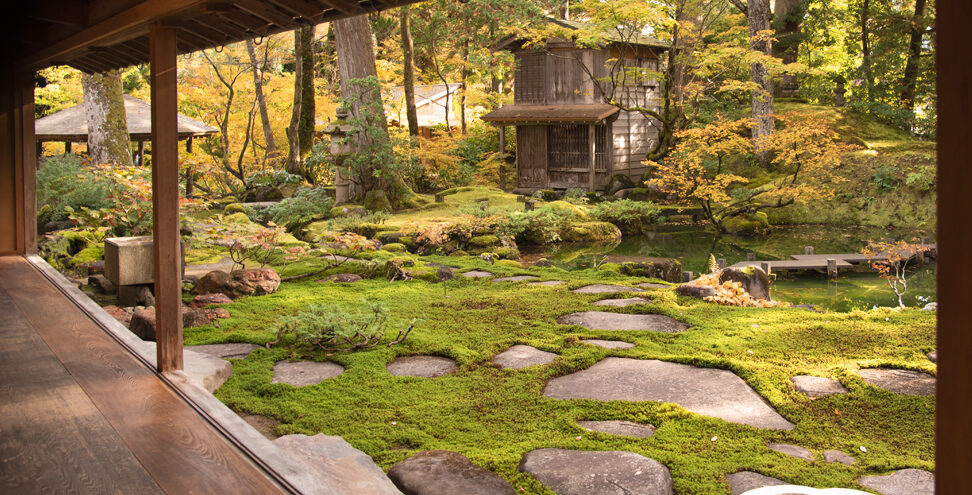
This is a garden with a grove and pond created in the mid-Edo Period. The landscaping method is from Kyoto, but local characteristics, such as an ample usage of Sado’s Akadama (red ball earth), can be seen in the garden. There are more than one hundred varieties of moss such as haircap moss (Polytrichum) and great scented liverwort (Conocephalum conicum) in the garden, and it is truly a rare moss garden only after Saiho-ji in Kyoto, which is famous for its moss garden.
cultural property : historic sites and places of scenic beauty as natural monuments
type : places of scenic beauty, historic sites
593 Takayanagichō Okanomachi, Kashiwazaki-shi, Niigata-ken 945-1502
Tel:0257-41-2100
Home page : www.teikanen.jp/
This is a garden with a grove and pond from the mid-Edo Period. This was a garden of the Murayama Family, who was a powerful village headman. Kameishi, the 8th head of the family, invited Kudan Niemon and Fujii Tomonoshin, who were the gardeners retained by the Shogunate, to work on the landscape.
In 1843, Aizawa Nanjo, a Confucian scholar from Echigo, named the garden after a segment of a poetry by Xie Lingyun, who was a poet from the Six Dynasties of China. It reads “he leaves a traditional formal court dress behind and admires beautiful scenery of hills and valleys.” It is said that Xie Lingyun was a poet who often created poetries to admire the beauty of mountains and water with delicate expressions. There is a pond with waterfalls in front of a hall called Teikan-do. There are buildings such as tearooms called Kanbaku-tei, Yotsutoki-an, Hogetsu-ro and Kansui-ken, as well as numerous garden stones around the garden. It is in a Kyoto style of gardening as the Kobori Enshu style was implemented and it was modeled after the Katsura-rikyu palace, but the garden also has a local flavor such as an ample usage of Sado’s Akadama (red ball earth). There are more than one hundred varieties of moss such as haircap moss (Polytrichum) and great scented liverwort (Conocephalum conicum) in the garden, and it is truly a rare moss garden only after Saiho-ji in Kyoto, which is famous for its moss garden.
Saioku-ji Garden
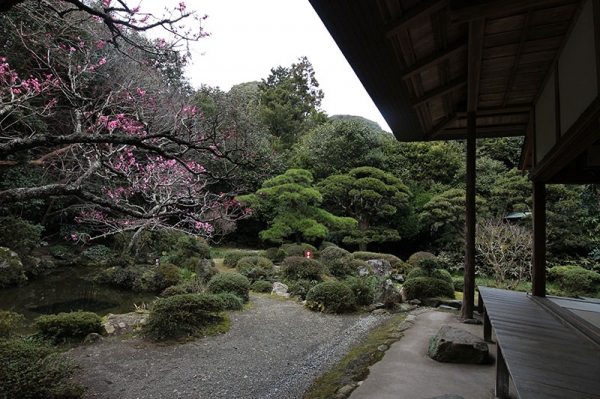
Saioku-ji was originally built as a thatched hut by Socho, a renga (linked poems) poet who worked for the Imagawa Family. Its garden was made by Socho himself. The garden was designated as a National Place of Scenic Beauty and Historic Site in 1936. In 1956, the areas around the waterfall and the front gate were added to the designation in order to protect the forests behind the temple as well as Mt. Tenchu, which is essential to the borrowed scenery.
cultural property : historic sites and places of scenic beauty as natural monuments
type : places of scenic beauty, historic sites
3316 Mariko, Suruga-ku, Shizuoka-shi, Shizuoka-ken 421-0103
Tel:054-259-3686
It is believed that renga poet, Socho, who worked for the Imagawa Family, built a thatched hut Saioku-ken in his later years, which Imagawa Ujichika renovated to a temple, Saioku-ji. It is also called Togeppo Saioku-ji. The garden was made by Socho, which is written about in his notes. West of the main temple building lies flat land where a small pond is situated and filled with fresh water springing from the north-eastern side.
A variety of trees are planted, and various Tateishi (vertical stones) are arranged along the edge of the pond. The garden utilizes Mt. Tenchu in the west as borrowed scenery.
The garden also has a moon-viewing stone, which is said to be a stone Socho would sit on to enjoy the moon. Behind the moon-viewing stone are the tombs of Socho and his teacher, Sogi, side by side. The garden had been designated as a Historic Site/Place of Scenic Beauty in 1936, but in order to protect the bamboo forest behind the temple and Mt. Tenchu—which is essential for the borrowed scenery—from changes of the environment surrounding Togeppo, the areas around the waterfall and the front gate were added to the designation in 1956.
Kojo-in Garden
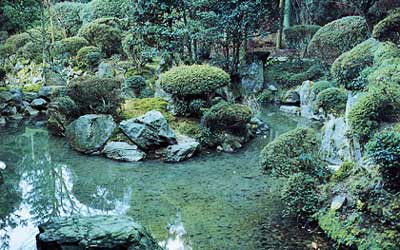
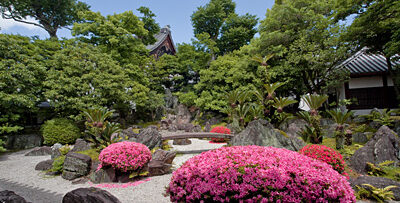
This is a garden at Kojo-in, which is one of the sub-temples of Mii-dera. Azaleas (Rhododendron spp., Rhododendron indicum) are planted densely in various locations, and Japanese cedars (Cryptomeria japonica), Japanese cypress (Chamaecyparis obtusa), and pines form dense forests on the hillside. It is considered to be an outstanding example of of gardens in the Omi region due to its small but dense composition that gives depth to the garden.
cultural property : historic sites and places of scenic beauty as natural monuments
type : places of scenic beauty, historic sites
246 Onjōjichō, Ōtsu-shi, Shiga-ken 520-0036
Tel:077-522-2238
Home page : www.shiga-miidera.or.jp/index.htm
This is a garden at Kojo-in, which is one of the sub-temples of Mii-dera. The timeframe in which the temple was constructed is unclear, but it is thought that the temple was built around 1601 when the Kyakuden (reception hall) was completed.
This view garden with a large pond is integrated with the Kyakuden. Since the Kyakuden’s pillars supporting the southern veranda stand on rocks protecting the pond shore, the pond can be seen directly under the veranda. With water approaching visitors’ feet, the Kyakuden creates a sense of elegance similar to the charm of floating architecture.
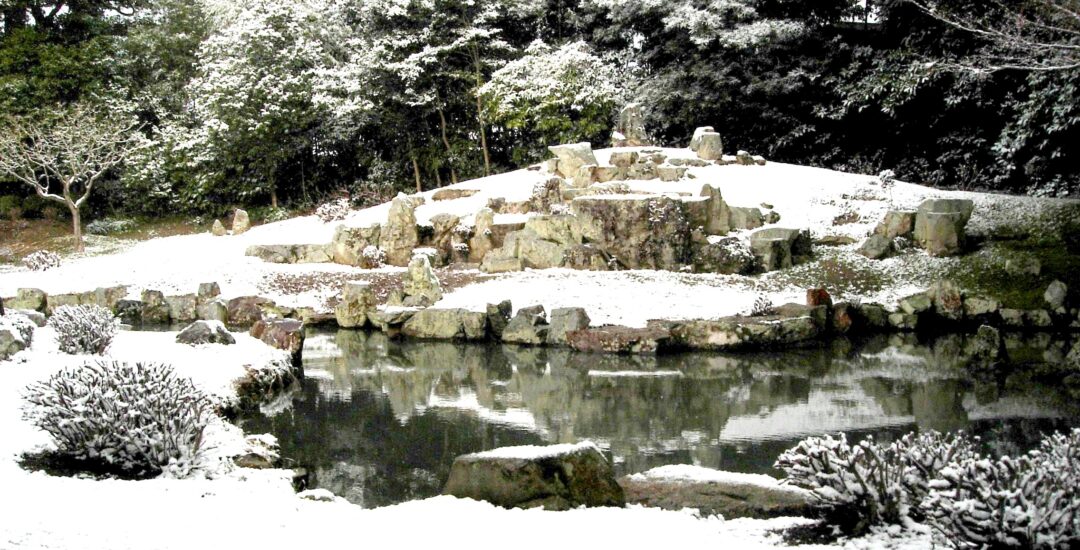
The pond stretches from east to west. A natural stone bridge is installed at a turtle island, and an old waterfall on the opposite shore is made of two Tateishi (standing stones) while three large Yodomari-ishi (stones representing boats) also grace the pond. Natural stones are arranged around the pond.
The southwestern section of the pond ends at a steep slope. Japanese cedars (Cryptomeria japonica), Japanese cypresses (Chamaecyparis obtusa), and pines grow densely on the hillside.Thick groupings of azaleas and dwarf azaleas are planted on the slope.
It is considered to be a representative garden of the Omi region due to its small but dense composition that gives it depth.
Zenpo-in Garden
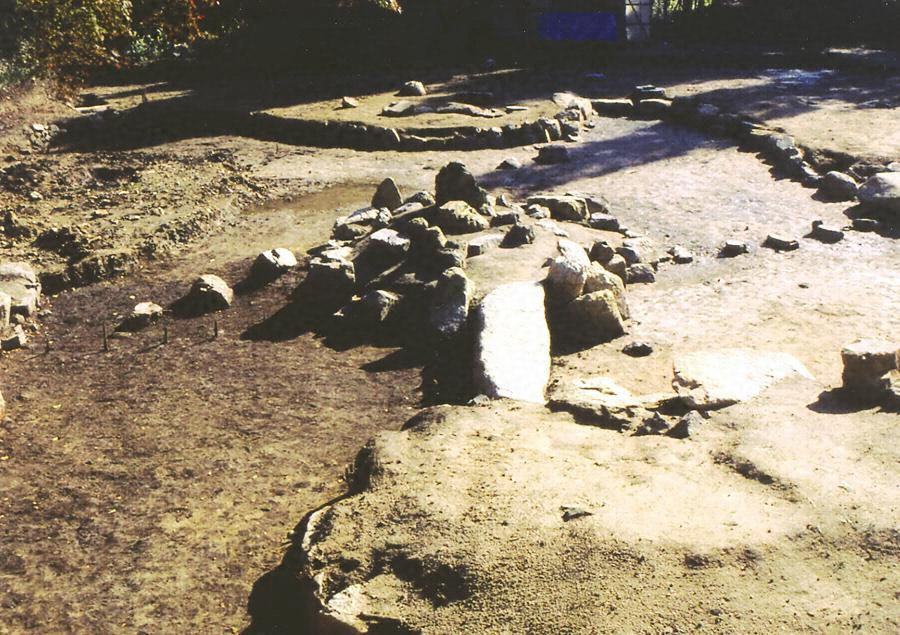
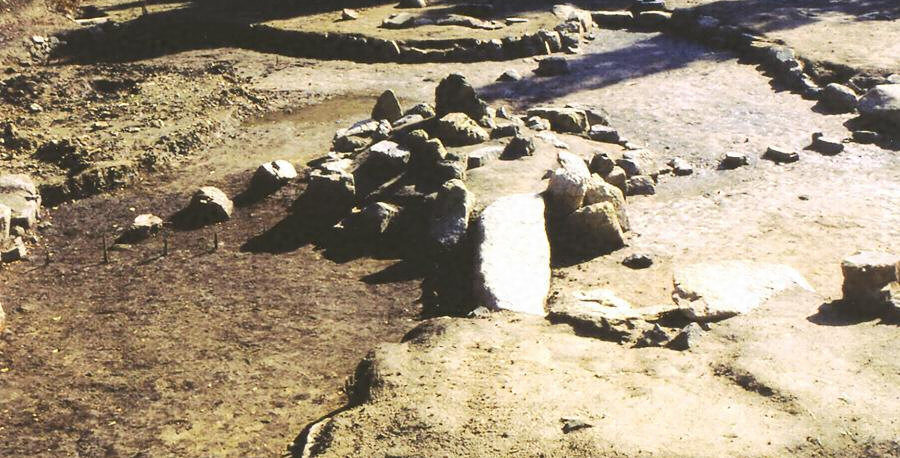
The timeframe of its construction is unclear, but it is thought to have been around the beginning of the Edo Period. The garden had been buried under earth and sand dumped by the debris flow of torrential rains in 1941. However, the excavation survey during the reconstruction and improvement project in recent years has revealed the entire garden. Although no associated buildings survived, the garden features have been well preserved.
cultural property : historic sites and places of scenic beauty as natural monuments
type : places of scenic beauty, historic sites
246 Onjōjichō, Ōtsu-shi, Shiga-ken 520-0036
Tel:077-522-2238
Home page : www.shiga-miidera.or.jp/index.htm
Zenpo-in is one of the six sub-temples of Mii-dera. The timeframe of its construction is unclear, but it is thought to have been built at the beginning of the Edo Period. Although the garden was designated as a National Place of Scenic Beauty/Historic Site in 1934, the site was buried under earth and sand dumped by the debris flow of torrential rains in 1941.
However, thanks to a surveyed map by garden research authority, Shigemori Mirei, and an excavation led by forest expert and landscape researcher, Okazaki Aya’aki, the full details of the garden were recovered. Although associated buildings no longer exist, the pond shore and stone arrangements of the garden have been preserved.
Based on a description in the database of the Otsu City Museum of History, the details of the garden’s original design have been recovered, such as two ponds in front of the study, a Nakajima (central island), a stone bridge, and arrangements of large stones. However, neither the study nor the garden has been reconstructed.
Myoshin-ji Garden
The garden consists of a garden with Hojo (the chief monk’s residence), which is believed to have been made in the Edo Period, and Yoko-en, which was newly built in 1965. The garden with Hojo is in a Karesansui (dry landscape) style that spreads to the west and south of the Hojo. Yoko-en was built when the bamboo forest behind it died off altogether as it reached the end of its life.
cultural property : historic sites and places of scenic beauty as natural monuments
type : places of scenic beauty, historic sites
1 Hanazonomyōshinjichō, Ukyō-ku, Kyōto-shi, Kyōto-fu 616-8035
Tel:075-461-5226
Myoshin-ji is the head temple of the Myoshin-ji school (the Rinzai sect). Its garden consists of a garden with Hojo (the chief monk’s residence), which is believed to have been created in the Edo Period, and Yoko-en, which was newly constructed in modern times. The garden with Hojo is in a Karesansui (dry landscape) style that spreads to the west and south of the Hojo. Yoko-en was built when the bamboo forest behind it died off altogether as the plants reached the ends of their lives.
The western section of the garden with Hojo is believed to have been made by the Muromachi Period painter, Kano Motonobu. It is called “Motonobu’s Garden.” Motonobu is considered to have established the Kano-style painting school.
Yoko-en was newly built in 1965 in the area where the bamboo forest, the Hojo garden’s background, used to grow. The bamboo forest died off in the late 1950s and early 1960s as it reached the end of its natural life. Yoko-en was designed and built by garden expert, Nakane Kinsaku. On the both sides of the site, he created Karesansui gardens named “Yo-no-niwa (Yang Garden)” and “In-no-niwa (Ying Garden).
Gyokuho-in Garden
The garden was built in the mid-Edo Period. It is divided into southern, northern, and eastern sections, with the South Garden, the Mountain Garden, and the Wind and Water Garden respectively. The entire ground of the South Garden is covered with white sand. Japanese white pines (Pinus parviflora) and Japanese black pines (Pinus thunbergii) are planted in rows. Both the Mountain Garden and the Wind and Water Garden have intricate stone arrangements, creating an elegant atmosphere.
cultural property : historic sites and places of scenic beauty as natural monuments
type : places of scenic beauty, historic sites
60 Hanazonomyōshinjichō, Ukyō-ku, Kyōto-shi, Kyōto-fu 616-8035
Tel:075-461-5226
This is the first sub-temple to have been built among 46 sub-temples at the head temple of the Myoshin-ji school (the Rinzai sect). It was constructed by Emperor Hanazono and also called “Gyokuho Zenkyu.” When going through the main gate, visitors can see Kuri (living quarters of monks) in the front. The Hojo and Kaizan-do (a hall where the remains of Myoshin-ji founder, Kanzan Egen, have been entombed) are linked by a corridor, and a garden in the style of the Momoyama Period is situated on the north and south sides of the corridor. The garden was built in the early Edo Period and is divided into three sections – south, north and east. These sections house the South Garden, the Keisokurei (mountain) Garden, and the Fusuisen (wind and water) Garden respectively.
The South Garden’s ground is covered with white sand. Japanese white pines (Pinus parviflora) and Japanese black pines (Pinus thunbergii) are planted.
The Keisokurei Garden has a Tsukiyama on the east side of Kaizan-do with stone arrangements that represent mountains. The Fusuisen Garden is located to the north, and has a dry waterfall, a Horai stone arrangement, and stepping stones. Among these components, a well called “Fusuisen” and a date-shaped basin can be found. Both the Keisokurei Garden and the Fusuisen Garden have skillful stone arrangements.
NishiHongwan-ji Daishoin Garden
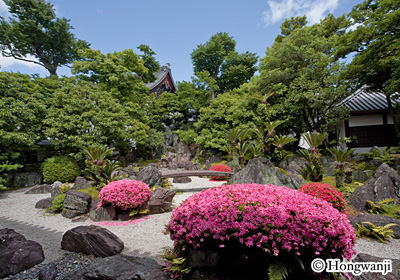
It is a Karesansui (dry landscape) garden of the inner court on the east side of the study, known as “Kokei-no-niwa.” Three central islands of different sizes are situated on white sand. The dry waterfall and rock arrangements are dynamic and strong, which is characteristic of gardens with groves and ponds in front of studies built during the Momoyama Period.
cultural property : historic sites and places of scenic beauty as natural monuments
type : places of special scenic beauty, historic sites
Hanayacho-sagaru, Horikawa-dori, Shimogyo-ku, Kyoto-fu, 600-8501
Tel:075-371-5181
This is the head temple of the Hongan-ji school (the Jodo Shinshu sect founded by Shinran Shonin). Daishoin Garden is a Karesansui (dry landscape) garden of the inner court on the east side of the study, known as “Kokei-no-niwa.”
The garden is flat with a Tsukiyama on the east side. There are many Tateishi (standing stones) and five lanterns. At the center, slightly to the north, there is a magnificent stone arrangement of a dry waterfall. A dry stream represented by cobble stones leads to the ground covered with white sand, recreating a swift current pouring into the ocean. Two central islands are protected by colorful stone edging, and an arched stone bridge and a small bridge made of natural stones connect the islands. Sago palms (Cycas revoluta) planted between stone arrangements are characteristic of study gardens with groves and ponds built in the Momoyama Period. The powerful and dignified stone arrangements and dry waterfall are also great examples of this Period.
Daisen-in Shoin Garden
The garden was built by Kogaku, a monk who founded Daisen-in. Surrounding the main temple in all four directions, the garden is divided by a roofed bridge, etc. to create space for a mountain, a river and the ocean. It is a masterpiece Karesansui (dry landscape) garden that recreates a mountain-and-water landscape by arranging many rocks in a small area.
cultural property : historic sites and places of scenic beauty as natural monuments
type : places of special scenic beauty, historic sites
54-1 Murasakino Daitokujichō, Kita-ku, Kyōto-shi, Kyōto-fu 603-8231
Tel:075-491-8346
Daisen-in is a sub-temple (built to commemorate the death of a high-ranking Zen monk) that stands in the precinct of Daitoku-ji, the north of Kyoto’s urban area. The temple was founded in 1509 by the 76th Daisho Kokushi, Kogaku Soko. A document preserved at Daisen-in states that the garden was also made by Kogaku himself.
The garden surrounds the main temple in all four directions. The south section represents the ocean with two ceremonial piles of sand on ground covered with white sand at both sides of the entrance. The east garden has a dry waterfall arrangement of large rocks and plantings of camelias and Japanese white pines (Pinus parviflora) to recreate the scenery of a secluded mountain. A stone bridge is installed under the dry waterfall, and a stone that resembles a boat is placed on white sand down the “stream,” to represent a large river flowing to the ocean. In this way, the garden depicts a mountain, a river and the ocean.
The roofed bridge that divides the garden into two was once removed at the end of the Meiji Era, resulting in the “mountain” and the “ocean” becoming connected. In 1960, the bridge was restored, and the garden regained its original state.
Manpuku-ji Garden
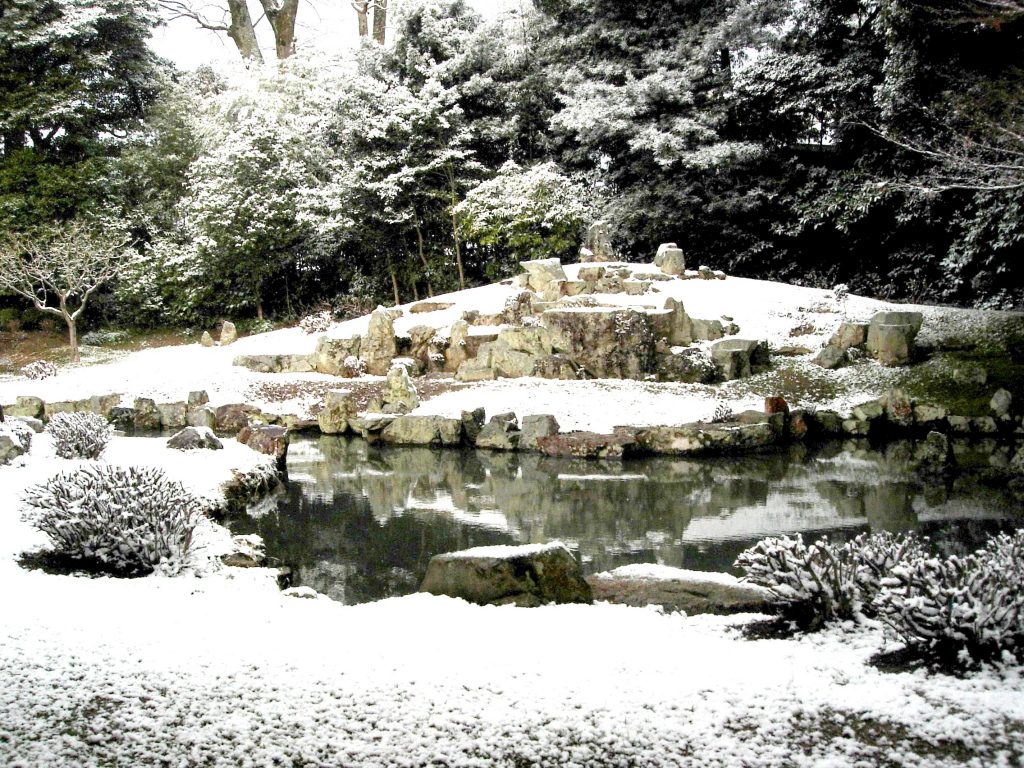
Manpuku-ji was originally founded as Anpuku-ji in the Heian Period, then moved to its current location in 1374 as Manpuku-ji. The garden is a “temple” style garden made by Sesshu in 1479. The pond in the front represents the Chinese character for “heart (kokoro).” A gently sloped Tsukiyama, and spiraling stone arrangements represent the world of Shumisen, of Buddhist cosmology.
cultural property : historic sites and places of scenic beauty as natural monuments
type : places of scenic beauty, historic sites
25-33 Higashimachi, Masuda-shi, Shimane-ken 698-0004
Tel:0856-22-0302
Home page : manpukuji.server-shared.com/
The origin of Manpuku-ji was a temple called Anpuku-ji, which was built in the Heian Period. Anpuku-ji was washed away in large tsunami, rebuilt as a martial art practice hall, then transferred to the current location by the 11th lord, Masuda Nanao, in 1374 (the Muromachi Period).
Its garden is said to have been made by Sesshu in 1479. It is in a temple style with a pond in the front center representing the Chinese character “heart (kokoro).”
The right-hand section of the pond is under the shadow of tree branches that are extending from a forest behind the pond. A stone arrangement of a waterfall is placed on the other shore of the pond. A cape is placed in front, and a Horai stone is located to the left of the dry waterfall. A gently-sloped Tsukiyama can be seen at the center of the other side of the pond. A low-height Tateishi is placed on top of the Tsukiyama, and stones are arranged in a spairaling shape down the slope to represent the world of Shumisen, which is the Buddhism cosmology. The area from the left-hand section of the pond to the west side of the building represents a more open, bright world.
Iko-ji Garden
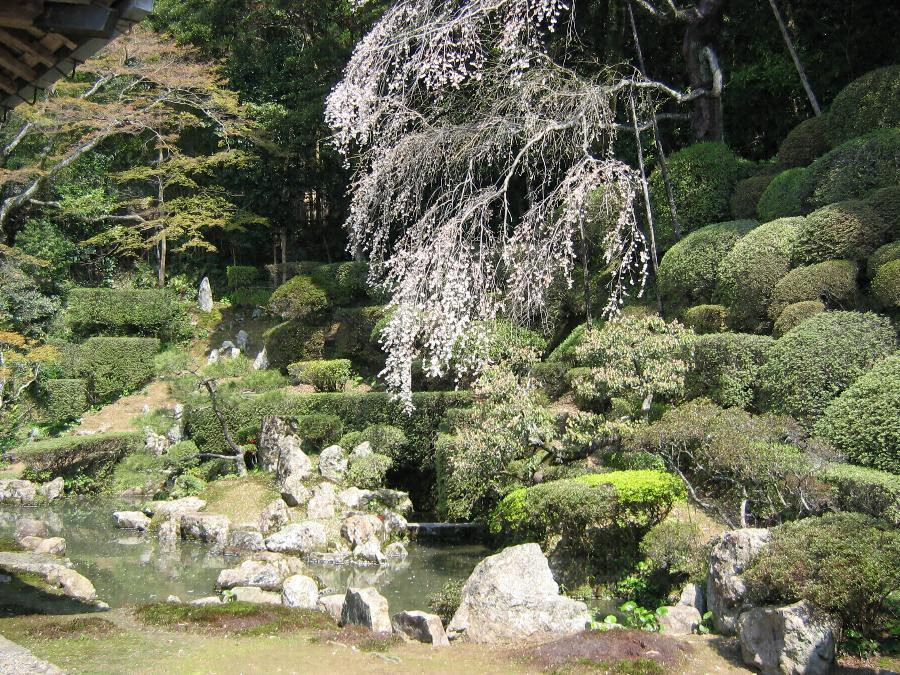
The 5th chief monk of Sukan-ji, the predecessor of the present Iko-ji, was Sesshu and he created a garden in one of the subordinate temples. Sukan-ji was dilapidated during the Warring States Period, but later combined with Iko-ji and remains to this day. This is a Horai-style garden with a crane-shaped pond and a turtle island, and it shows a variety of scenery from season to season.
cultural property : historic sites and places of scenic beauty as natural monuments
type : places of scenic beauty, historic sites
4-29 Somebachō, Masuda-shi, Shimane-ken 698-0011
Tel:0856-22-1668
Iko-ji is a temple of the Tofuku-ji school of the Rinzai sect. Its predecessor was called Sukan-ji and it was founded during the Muromachi Period. Sukan-ji became dilapidated during the Warring States Period, but the 17th head of the Masuda Family, Munekane, restored the temple as Iko-ji.
The 5th chief monk of Sukan-ji was Sesshu, who was a famous ink painter, and created a garden in one of the subordinate temples which became the base of the current garden.
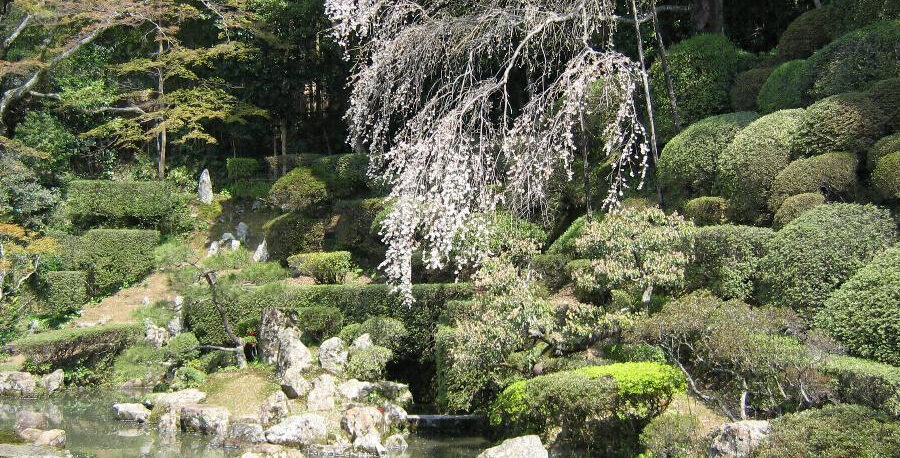
It is a Horai-style stroll and view garden with a pond. The pond is shaped like a crane and there is a turtle island in the pond. It is famous for its weeping cherry trees in the spring and azaleas in May. Various trees create cool shade in the summer, and large maple trees turn red in the fall. The snowscape in winter reminds visitors of the ink paintings by Sesshu. The garden has various appearances from season to season. There are also other things to see in the temple. An ash mound is believed to be the place where Sesshu was cremated. There is a grave of Masuda Munekane, the lord of the clan that governed this area for a long time, and historical statues such as arhat statues.
Joei-ji Garden
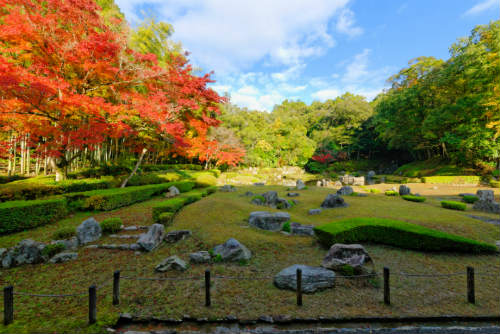
Joei-ji was built as a villa by Ouchi Masahiro about 500 years ago. It is said that Ouchi requested Sesshu to design the garden. There is a pond shaped like the character for “heart (Kokoro)”, a dry waterfall and standing stones in the garden with mountains and forests in its background. It seems that some renovations have been conducted, but most of the original landscapes have been preserved.
cultural property : historic sites and places of scenic beauty as natural monuments
type : places of scenic beauty, historic sites
2001−1 Miyanoshimo, Yamaguchi-shi, Yamaguchi-ken 753-0011
Tel:083-922-2272
Joei-ji was built as a villa by Ouchi Masahiro about 500 years ago. It is said that Ouchi requested Sesshu to design the garden.
The garden is located in the entrance of a small valley, which opens in the direction from east to south, on the edge of the hill. The garden is designed in a deep valley and its front faces the mountain.
It has mountains and forests in its background and there is a pond shaped like the character for “heart (Kokoro)” in the back. In front of the pond, a dry waterfall and numerous garden stones are arranged. The designs, including the method used for the standing stones, are ingenious and the garden is full of tasteful elements. It seems that some renovations have been conducted but most of the original landscapes have been preserved. The garden is full of the Zen taste which is characteristic of Sesshu, an artist monk who created this garden.
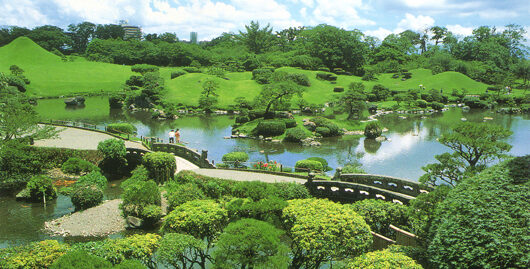
Suizen-ji Joju-en
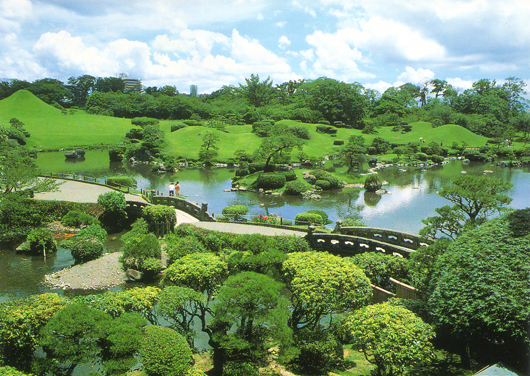
This is a Tsukiyama Sansui (mountain-and-water landscape) garden. A pond simulating a lake has a small island. In the back of a line of stepping stones, there is a gentle slope of a Tsukiyama (artificial hill). Clean spring water bubbles and flows freely into the pond. The garden’s name, “Joju-en” originates from “Gui Qu Lai Ci” (Come Away Home), a Chinese poem by Tao Yuanmng (365 – 427 CE).
cultural property : historic sites and places of scenic beauty as natural monuments
type : places of scenic beauty, historic sites
8-1 Suizenji Kōen, Chūō-ku, Kumamoto-shi, Kumamoto-ken 862-0956
Tel:096-383-0074
Home page : www.suizenji.or.jp
In 1632, Hosokawa Tadatoshi, the first lord of the Hosokawa Family (Higo Domain), enjoyed the area while he was practicing falconry and built a teahouse there. Later, the garden was completed during the era of Hosokawa Tsunatoshi, the third lord of the Hosokawa Family. It is a stroll garden and was named Joju-en based on “Gui Qu Lai Ci” (Come Away Home), a Chinese poem by Tao Yuanmng (365 – 427 CE). The garden features a pond simulating a lake that includes an island. In the back of the line of stepping stone, a gentle slope of a Tsukiyama (artificial hill) is created. Clean spring water bubbles and flows freely into the pond.
In the Genroku Era (1688 – 1707), many arbors were built and enjoyed. Due to the Horeki Reform (for the Domain’s fiscal reconstruction), however, all buildings except Suigetsu-tei were removed and of many kinds of trees, only pine trees remain now. When the Meiji Era began (in 1869), lands and people were returned to the emperor (“Hanseki Hokan”). The garden temporarily became government land. On the north side of the garden is the Izumi-jinja Shrine that honors the lords of the Hosokawa Family, including Hosokawa Tadaiju and Fujitaka.