shiga」タグアーカイブ

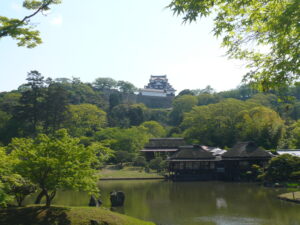
Taga-jinja Oku-shoin Garden

This is a garden at Kojo-in, which is one of the sub-temples of Mii-dera. Azaleas (Rhododendron spp., Rhododendron indicum) are planted densely in various locations, and Japanese cedars (Cryptomeria japonica), Japanese cypress (Chamaecyparis obtusa), and pines form dense forests on the hillside. It is considered to be an outstanding example of of gardens in the Omi region due to its small but dense composition that gives depth to the garden.


cultural property : historic sites and places of scenic beauty as natural monuments 
type : places of scenic beauty

604 Taga, Inukami District, Shiga-ken 522-0341
Tel:0749-48-1101

Home page : www.tagataisya.or.jp/about/


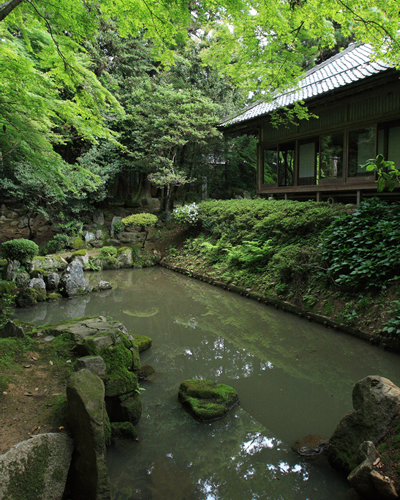
This is a garden at Kojo-in, which is one of the sub-temples of Mii-dera. The timeframe in which the temple was constructed is unclear, but it is thought that the temple was built around 1601 when the Kyakuden (reception hall) was completed. This view garden with a large pond is integrated with the Kyakuden. Since the Kyakuden’s pillars supporting the southern veranda stand on rocks protecting the pond shore, the pond can be seen directly under the veranda. With water approaching visitors’ feet, the Kyakuden creates a sense of elegance similar to the charm of floating architecture. The pond stretches from east to west. A natural stone bridge is installed at a turtle island, and an old waterfall on the opposite shore is made of two Tateishi (standing stones) while three large Yodomari-ishi (stones representing boats) also grace the pond. Natural stones are arranged around the pond. The southwestern section of the pond ends at a steep slope. Japanese cedars (Cryptomeria japonica), Japanese cypresses (Chamaecyparis obtusa), and pines grow densely on the hillside.Thick groupings of azaleas and dwarf azaleas are planted on the slope. It is considered to be a representative garden of the Omi region due to its small but dense composition that gives it depth.
Seigan-ji Garden

This garden is located at Seigan-ji, a temple of the Soto sect. It is believed that the third Kokin, a Buddhist monk, ordered the gardener, Katori, to make the garden in the early Edo Period. Katori is known for creating the Genkyu-en and Raku-raku-en of the Hikone Castle. The garden is set against a lush hill and is situated on its hillside at the back of the main temple.


cultural property : historic sites and places of scenic beauty as natural monuments 
type : places of scenic beauty

669 Maihara, Maibara-shi, Shiga-ken 521-0012
Tel:0749-52-0463

Home page : www.seiganji.org/


This is a garden located at Seigan-ji, a temple of the Soto sect. The temple was founded as Beisen-ji by Sasaki Kyogoku Doyo of the Omi Genji Clan in the early period of the Northern and Southern Dynasties (the Enbun Era). He transcribed the eight volumes of the Lotus Sutra as an offering to the temple. Most of the temple building burned down in war fire during the Eisho Era, but after more than 150 years, in 1650, the temple was reconstructed and renamed Seigan-ji.
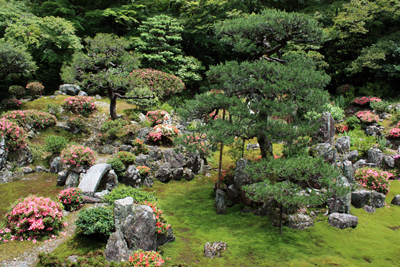
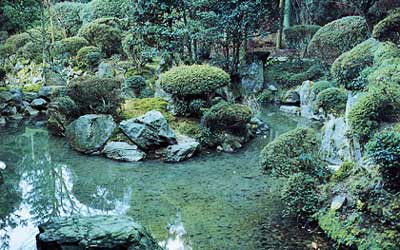
The garden is located in the back of the main temple and built on the hillside with a lush grove in the background. It is a stroll Karesansui (dry landscape) garden that utilizes the landform of Mt. Tao’s foothill, and includes a dry pond with a stone bridge and a Horai island as well as a dry waterfall on the far right. The stone lantern in front of Kuri (living quarters of monks) is a Yose-doro (a type of lantern that combines parts of different lanterns), a style popular among masters of the tea ceremony, adding elegant scenery to the garden. It is believed that the third Kokin, a Buddhist monk, ordered the gardener Katori to make the garden in the early Edo Period. Katori is known for creating Genkyu-en and Raku-raku-en of the Hikone Castle.
The Seigan-ji garden gives the illusion of flowing water using haircap moss (Polytrichum) instead of stones or sand. After it rains, water that has seeped into the moss springs out as underflow water, transforming the dry pond into a real one. The scenery after a rain is exceptional.

Kojo-in Garden

This is a garden at Kojo-in, which is one of the sub-temples of Mii-dera. Azaleas (Rhododendron spp., Rhododendron indicum) are planted densely in various locations, and Japanese cedars (Cryptomeria japonica), Japanese cypress (Chamaecyparis obtusa), and pines form dense forests on the hillside. It is considered to be an outstanding example of of gardens in the Omi region due to its small but dense composition that gives depth to the garden.


cultural property : historic sites and places of scenic beauty as natural monuments 
type : places of scenic beauty, historic sites

246 Onjōjichō, Ōtsu-shi, Shiga-ken 520-0036
Tel:077-522-2238

Home page : www.shiga-miidera.or.jp/index.htm


This is a garden at Kojo-in, which is one of the sub-temples of Mii-dera. The timeframe in which the temple was constructed is unclear, but it is thought that the temple was built around 1601 when the Kyakuden (reception hall) was completed.
This view garden with a large pond is integrated with the Kyakuden. Since the Kyakuden’s pillars supporting the southern veranda stand on rocks protecting the pond shore, the pond can be seen directly under the veranda. With water approaching visitors’ feet, the Kyakuden creates a sense of elegance similar to the charm of floating architecture.
The pond stretches from east to west. A natural stone bridge is installed at a turtle island, and an old waterfall on the opposite shore is made of two Tateishi (standing stones) while three large Yodomari-ishi (stones representing boats) also grace the pond. Natural stones are arranged around the pond.
The southwestern section of the pond ends at a steep slope. Japanese cedars (Cryptomeria japonica), Japanese cypresses (Chamaecyparis obtusa), and pines grow densely on the hillside.Thick groupings of azaleas and dwarf azaleas are planted on the slope.
It is considered to be a representative garden of the Omi region due to its small but dense composition that gives it depth.
Zenpo-in Garden

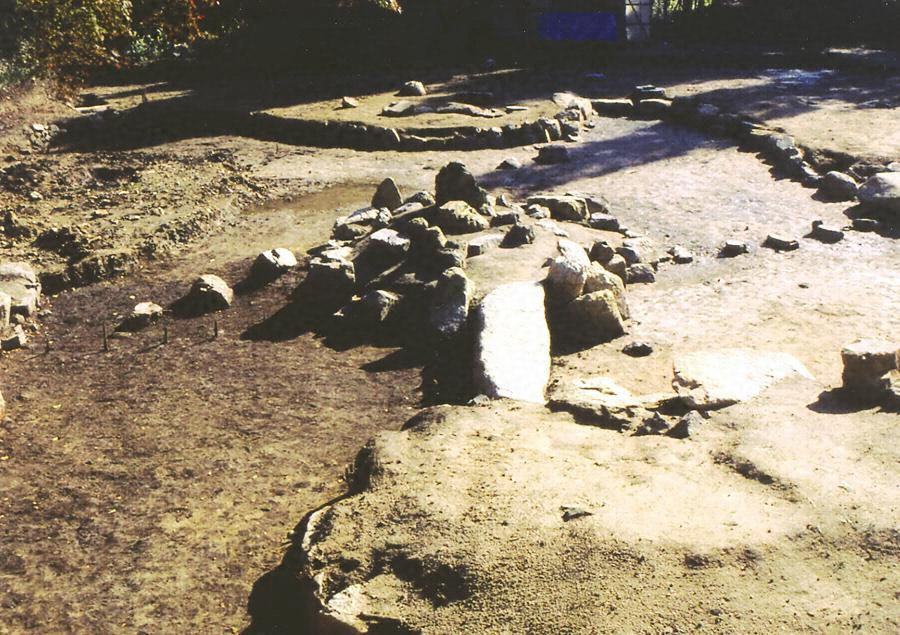
The timeframe of its construction is unclear, but it is thought to have been around the beginning of the Edo Period. The garden had been buried under earth and sand dumped by the debris flow of torrential rains in 1941. However, the excavation survey during the reconstruction and improvement project in recent years has revealed the entire garden. Although no associated buildings survived, the garden features have been well preserved.


cultural property : historic sites and places of scenic beauty as natural monuments 
type : places of scenic beauty, historic sites

246 Onjōjichō, Ōtsu-shi, Shiga-ken 520-0036
Tel:077-522-2238

Home page : www.shiga-miidera.or.jp/index.htm


Zenpo-in is one of the six sub-temples of Mii-dera. The timeframe of its construction is unclear, but it is thought to have been built at the beginning of the Edo Period. Although the garden was designated as a National Place of Scenic Beauty/Historic Site in 1934, the site was buried under earth and sand dumped by the debris flow of torrential rains in 1941.
However, thanks to a surveyed map by garden research authority, Shigemori Mirei, and an excavation led by forest expert and landscape researcher, Okazaki Aya’aki, the full details of the garden were recovered. Although associated buildings no longer exist, the pond shore and stone arrangements of the garden have been preserved.
Based on a description in the database of the Otsu City Museum of History, the details of the garden’s original design have been recovered, such as two ponds in front of the study, a Nakajima (central island), a stone bridge, and arrangements of large stones. However, neither the study nor the garden has been reconstructed.

Hyozu-jinja Garden

This is a garden facing north, situated at the south side of the inner shrine of Hyozu-jinja. When the garden was designated as a National Place of Scenic Beauty in 1953, it was believed to have been built in the mid- to late Kamakura Period. However, the later reconstruction and improvement project revealed ruins characteristic of the Heian Period, confirming that the garden was made in the late and final years of the Heian Period.


cultural property : historic sites and places of scenic beauty as natural monuments 
type : places of scenic beauty

566 Gojo, Yasu-shi, Shiga-ken 520-2424
Tel:077-589-2072


This is a stroll garden with a large pond built facing north at the south of the inner shrine of Hyozu-jinja. There is a Nakajima (central island) with a stone bridge in the pond made in the shape of the Chinese character for “heart (Kokoro).” The garden has diverse scenery including the Nakajima with a Hokora (small shrine), a peninsula, and a Tsukiyama (artificial hill).
During a recent repair and improvement project, the pond was drained to carry out excavation. As a result, the ruin of a Suhama (sandy beach) was found, which is characterstic of gardens built in the Heian Period.
The garden was originally thought to have been created in the mid- to final Kamakura Period, but the discovery of the ruin confirmed that it was made in the late- to final Heian Period. The garden is covered in fresh green haircap moss (Polytrichum) and Hypnum plumaeforme Wilson. Visitors can enjoy beautiful seasonal scenery such as azaleas in spring, tender green in early summer, sweet flags (Acorus calamus) during the rainy season, Japanese maples in fall, and a snowscape in winter.

Genkyu rakuraku-en

The garden consists of Genkyu-en and Raku-raku-en, and is located northeast of Hikone Castle, between the inner moat and what was once an inner lake. It is thought that the garden was made in the Enpo Era (Edo Period). It is an outstanding Daimyo garden that seamlessly links to its borrowed scenery, which includes the Hikone Castle’s Tenshu (castle tower) and a beautiful background of mature trees.


cultural property : historic sites and places of scenic beauty as natural monuments
type : places of scenic beauty,(special historical sites)

3 Konkichō, Hikone-shi, Shiga-ken 522-0061
Tel:0749-22-2742


The garden has two components, Genkyu-en, which is a stroll garden, and the Tsuki Palace’s Raku-raku-en. It is located northeast of Hikone Castle and between the inner moat and what was once an inner lake. It is thought that the garden was made in the Enpo Era of the early Edo Period.
Genkyu-en has a large pond with four Nakajima (central islands) including Moto-jima and Nii-jima. A Tsukiyama (artificial hill) stretches from the east side to the north side of the garden, and a walking path goes through the garden. The main scenery of the garden includes Moto-jima, which is an arrangement of large stones, and Hakkei-tei built on the opposite side, facing the pond. From the north side of the garden, visitors can see a beautiful landscape with the Hikone Castle’s Tenshu (castle tower) and forests in the background.
Tsuki Palace was added during the Bunka Era, and the garden became part of an Okumuki-shoin (study for family members) after the Genkyu-en was partially rennovated. Raku-raku-en has stone arrangements that represent a waterfall and its flow, and is currently a Karesansui (dry landscape) garden. However, there was a water supply facility in the past, which provided water to the garden.