
 Seibi-en
「Tohoku」カテゴリーアーカイブ
Seibi-en
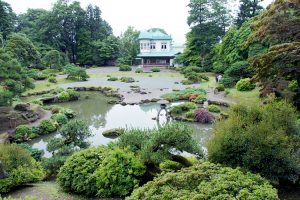
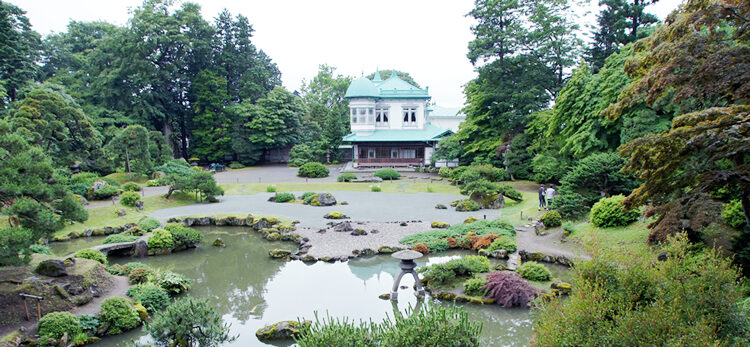
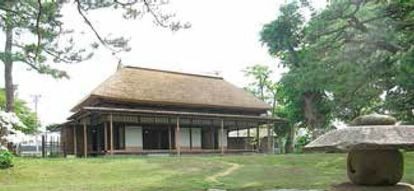
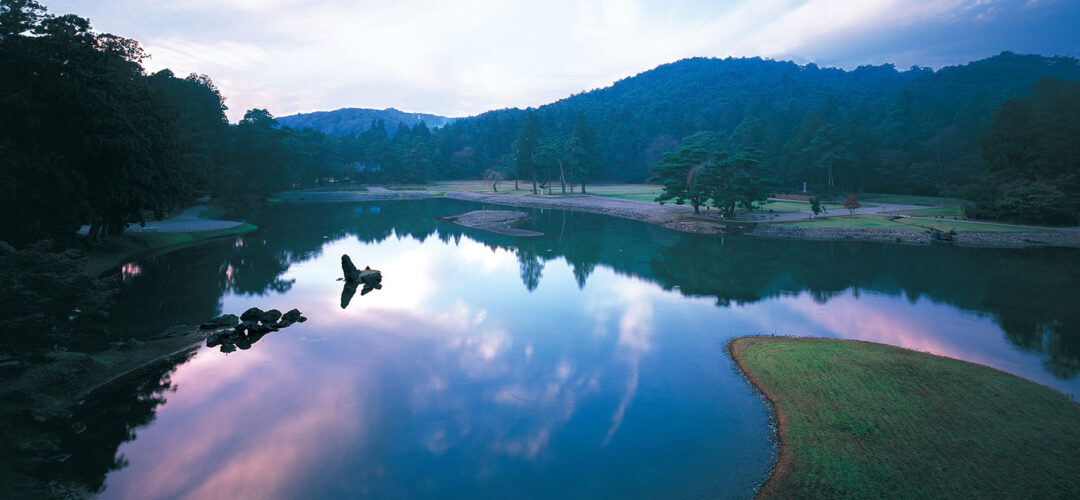
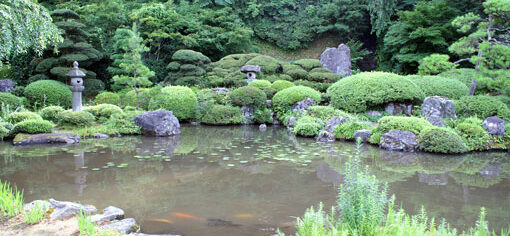
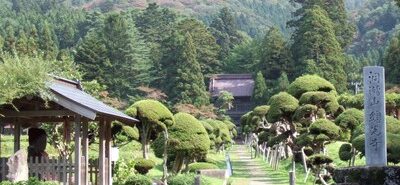
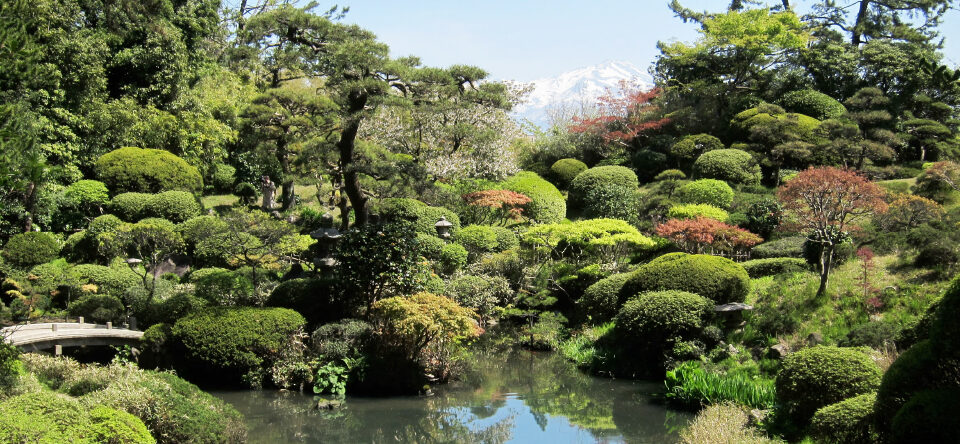
This garden was created by Seito Moriyoshi, the 24th head of the Seito Family, who served as Dai Shoya (a village official) in the Meiji Era. The garden is one of the three outstanding gardens of the Meiji Era (1868 – 1912). The garden has a pond at its center, featuring Tsukiyama representing “shin” (formal) and another Tsukiyama representing “gyo” (semiformal). “So” (informal), is a flat garden. A Western-style building commands a great view of the countryside of the Tsugaru plain with distant mountains as borrowed scenery.
cultural property:historic sites and places of scenic beauty as natural monuments
type:places of scenic beauty
1, Sarukaisibayashi, Hirakawa-shi, Aomori-ken 036-0242
Tel:0172-57-2020
Home page:www.seibien.jp
Seito Moriyoshi, the 24th head of the Seito Family, a wealthy farmer in the Tsugaru region, invited Master Obata Teiju to create the garden. It was completed in 1902, after nine years of work. It features a pond at its center, consisting of three levels classified by formality: “shin” (formal), “gyo” (semiformal), and “so” (informal).
There is a dry pond in front of the Seibi-kan building, and a pond at a lower level. The pond features Shinsen-to and Ni-to islands, where pines representing Horai (Mount Penglai) pines are planted. Two Tsukiyamas (artificial hills) are created on both sides of the pond, representing “shin” and “gyo” respectively. “So” is a flat garden located at the south side of the Tsukiyama of “gyo” and the northeast side of the Seibi-kan building, featuring a splendid pruned Japanese yew (Taxus cuspidata).
The Seibi-kan building commands distant seasonal views of the countryside of the Tsugaru Plain and mountains as borrowed scenery. Seibi-en is an outstanding example of the Oishi Bugaku gardening school. The Oishi Bugaku gardening school is one of the garden schools primarily developed in the Tsugaru Domain in the late Edo period (1850s – 1868). It is said that the school originated when court nobles who left Kyoto (the ancient capital city of Japan) combined Kyoto-style Buddhist culture and ancient Shinto culture in the region. The name of the school comes from Oishi Bugaku, who is believed to be the founder of the school.
Zuiraku-en
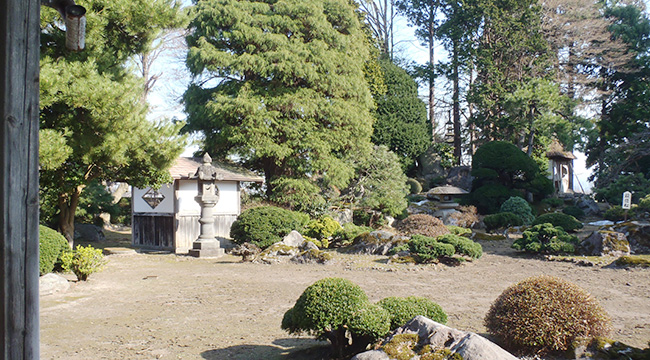
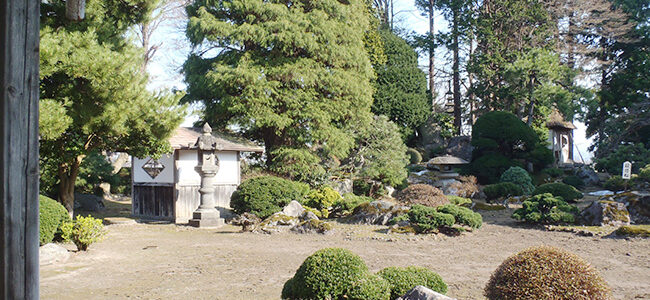
This garden is a good reflection of the gardening techniques of the Oishi Bugaku gardening school that have been handed down in the Tsugaru region, such as creating Tsukiyama (artificial hills), arranging large rocks, a dry waterfall, a dry pond, and a stone bridge across the pond. Sketches drawn when creating the garden, and an inscription describing the modification work are archived at the garden. Visitors can learn about the history of the garden creation and its transitions afterwards.
cultural property : historic sites and places of scenic beauty as natural monuments
type : places of scenic beauty
26-2, Ooaza Miyadate Aza Miyadate Sawa, Hirosaki-shi, Aomori-ken 036-8384
Tel:0172-82-1642
Home page : http://zuirakuen.com/
This is the garden of a wealthy farming family in the Miyadate area, the Tsushima Family. The Tsushima family ran Dai Shoya (a village official) for generations during the era of Tsugaru Domain. It is a Karesansui (dry landscape) garden occupying a wide space in front of the south side of the building.
The garden includes an arrangement of two paths of large stepping stones, a worship stone, and a water basin. Further inside, the garden features a dry waterfall, a dry pond, and a stone bridge across the pond. A low miniature hill sits at the far back on the right (west) side and a taller hill at the left (east) side, along with spontaneously arranged large rocks. A small arbor and stone lantern are placed in between.
Takahashi Teizan started building the garden in 1890 and worked on it for the following 15 years. Later his two apprentices, Ikeda Teigetsu and Tonosaki Teiyo, resumed addition and modification work at the beginning of the Showa Period. It was finally completed in 1936. There is a description of the origin of the garden on the back of a Tateishi (standing rock) in front of an Inari (goddess of rice) shrine at the right back of the garden. Design drawings created during the addition and modification work are archived. This is one of the outstanding gardens displaying the gardening techniques of the Oishi Bugaku gardening school that have been handed down in the Tsugaru region.
Kanehiranari-en
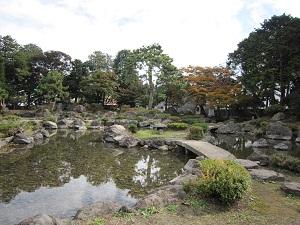
Kanehiranari-en is recognized as an important garden that perfectly conveys the unique style of the Oishi Bugaku gardening school that dominated the Tsugaru region from the end of the Edo Period (approx. 1750 – 1850) through modern times. The overall premises, including the main building and garden, are all preserved in good condition. The garden was designated as a Historic Site, Place of Scenic Beauty, and Natural Monument on January 26, 2006.
cultural property : historic sites and places of scenic beauty as natural monuments
type : places of scenic beauty
2−1, Uchimachi, Kuroishi-shi, Aomori-ken 036-0306
Tel:0172-52-2111
City of Kuroishi Board of education Cultural properties section
The third Takahashi Teizan was invited by Kato Uhei, a politician and business man, to create this garden in 1882. He died before completing the garden. His apprentices, Obata Teijyu and Ikeda Teigetsu, succeeded him in the work and completed the garden in 1902. The garden is also known as “Sawanari-en” because of the first trade name of “Sawaya Narinosuke” in the sake-brewing industry, which was Uhei’s family business.
“Kanehiranari-en” was started by Kato Uhei as one of his measures against unemployment. In the spirit of his belief that “money should be distributed to all people, leading to a peaceful society,” the garden was named “Kanehiranari-en (money peace-making garden).” The garden has a large pond located at the far back on the east side of the main building. The shape of the premises gives depth to this garden, with its three ponds whose shorelines are created with intricate stone arrangements, Tsukiyama behind the shorelines, and a dry waterfall created by dynamic stone arrangements. The style of the “Oishi Bugaku gardening school” can be seen in the unique usage of stones and detailed design. It is one of the great gardens that convey the unique style of the “Oishi Bugaku gardening school,” which dominated the Tsugaru region from the end of the Edo period (approx. 1750 – 1850) and modern times.
Kyu Ikeda Family Gardens
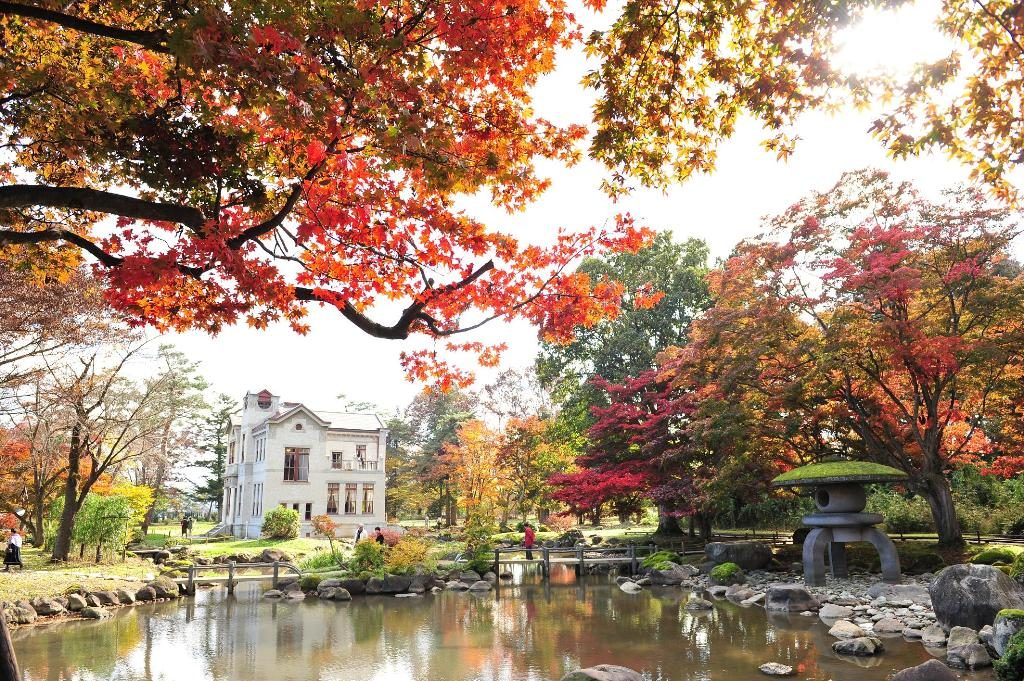
This garden is located in the countryside of Yokote Basin. Its premises are shaped like a floating island. This garden is regarded to have exceptionally high visual and academic value as a garden designed by Nagaoka Yasuhei, a pioneer of modern landscaping and was designated as the first National Place of Scenic Beauty in Akita Prefecture in February 2004.
cultural property : historic sites and places of scenic beauty as natural monuments
type : places of scenic beauty
1, Takanashi Aza Ooshima, Daisen-shi, Akita-ken 014-0805
Tel:0187-62-6257
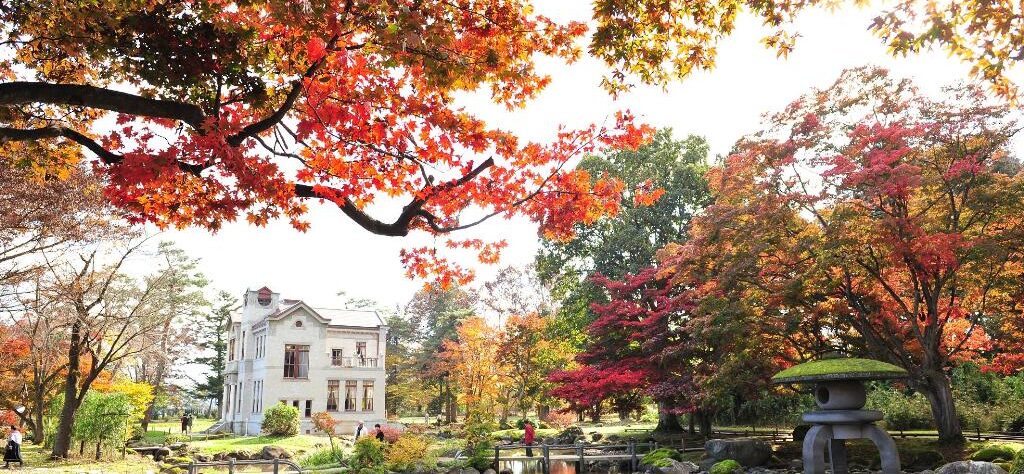
The Ikeda Family was the village head of Takanashi, Daisen City, Akita Prefecture, from the mid-Meiji Era until World War II. The family has been known as one of the Three Major Landowners of the Tohoku Region, along with the Honma Family of Yamagata Prefecture and Saito Family of Miyagi Prefecture. When the residence built by the 13th head of the Ikeda Family, Buntaro, collapsed during the earthquake in 1896, the family consolidated and organized their land in cooperation with the government’s farmland consolidation and expanded their residence site. The garden was created with the help of Nagaoka Yasuhei, the founder of modern landscaping, which was completed for the most part during the Taisho Era.
The garden is located in the central section of the Senhoku Plain, surrounded by vast countryside with the Ou Mountains to the east, Mt. Jingu-ji-dake to the west, and Mt. Chokai to the southwest, all of which are visible in the distance from the garden. The main part of the garden has an island at the center and a shallow garden pond with a large Yukimi-doro (legged stone lantern) on its western shore, and water flows around these features to create unique layout of the garden site.
The enormous lantern, 4m high and approximately 4m wide at its top, makes it an impressive main scenic component.
Kyu Villa of Mr.Satake,Akita Domain (Joshi-tei) Garden
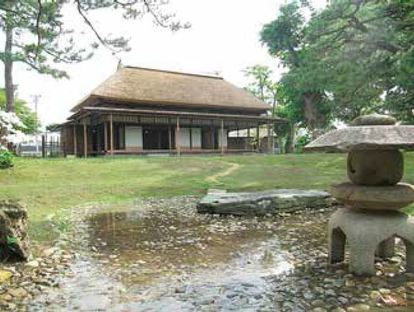
Joshi-tei was originally part of the villa of Satake Yoshizumi, the third lord of the Akita Domain in the Genroku period (1688 – 1704). It is positioned next to the Karamete-mon gate (back gateway) of the Satake Family’s Kubota-jyo Castle. The garden is located in a scenic site, commanding a distant view of the Taihei cordillera. It was designated as a National Place of Scenic Beauty in 2007. It has been restored and improved based on ruins and historical sources since 2014, and was opened to the public in October 2017.
cultural property : historic sites and places of scenic beauty as natural monuments
type : places of scenic beauty
2-73, Asahikawaminamimachi, Akita-shi, Akita-ken 010-0834
Tel:018-834-6300
Home page : https://www.city.akita.lg.jp/kanko/kanrenshisetsu/1002685/1013885/1002284.html
This garden was created in a scenic area of the countryside of the Tohoku region during the mid-Edo period. A Tsukiyama (artificial hill) in the garden blends in with the surrounding mountains, creating its own natural features.
The garden was created with the north as its front, commanding a distant view of Shin Shiroyama mountain and the Taihei cordillera. Kankodai, the tallest artificial hill in the garden is located in the northeast of the garden, from which three artificial hills to the south and one to the west continue. A “Gyokukanchi,” a garden pond with shallow streams, is located at the center of the garden premises, featuring Nakajima (the central island) made of a three-meter boulder, “Kyogoto,” at the center of the pond. Water flowing out of the valley of an eastern artificial hill forms a Tsutai-ochi (water flowing on slopes) waterfall, “Jingensen,” reaches the pond, and again flows out of the pond from its western side, forming a stream. The stream flows along the south side of an ornamental stone, “Kakkoseki,” goes under a stone bridge, “Seikikyo,” forms a mountain stream, and reaches the tea garden of a tearoom, “Seion-tei,” located on a lower level. The stream from the east to the west flows continuously, and the structure of the “15 views in the garden” along with the name of Joshi-tei are unique and are considered to hold high artistic value.
Motsu-ji Garden
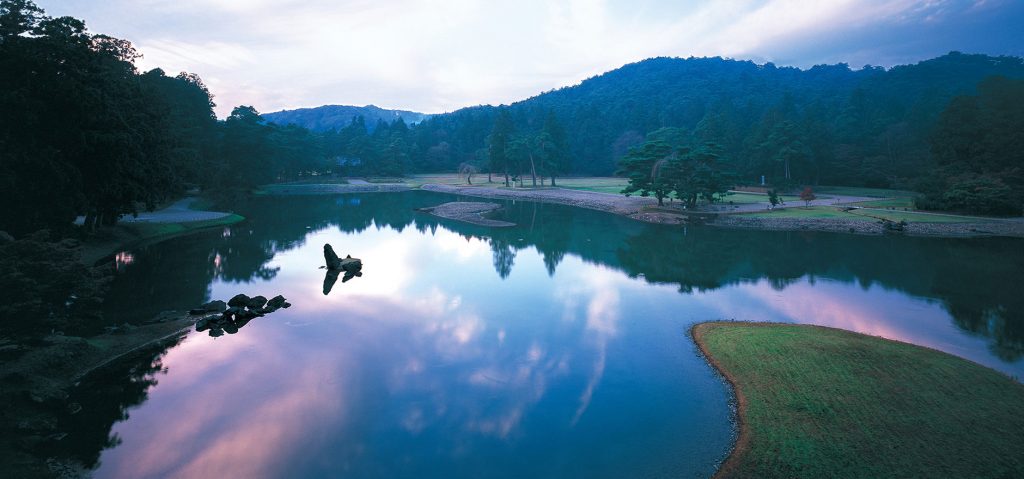
A Jodo (Pure Land)-style garden. Natural sceneries are expressed including stone arrangements such as Tsukiyama in a dry landscape garden style and Yarimizu (curved brook) to draw water to the pond. The park still retains the shape of its elegant landscape from the Heian Period with the Oizumigaike pond in the middle. This precious garden will bring ideas and techniques from Sakuteiki, Japan’s oldest landscaping book, to the modern world.
cultural property : historic sites and places of scenic beauty as natural monuments
type : places of special scenic beauty
58,Hiraizumi Aza Oosawa, Hiraizumi-chō, Nishiiwai-gun, Iwate-ken 029-4102
Tel : 0191-46-2331
Home page : www.motsuji.or.jp
Motsu-ji was founded by Jikaku Daishi En’nin and it reached the height of its prosperity during the second and third lords of the Northern Fujiwara Family, Motohira and Hidehira. During that time, numbers of pagodas and living quarters for monks were constructed. After the fall of the Fujiwara Family, the temple met with natural calamities and all the buildings were burnt down. However, the old foundations of the garden and main temple were found after an excavation and the former landscape was restored.
If you look toward the north from the main temple, a vast “Oizumigaike pond” filled with pure water can be seen in front of a small mountain called Tou-yama. Along with the edge of the “Oizumigaike pond”, natural sceneries such as a Mizuwake (water-divider) simulating a sandbank and rough seashore, a Tateishi (standing rock) which serves as a Namigaeshi (turning waves), a rockwork of Tsukiyama (artificial hill), a Yarimizu (curved brook) to draw water can be seen.
Jodo (Pure Land)-style gardens influenced by the Jodo tradition of Buddhism were created from the Heian Period to the Kamakura Period. The Motsu-ji Garden created during the Heian Period brings ideas and techniques from “Sakuteiki” (Japan’s oldest landscaping book) to the modern world. Combined with the scenery of the surrounding forest, it reminds visitors of the beauty from the past.
Sakai Family Garden
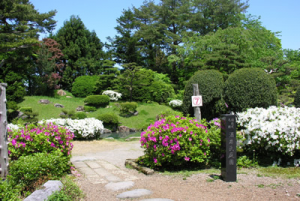
This is a Tsukiyama (artificial hill) and pond garden in the north of the old Goinden building for Sakai, the lord of Shonai and it is located inside the Chido Museum. It preserves a style and technique of gardens with a study which were popular during the mid-Edo Period. It was designated as a National Place of Scenic Beauty in 1976 because of its importance as an exemplary garden with a study which is very rare in the Tohoku region.
cultural property : historic sites and places of scenic beauty as natural monuments
type : places of scenic beauty
10-18 Kachūshinmachi, Tsuruoka-shi, Yamagata-ken 997-0036
Chido Museum
Tel:0235-22-1199
Home page : http://www.chido.jp/
It is currently located inside the Chido Museum premises. This is a Tsukiyama (artificial hill) and pond garden in the north of the old Goinden building for Sakai, the lord of Shonai. There is a Tsukiyama on the opposite shore of the pond. A stone standing in the middle of the Tsukiyama is the center of the garden and other landscaping elements are positioned around it.
A dry waterfall is assembled on the left side of the garden in order to create scenery simulating a valley. The area under the waterfall is landscaped to look like a rough seashore. A pine tree with overhanging branches is planted on the peninsula on the right side of the garden. In front of the pine tree, slightly to the left, there is a Tateishi (standing rock) made of silicified wood, which is shaped like a turtle head, in the water. A deep cove is created in the back in order to create a serene scene with trees for shade.
When it was originally built, Mt. Chokai in the far distance was used as borrowed scenery behind the Tsukiyama.
It preserves a style and technique of gardens with a study which were popular during the mid-Edo Period, and this garden is considered to be an exemplary garden with a study which is very rare in the Tohoku region.
Gyokusen-ji Garden
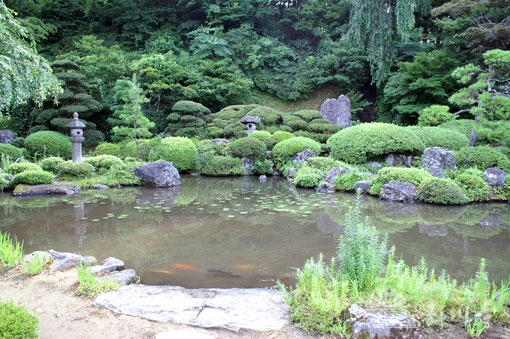
The Gyokusen-ji Garden was created in the 1450s and improved in the 1650s. This is a Horai-style garden with a path around a large pond in the middle. There is a waterfall which flows from a natural mountain. Pure stands of Japanese primrose (Primula japonica) grow in the garden, which are very rare, even in Japan. It was designated as a Cultural Property and Scenic Site of Japan in 1987.
cultural property : historic sites and places of scenic beauty as natural monuments
type : places of scenic beauty
35, Haguromachi Tamagawa, Tsuruoka-shi, Yamagata-ken 997-0121
Tel:0235-62-2746
Gyokusen-ji is located at the northwest base of the Three Mountains of Dewa and it is told that it was founded in 1251 during the Kamakura Period by Ryonen Homyo, a Zen monk who was the leading pupil of Dogen Zenji (a Zen master) who was a founder of the Soto sect. The garden was created in 1450 during the Muromachi Period and improved in 1650 during the Edo Period. This is a Horai-style garden with a path around a large pond in the middle. The waterfall is designed to flow into the garden from a natural mountain. There are many stone arrangements around the pond and shrubs that are trimmed in a round shape are planted without any gaps between the stones. The soil around the stepping stones is mossy which adds elegance to the garden’s scenery. This garden is also called the “temple of Japanese primrose” because of its pure stands, which are very rare, even in Japan.
Soko-ji Garden
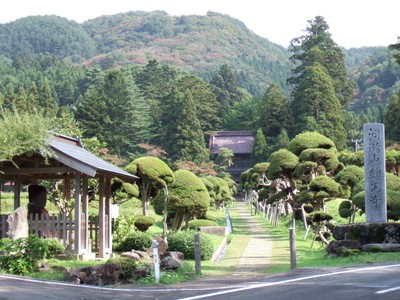
A Tsukiyama garden with grove and pond. The Tsukiyama and the pond can be viewed from the main temple and the Kuri study. In the distance you can see “Mine no Yakushi-do” at the top, and “Naka no Yakushi-do” at the middle of the mountain to the east. Pure water from the Furou no Taki waterfall pours into the pond passing through the Namiwake-ishi (wave-dividing stone). It is called the “Hourai-en” garden and was designated as a Scenic Site of Japan in 1996.
cultural property : historic sites and places of scenic beauty as natural
type : places of scenic beauty
8,Sokojisawa, Sakata-shi, Yamagata-ken 999-6831
Tel:0234-62-2170
Home page : www.sokoji-sakata.com
Soko-ji is a Zen temple of the Soto Zen sect and it is told that it was founded by the venerable Zen monk, Getsuan Ryoin, during the period of the Northern and Southern Dynasties by enshrining a statue of Yakushi (the healing Buddha) on the summit of the mountain. The front of the precinct is facing west and the garden is landscaped in the Tsukiyama (artificial hill) garden style with the grove and pond behind the main temple and the Kuri building (living quarters for monks). The view of the garden from the study is comprised of a Taki-ishigumi (a waterfall with assembled rocks) on the top left side. The water coming down from that waterfall flows next to the Tsukiyama in the middle and pours into the pond. There is a flat Nakajima (central island) in the pond and the water from the pond falls by the Kuri from the southwest corner. If you go out to the garden from the study, you can walk to the central island from the retaining stone of the pond via water-crossing stones made with five millstones. There are large stones on both the south and north sides of the central island. It is narrow between the central island and the eastern shore of the pond and there is a bridge made of a single stone. After crossing to the opposite shore, you will find sparsely-positioned stepping stones in a diagonally upward direction and that is also a path leading to the grassland in the heart of the Tsukiyama on the left.
This is a typical Japanese garden perfected in the second half of the Edo Period which is an elegant Zen temple garden.
Villa of Mr. Honma (Kakubu-en) Garden
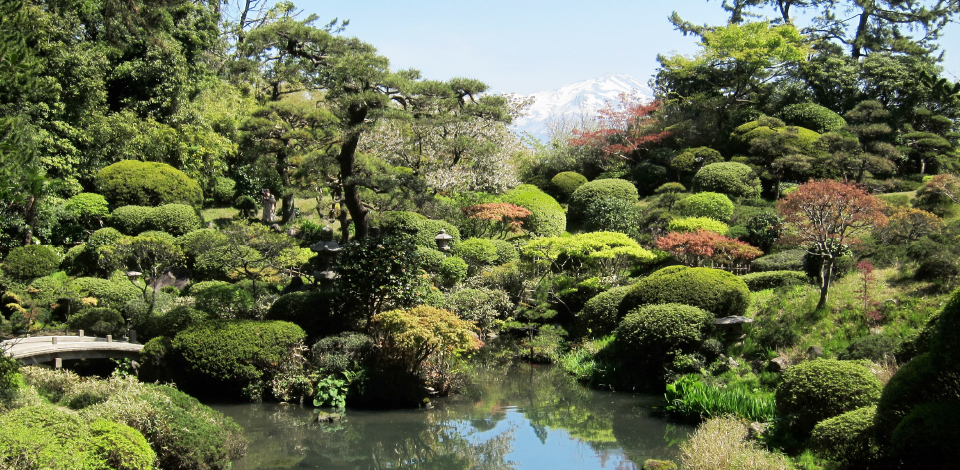
The garden was created by the fourth head of the Honma Family, Kodo, and it is in a style of Japanese garden with a path around the central pond. A complete view of the pond garden with a rich variety of landscape and Mt. Chokai as borrowed scenery can be enjoyed. The lord Sakai named the building overlooking graceful Mt. Chokai as “Seien-kaku” as well as “Kakubu-en” because a crane flew toward a pine tree on the central island of the pond.
cultural property : historic sites and places of scenic beauty as natural monuments
type : places of scenic beauty
7-7 Onarichō, Sakata-shi, Yamagata-ken 998-0024
Public interest foundation, Homma Museum of Art
Tel:0234-24-4311
Home page : www.homma-museum.or.jp
The Honma Family is known as one of the three major landowners in the Tohoku region. They became wealthy merchants mainly due to the shipping business in the Japan Sea from the second half of early modern times to recent modern times. Originally, the garden started out as a villa which was built in 1813 (the Edo Period) by the fourth head of the Honma Family, Honma Kodo. It was created as a rest area for the lord of Shonai, Sakai Tadakata, prior to the lord’s inspection trip to his territory. It was constructed by using the labor of stevedores during the winter time. The stevedores in the early modern period supported the seaport city, Sakata. The garden is in a style of Japanese garden with a path around the main building and a pond and colorful ornamental stones of red and blue are used. A complete view of the pond garden with a rich variety of landscape and Mt. Chokai as borrowed scenery can be enjoyed from the second floor of Seien-kaku. The lord Sakai Tadakata, who visited the garden during his inspection trip, named the building overlooking Mt. Chokai as “Seien-kaku”.
Also, it is said that the garden is named “Kakubu-en (a garden with a dancing crane)” because a crane landed on a pine tree on Nakajima (the central island) of the pond.
Nanko Park
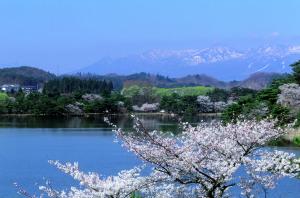
The Japanese park system was established in 1873, at the beginning of the Meiji Era. This park was created prior to that, at the end of the Edo Period, by Matsudaira Sadanobu, the 12th lord of the Shirakawa domain, with an idea of “samurai and commoners sharing a joy” and the public being able to take a rest regardless of their social status. It was constructed in 1801 with elements of gardens and designated as a National Historic Site/Place of Scenic Beauty in 1924.
cultural property : historic sites and places of scenic beauty as natural monuments
type : places of scenic beauty, historic sites
1 hoka, Nanko, Shirakawa-shi, Fukushima-ken 961-0812
Shirakawa-city Construction department Cultural Property Division
Tel:0248-27-2310
Home page : http://www.city.shirakawa.fukushima.jp/page/page001385.html
This park was constructed by Matsudaira Sadanobu, who is known for the Kansei Reforms during the Edo Period. Sadanobu intended to create a place without a wall where anybody can take a rest regardless of their social status and visit anytime. It is said to be the oldest place called “park” in Japan.
There are gently sloping hills in the north of the park and a pond (Nanko) in the south, and both create an expansive view around the park. There are various kinds of trees among lush pine trees on the hills. Visitors can enjoy a wide variety of seasonal flowering plants in the forest.
The island in the middle of the pond is also covered with trees and flowers. There are fish and birds in the pond that are a pleasure to the eyes of visitors.
Among scenic spots that are created for nature outings, there are only a few of them that are landscaped with a pond as a center piece. The park was named after a lakeside park described in the old Chinese book, “Famous Gardens of Luoyang,” as it tried to replicate the essence of the Chinese park.
Garden for the lord of Aizu, Matsudaira (Oyaku-en)
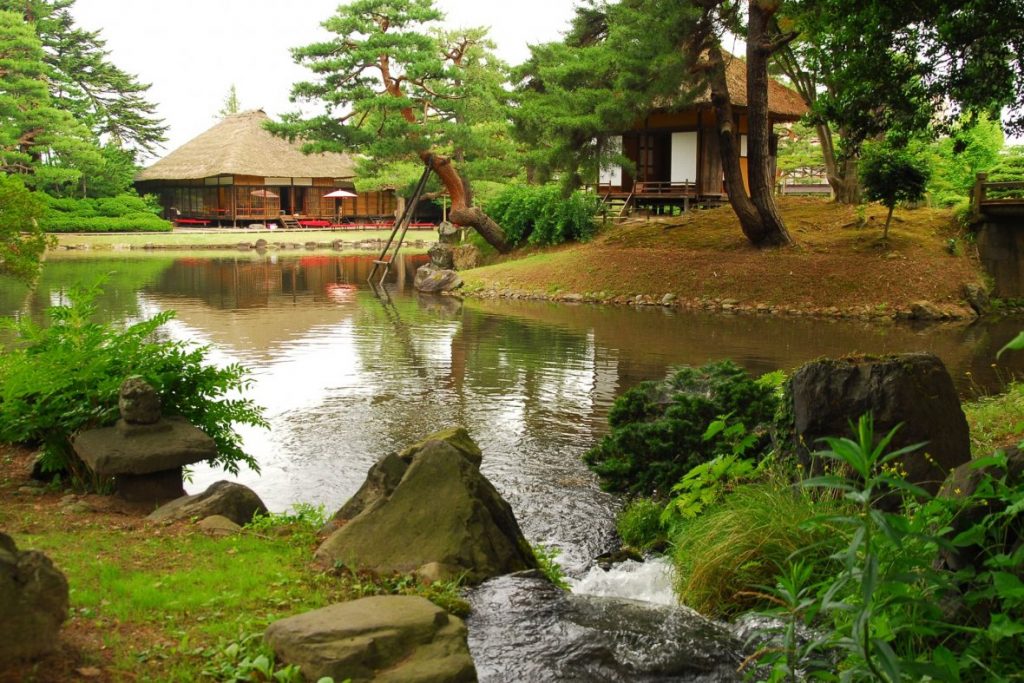
It is said that the garden started out as a villa built by a lord of Aizu about 600 years ago. This is in a style of Japanese garden with a path around a pond, which is in the middle, shaped like the character for “heart (Kokoro).” It was named “Oyaku-en (a herb garden)” because various medicinal herbs were cultivated here. It was designated as a National Place of Scenic Beauty in 1932.
cultural property : historic sites and places of scenic beauty as natural monuments
type : places of scenic beauty
8-1 Hanaharumachi, Aizuwakamatsu-shi, Fukushima-ken 965-0804
Tel:0242-27-2472
Home page : http://www.tsurugajo.com/oyakuen/
The garden has borrowed scenery with the mountains on the east side of the garden and it is considered to be an exemplary Daimyo garden during the Edo Period with a path around a pond. Originally, it was a villa built by Ashina Morihisa during the Muromachi Period. It is said that he built the villa because there was a spring with miraculous powers. It later became a villa for the lord of Aizu, Matsudaira, and started to be called “Oyaku-en” because various medicinal herbs were planted. It is said that it was built around the mid-Edo Period, but an actual date is unknown.
There is a pond shaped like the Chinese character for “heart (Kokoro)” in the middle of the garden with an island at the center. There is a bridge to the island, and a gazebo called “Rakuju-tei” is on the island.
There is a waterfall on the southeast edge of the pond and a path paved with stones on the south side. There are some stones arranged along the waterside. Large trees such as Japanese firs (Abies firma), Japanese cedars (Cryptomeria japonica) and pines are spread in the south and east part of the garden. There are Japanese red pines (Pinus densiflora) here and there in the north side.
It was used as a sanatorium for the new government forces during the Boshin War, thus it was preserved without being destroyed.