
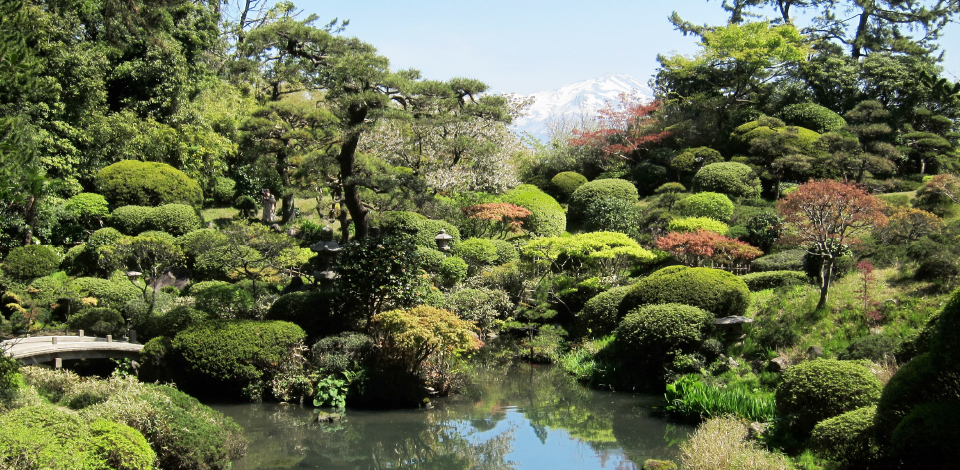
The garden was created by the fourth head of the Honma Family, Kodo, and it is in a style of Japanese garden with a path around the central pond. A complete view of the pond garden with a rich variety of landscape and Mt. Chokai as borrowed scenery can be enjoyed. The lord Sakai named the building overlooking graceful Mt. Chokai as “Seien-kaku” as well as “Kakubu-en” because a crane flew toward a pine tree on the central island of the pond.
cultural property : historic sites and places of scenic beauty as natural monuments
type : places of scenic beauty
7-7 Onarichō, Sakata-shi, Yamagata-ken 998-0024
Public interest foundation, Homma Museum of Art
Tel:0234-24-4311
Home page : www.homma-museum.or.jp
The Honma Family is known as one of the three major landowners in the Tohoku region. They became wealthy merchants mainly due to the shipping business in the Japan Sea from the second half of early modern times to recent modern times. Originally, the garden started out as a villa which was built in 1813 (the Edo Period) by the fourth head of the Honma Family, Honma Kodo. It was created as a rest area for the lord of Shonai, Sakai Tadakata, prior to the lord’s inspection trip to his territory. It was constructed by using the labor of stevedores during the winter time. The stevedores in the early modern period supported the seaport city, Sakata. The garden is in a style of Japanese garden with a path around the main building and a pond and colorful ornamental stones of red and blue are used. A complete view of the pond garden with a rich variety of landscape and Mt. Chokai as borrowed scenery can be enjoyed from the second floor of Seien-kaku. The lord Sakai Tadakata, who visited the garden during his inspection trip, named the building overlooking Mt. Chokai as “Seien-kaku”.
Also, it is said that the garden is named “Kakubu-en (a garden with a dancing crane)” because a crane landed on a pine tree on Nakajima (the central island) of the pond.