
 Okayama Koraku-en
「places of special scenic beauty」カテゴリーアーカイブ
Motsu-ji Garden
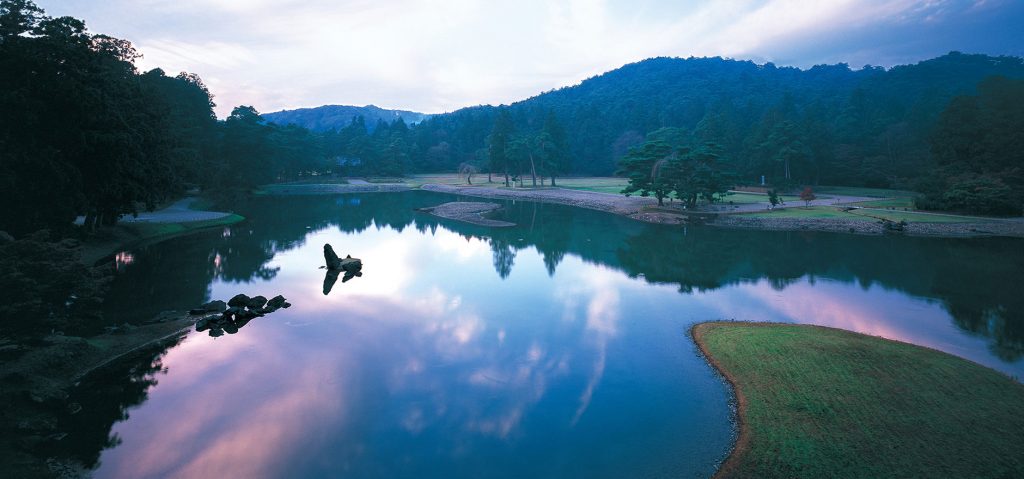
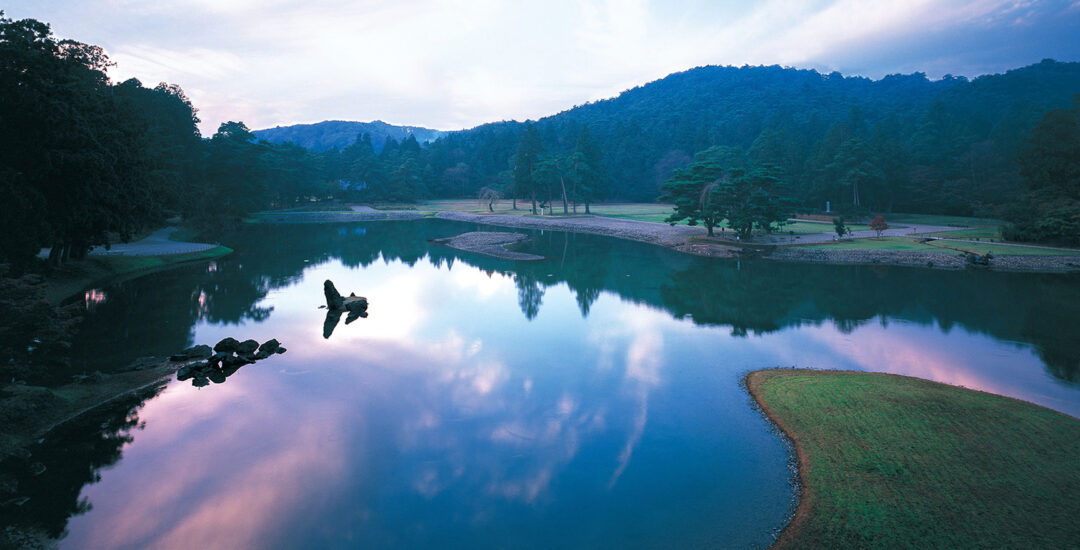
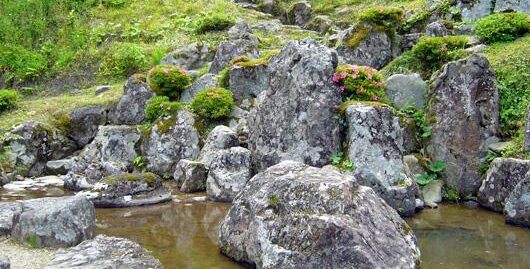
A Jodo (Pure Land)-style garden. Natural sceneries are expressed including stone arrangements such as Tsukiyama in a dry landscape garden style and Yarimizu (curved brook) to draw water to the pond. The park still retains the shape of its elegant landscape from the Heian Period with the Oizumigaike pond in the middle. This precious garden will bring ideas and techniques from Sakuteiki, Japan’s oldest landscaping book, to the modern world.
cultural property : historic sites and places of scenic beauty as natural monuments
type : places of special scenic beauty
58,Hiraizumi Aza Oosawa, Hiraizumi-chō, Nishiiwai-gun, Iwate-ken 029-4102
Tel : 0191-46-2331
Home page : www.motsuji.or.jp
Motsu-ji was founded by Jikaku Daishi En’nin and it reached the height of its prosperity during the second and third lords of the Northern Fujiwara Family, Motohira and Hidehira. During that time, numbers of pagodas and living quarters for monks were constructed. After the fall of the Fujiwara Family, the temple met with natural calamities and all the buildings were burnt down. However, the old foundations of the garden and main temple were found after an excavation and the former landscape was restored.
If you look toward the north from the main temple, a vast “Oizumigaike pond” filled with pure water can be seen in front of a small mountain called Tou-yama. Along with the edge of the “Oizumigaike pond”, natural sceneries such as a Mizuwake (water-divider) simulating a sandbank and rough seashore, a Tateishi (standing rock) which serves as a Namigaeshi (turning waves), a rockwork of Tsukiyama (artificial hill), a Yarimizu (curved brook) to draw water can be seen.
Jodo (Pure Land)-style gardens influenced by the Jodo tradition of Buddhism were created from the Heian Period to the Kamakura Period. The Motsu-ji Garden created during the Heian Period brings ideas and techniques from “Sakuteiki” (Japan’s oldest landscaping book) to the modern world. Combined with the scenery of the surrounding forest, it reminds visitors of the beauty from the past.
Koishikawa Koraku-en
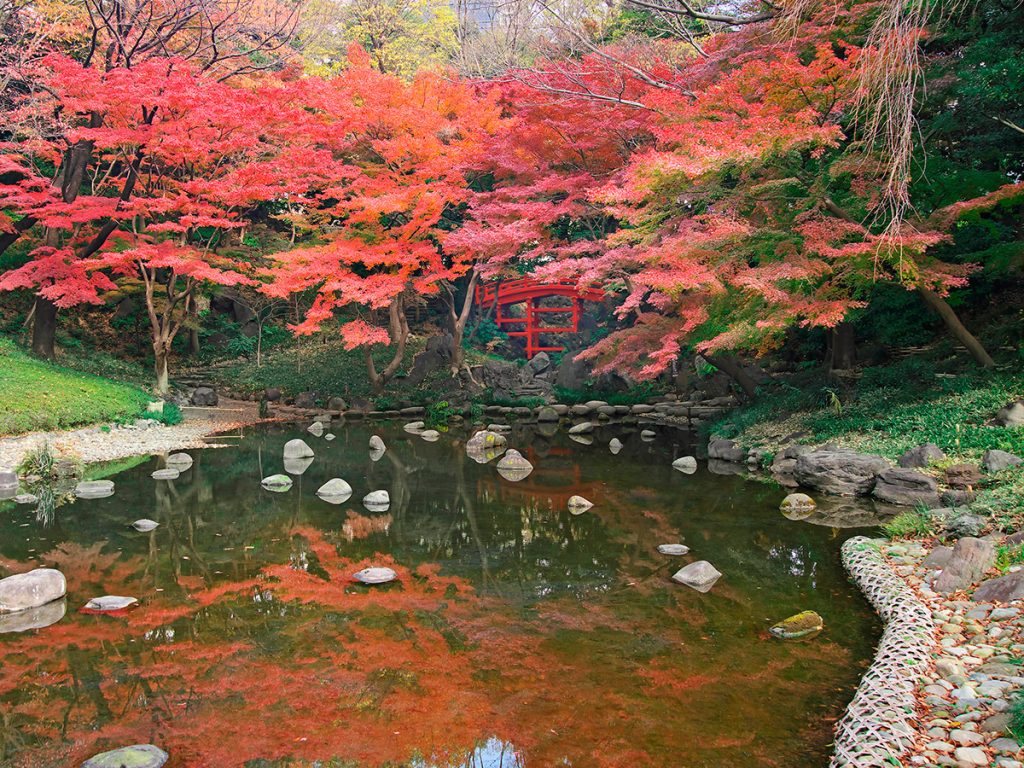
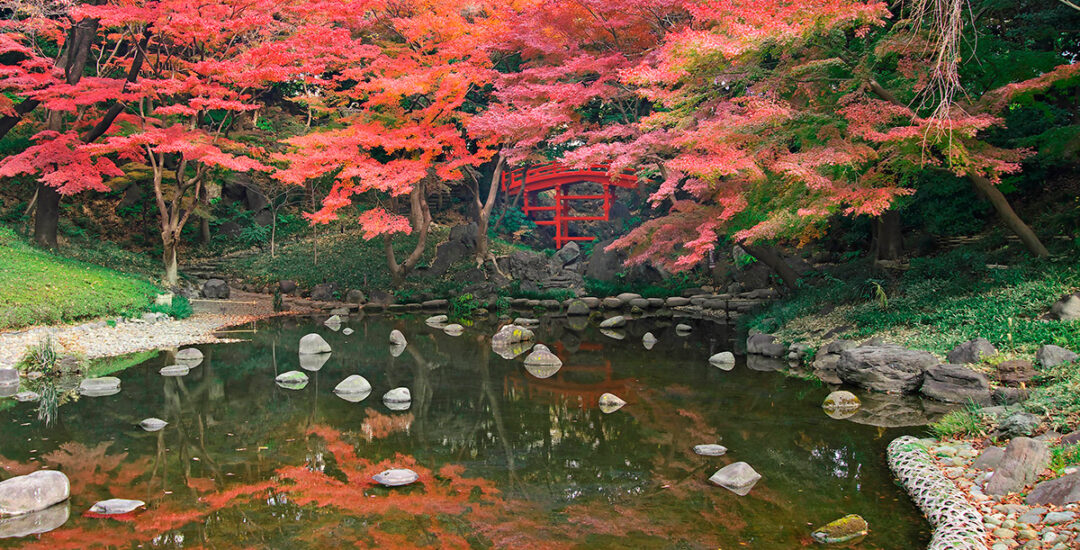
This garden was created in the second house (later it became the first house) of the Daimyo of Mito Tokugawa in Edo in 1629 by drawing water from the branch of the Kanda waterworks. This is a stroll garden with a path around a pond and considered to be a typical Daimyo garden in the early stages during the Edo Period. It was designated as a Special Historic Site and a Special Place of Scenic Beauty by the Cultural Properties Protection Law in 1952.
cultural property : historic sites and places of scenic beauty as natural monuments
type : places of special scenic beauty, special historical sites
1-chōme-6-6 Kōraku, Bunkyō-ku, Tōkyō-to 112-0004
Tel:03-3811-3015
Home page : https://www.tokyo-park.or.jp/park/koishikawakorakuen/index.html
The 1st lord of Mito, Tokugawa Yorifusa, started the construction in 1625 and later the 2nd lord Mitsukuni completed it. Mitsukuni hired Zhu Zhiyu, a Confucian scholar, who was a surviving retainer of the Ming Dynasty, in order to integrate the Chinese taste to the garden. The garden is located on the edge of the Koishikawa plateau and it is a stroll garden with a path around a Tsukiyama (artificial hill) and a pond. The pond uses the water from the Kanda waterworks. Mitsukuni named the garden from the line, “(if there is a concern) the leaders shall be concerned before the people are and (if there is something to enjoy) the leaders enjoy after the people do” in “Gakuyoro-ki”. This is considered to be an early style of the typical Daimyo garden from the Edo Period.
Some buildings only remain as ruins because of the great earthquake of 1855 and a fire on Kantoku-tei in 1880, but the pond and the forest remain beautiful as before.
Rikugi-en
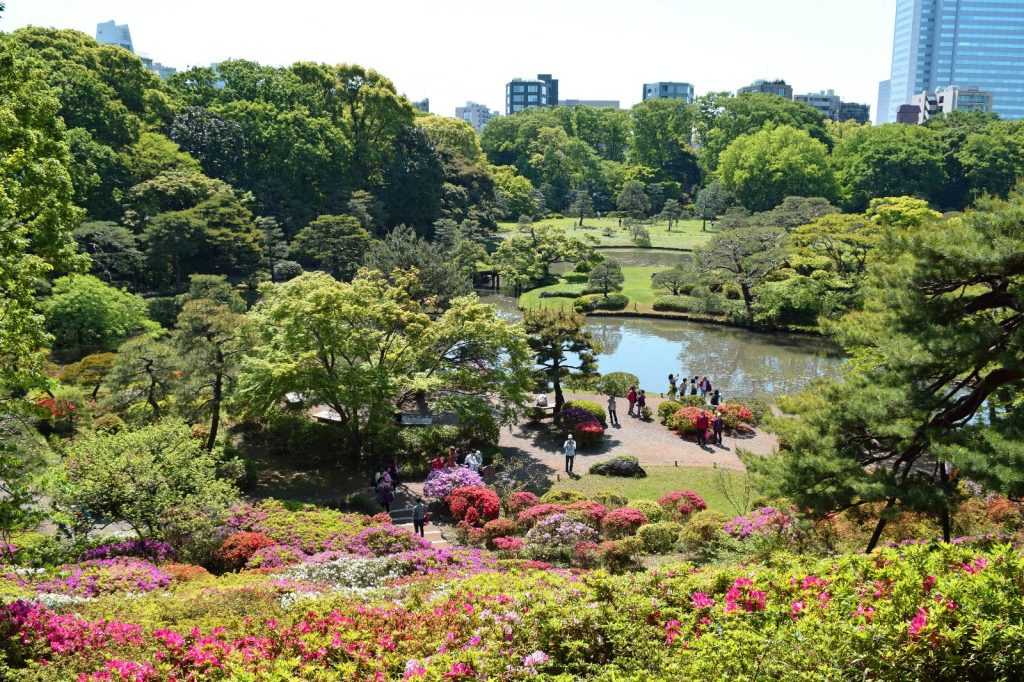
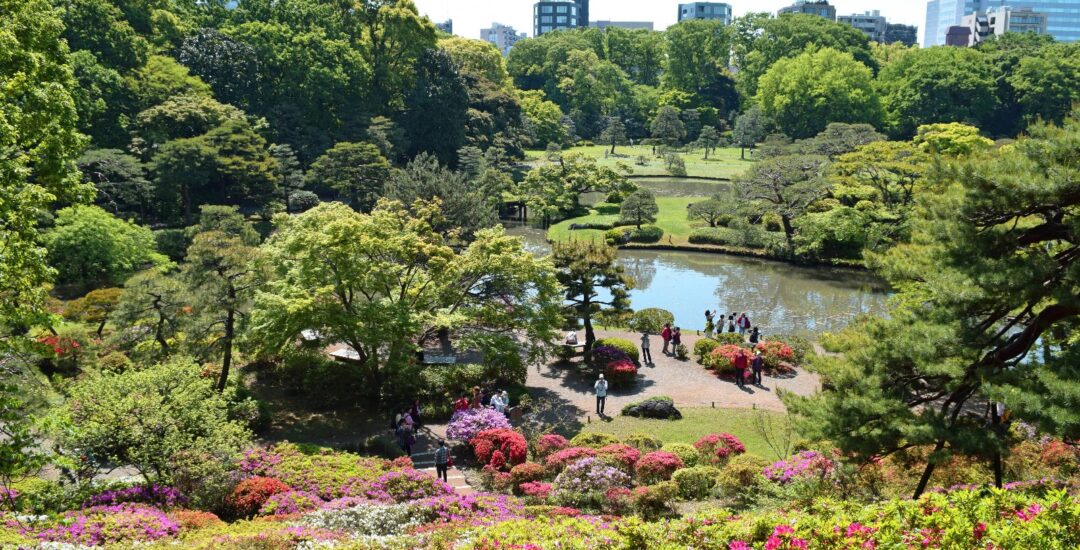
It is considered to be one of the Two Great Gardens of Edo along with Koishikawa Koraku-en. It was built by Yanagisawa Yoshiyasu who was a grand chamberlain of the 5th Shogun, Tokugawa Tsunayoshi, in 1695 and it took 7 years to complete. This is a stroll garden with a path around Tsukiyama (artificial hills) and ponds. It is famous for its “Eighty Eight Places” which recreates landscapes of beautiful places such as Wakanoura and other places that were so beautiful people wrote tanka poems about them. It was designated as a National Special Place of Scenic Beauty in 1953.
cultural property : historic sites and places of scenic beauty as natural monuments
type : places of special scenic beauty
6-16-3 Honkomagome, Bunkyō-ku, Tōkyō-to 113-0021
Tel:03-3941-2222
Home page : https://www.tokyo-park.or.jp/park/rikugien/index.html
Yanagisawa Yoshiyasu created this garden during the Genroku Era in the Edo Period. In 1702, he named the garden “Rikugi-en” and the building “Rikugi-kan” from “Rikugi” in the Classic of Poetry. It is a stroll garden with a path around Tsukiyama (artificial hills) and ponds with a style of the Katsura-rikyu garden created in the beginning of the Edo Period. It is famous for its “Eighty Eight Places” which recreates landscapes of beautiful places such as Kishu Wakanoura that were so beautiful people wrote tanka poems about them. It is one of the Two Great Gardens of Edo along with Koishikawa Koraku-en.
The garden became dilapidated after Yanagisawa Yoshiyasu retired from the government work. It was reconstructed during the Bunka Era at the end of the Edo Period, but part of the buildings were already lost by then.
The Iwasaki Family of Mitsubishi bought the premises in the Meiji Era and the scenery was restored after renovation. Although there were many areas modified during that time, but the main portion still remains. It is considered to be one of the major Daimyo gardens that exist today.
Kyu Hamarikyu Gardens
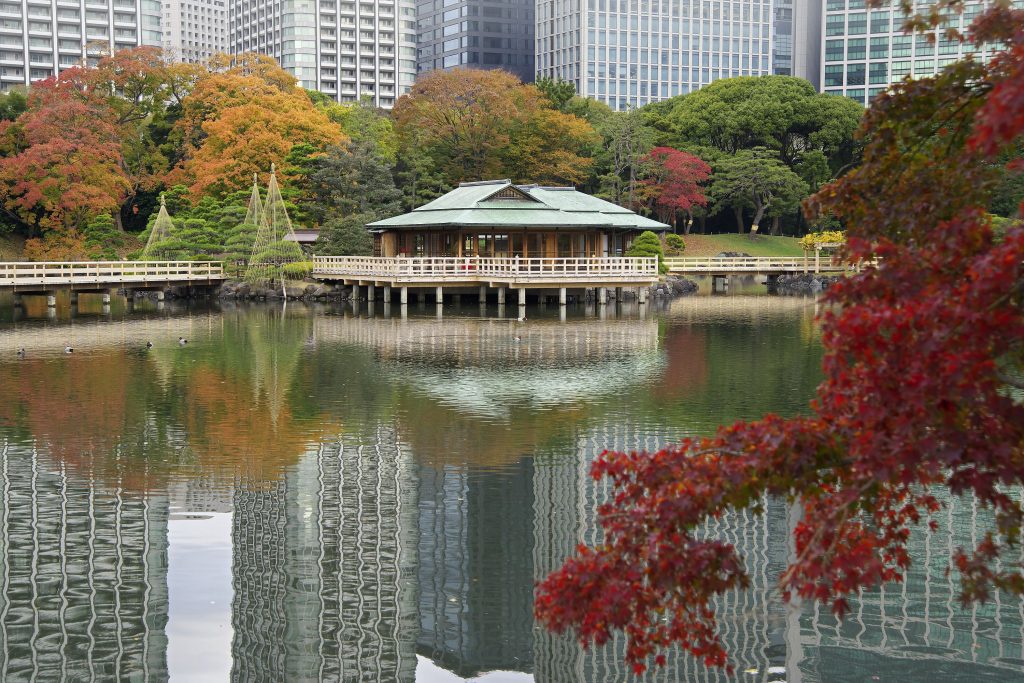
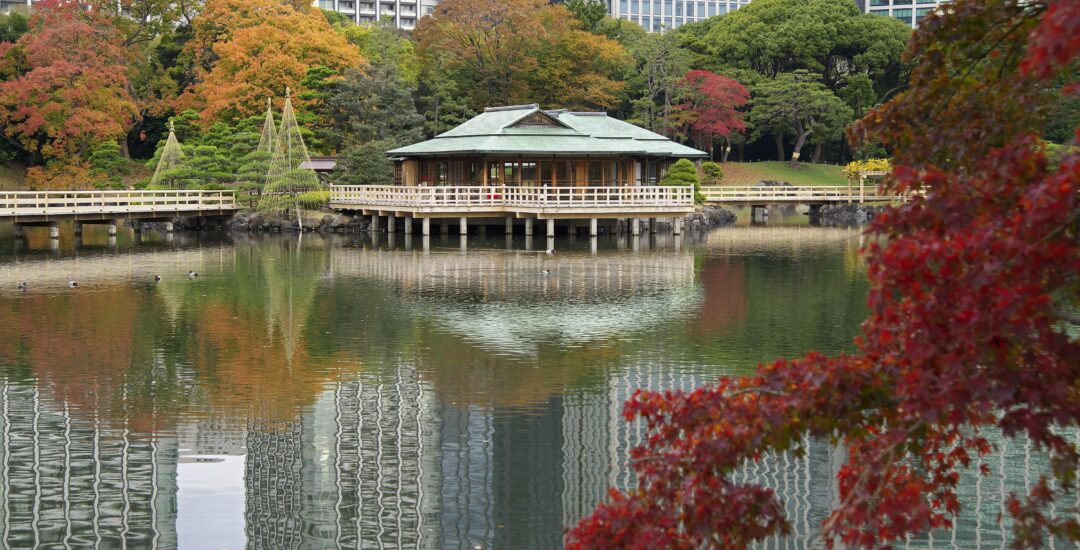
This is one of the outstanding Daimyo gardens from the Edo Period and it has a pond with an inflow of the tide and two areas designated for duck hunting. The atmosphere of the pond changes as the tide turns. This is the only existing garden in Japan with a pond using the ocean tide. It was designated as a Special Historic Site and a Special Place of Scenic Beauty by the Cultural Properties Protection Law in 1952.
cultural property : historic sites and places of scenic beauty as natural monuments
type : places of special scenic beauty, special historical sites
1-1 Hamarikyūteien, Chūō-ku, Tōkyō-to 104-0046
Tel:03-3541-0200
Home page : https://www.tokyo-park.or.jp/park/hama-rikyu/index.html
This is one of the outstanding Daimyo gardens from the Edo Period and it has a pond with an inflow of the tide and two areas designated for duck hunting. The atmosphere of the pond changes as the tide turns. This is the only garden with a pond using the ocean tide among all remaining Daimyo gardens in Tokyo. There was a vast field of reed until the beginning of the Edo Period (the Kan’ei Era) and it was used for falconry for the Shogunate. Matsudaira Tsunashige who was a prime minister of Kofu built a villa called Kofu Hama Yashiki in 1654. It later passed into the Shogunate’s possession when Ienobu was the 6th Shogun and it was renamed as Hama Goten.
The north side and the south side of the garden have different styles. The south side is centered around a large pond which draws seawater. There are paths and bridges around the pond so that visitors can enjoy strolling and admiring beautiful scenery from different viewpoints around the pond either by the pond or on the bridge over the water. There are duck hunting grounds in both the east and west sides of the garden. In those days, visitors could see Odaiba and the mountains of Boso in the southeast and Mt. Fuji in the west in the distance, but now high-rise buildings on the waterfront of the Tokyo Bay are the backdrop of the garden.
Kenroku-en
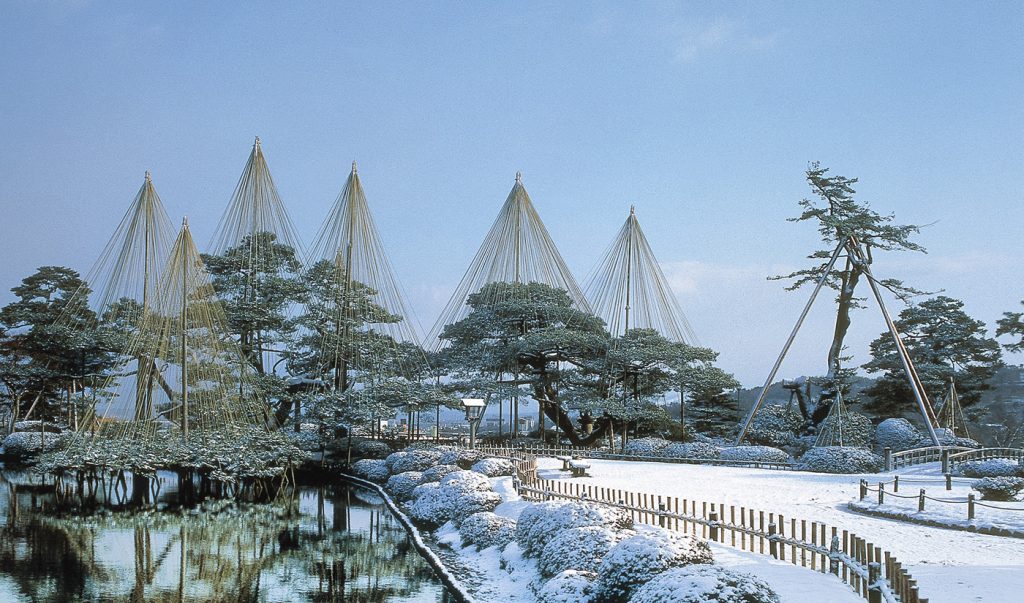
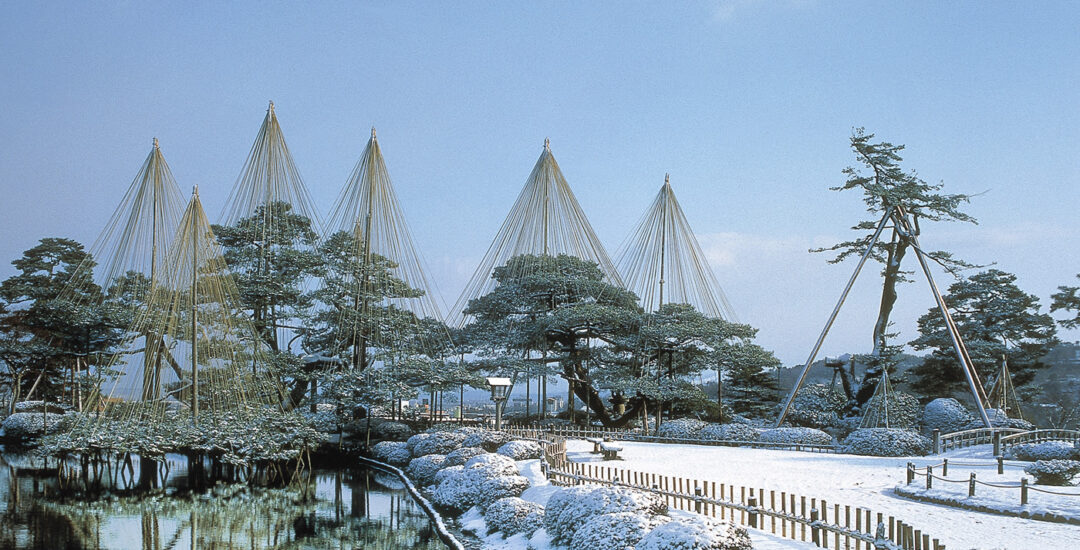
The construction of this garden started when the 5th lord of the Kaga Domain, Maeda Tsunanori, created Renchi-tei (a lotus pond and garden) in 1676. The construction continued over many years by the successive lords of the Kaga Domain. The garden was significantly renovated during the time of the 13th lord, Maeda Nariyasu, to draw water from a distant Tatsumi water channel to the pond. Diverse waterscapes including a waterfall, a meandering stream and a fountain were also added to the garden.
cultural property : historic sites and places of scenic beauty as natural monuments
type : places of special scenic beauty
1 Kenrokumachi, Kanazawa-shi, Ishikawa-ken 920-0936
Tel:076-221-5508
This is one of the Three Great Gardens of Japan. Its construction started when the 5th lord of the Kaga Domain, Maeda Tsunanori, created Renchi-tei (lotus pond and garden) in 1676. The construction continued over many years by the successive lords of the Kaga Domain. It was created by adopting the components of a stroll garden while utilizing garden techniques of various eras. The design takes advantage of the size of the site by placing a large pond in the middle, creating a Tsukiyama (artificial hill), and placing an arbor and a tea house where visitors can take a break while enjoying the garden. The foundation of the garden design came from Shenxian thought (ancient Chinese folk belief in the existence of immortal hermits in the mountain). A large pond was made to resemble the ocean, placing an island representing one where immortal mountain hermits would live, and adding various trees to create seasonal beauty.
The garden was significantly renovated during the time of the 13th lord, Maeda Nariyasu, to draw water from a distant Tatsumi water channel to the pond. Diverse waterscapes including a waterfall, a meandering stream and a fountain were also added to the garden.
Garden of the Ichijōdani Asakura Family
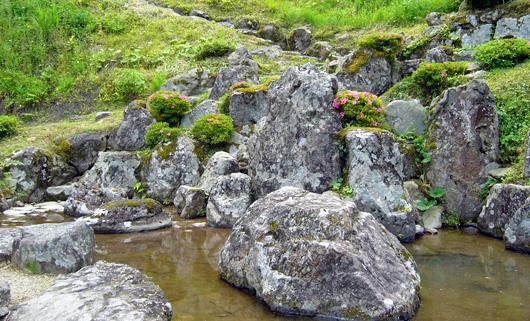
This is a collection of garden remains discovered along with the remnants of the Ichijodani Asakura Family historic site dating back to the Warring States Period during the excavation. They are located in Kidonouchi-cho, a southern suburb of Fukui City. Although the gardens are excavated remains, they are valuable materials that preserve the outstanding culture of warlords at the end of the Muromachi Period.
cultural property : historic sites and places of scenic beauty as natural monuments
type : places of special scenic beauty
28-37 Kidonouchicho, Fukui-shi, Fukui-ken 910-2153
Tel:0776-41-2173
Home page : www.fukuisan.jp/ja/asakura/index.html
This is a collection of gardens that were excavated along with building remains of the Warring States Period during the survey of the Ichijodani Asakura Family historic site. The site is located in the Kidonouchi community, in the southern suburb of Fukui City, that includes the Ichijodani River. The remains include three-dimensional stone (tuff breccia) arrangements with mountains as its background. A number of garden remnants include a garden with a grove and a pond where garden stone arrangements are placed around the pond, a simple and refined flat Karesansui (dry landscape) garden with a few Tateishi (standing stones)/Fuseishi (reclining stones) and pebbles, and more. The three gardens that belonged to the remains of Yudono, Suwa-yakata, Nan’yo-ji had stone arrangements exposed to the ground and had been known as outstanding gardens. They were designated as the Places of Scenic Beauty in 1930, but fell into ruin again. In 1967, the three gardens were improved by removing bushes and accumulated debris in the ponds. In 1987, stone channels and culverts for drawing water to the ponds were excavated at the remains of Yudono and Suwa-yakata. Four gardens have been excavated, and the one at the Yudono remains is believed to be the oldest, while the other three were built in the time of Asakura Yoshikage (1533-1573). Although these are excavated remains, they are valuable materials that preserve the outstanding culture of warlords at the end of the Muromachi Period.
Daigo-ji Sanpo-in Garden
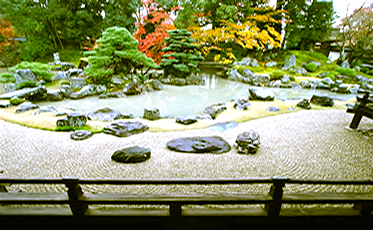
Daigo-ji is a famous temple founded in the Heian Period. This garden is adjacent to Sanpo-in, where the chief monk lives. Although the premises of Daigo-ji was devastated by the Onin-Bunmei War, it was reconstructed after Toyotomi Hideyoshi hosted “Daigo’s Cherry-blossom Viewing.” The garden was made by exceptional gardeners.
cultural property : historic sites and places of scenic beauty as natural monuments
type : places of special scenic beauty, special historical sites
22 Daigohigashiojicho, Fushimi-ku, Kyōto-shi, Kyōto-fu 601-1325
Tel:075-571-0002
Home page : www.daigoji.or.jp/garan/sanboin_detail.html
Daigo-ji is a famous temple that is said to have been founded by Rigen Daishi Shoho, who offered a Kan’on statue at Mt. Kasatori (the spring water from this mountain has been called “Daigo” water) in the Heian Period. The chief monk had resided in Sanpo-in, but the premise of Daigo-ji fell into ruin during the Onin-Bunmei War, which also destroyed Sanpo-in. The devastated Daigo-ji was reconstructed by Gien Jugo under the protection of Toyotomi Hideyoshi. It is told that, prior to 1598, when new Sanpo-in were to be made at the site of Kongorin-in, Toyotomi Hideyoshi himself roped off an area and ordered three gardening magistrates to rebuild the garden. Although Toyotomi Hideyoshi died in August 1598, the garden construction continued under the instruction of Gien, which lasted for 27 years until Gien also died.
The garden has a pond at the center, with three islands and nine bridges. There is a Tsukiyama (artificial hill) to the south and a waterfall to the east. Many ornamental stones are arranged along the pond shore. Fujito stone, a famous stone owned by past rulers, was also placed among them. The site has tall evergreen trees such as Japanese white pines (Pinus parviflora), chinquapins (Castanopsis sieboldii), and Japanese blue oaks (Quercus glauca), creating a magnanimous yet graceful atmosphere.
Jisho-ji Garden
The garden belongs to a Zen temple of the Shokoku-ji school (the Rinzai sect), and is representative of the Higashiyama culture. It was built in 1339 modeled after a garden at Saiho-ji, made by Muso Soseki. The garden has Tsukiyama (artificial hills) and ponds, with mountains, called “Tsukimachi-yama” and “Daimonji-yama” in the background.
cultural property : historic sites and places of scenic beauty as natural monuments
type : places of special scenic beauty, special historical sites
2 Ginkakujichō, Sakyō-ku, Kyōto-shi, Kyōto-fu 606-8402
Tel:075-771-5725
This is a Zen-temple garden that belongs to the Shokoku-ji school of the Rinzai sect and an excellent example of the Higashiyama culture. This is a garden of a mountain villa known as Higashiyama-dono. The villa was built by the 8th Shogun Ashikaga Yoshimasa of the Muromachi Shogunate for his retirement, following the example of Kitayama-dono Kinkaku Rokuon-ji, built by the 3rd Shogun Ashikaga Yoshimitsu. The garden is said to have been modeled after the garden of Saiho-ji designed by Muso Soseki in 1339.
The garden consists of upper and lower levels: A stroll garden with a pond is located on the ground level and a Karesansui (dry landscape) garden on the back hill. The stroll garden has a pond called “Kinkyochi” at the center, and Ginkaku and Togu-do are situated on both sides of the pond. The landscape of these gardens was significantly altered during the renovation in the early Edo Period.
The key garden components are Ginshadan and cone-shaped Kogetsu-dai created from white sand. It is believed that Ginshadan, which depicts the scene of waves at Lake Seiko in China, and Kogetsu-dai, formed to resemble Mt. Fuji, were made with moonlight reflections in mind.
Nijo Castle Ninomaru Garden
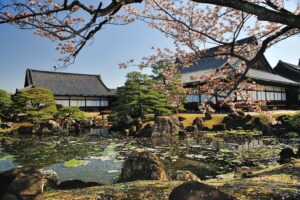
Ninomaru Garden was renovated to prepare for Emperor Gomizuno’o’s visit in 1626 under the instructions of Sakuji Bugyo (Commissioner of Works), Kobori Enshu. The pond in the garden has the Horai Island at the center and the Crane Island on one side and the Turtle island on the other. The pond can be enjoyed from three directions: The great hall of Ninomaru Palace, Kuro-shoin, and the remnant of the Gyoko Palace. The garden is said to be the best example of a garden with Tsukiyama (artificial hills) and ponds found at the currently existing castles.
cultural property : historic sites and places of scenic beauty as natural monuments
type : places of special scenic beauty
541 Nijo-jo-cho, Horikawa-nishi-iru, Nijo-jo-dori, Nakagyo-ku, Kyoto city, Kyoto-fu 604-8301
Tel:075-841-0096
Ninomaru Garden was renovated as a garden facing the palace for Emperor Gomizuno’o’s visit in 1626 under the instructions of the Shogunate’s Sakuji Bugyo (Commissioner of Works), Kobori Enshu. Later, the palace was removed and relocated, but the garden was carefully crafted and renovated so that it can be enjoyed from three directions – the great hall of the Ninomaru Palace, Kuro Shoin, and the remnant of the Gyoko Palace. The pond has curved edges with various characteristics, three central islands (the Horai Island, the Crane Island, the Turtle Island), four natural stone bridges, and a three-level waterfall in the north-western corner. There are also many stone arrangements along the pond edges and shore. The western section of the garden features a background of forests consisting of pines, Japanese nutmeg trees (Torreya nucifera), Kurogane hollies (Ilex rotunda), Japanese blue oaks (Quercus glauca), chinquapins (Castanopsis sieboldii), Japanese pittosporum (Pittosporum tobira), Muku trees (Aphananthe aspera), cherries, maples, etc. The southern part of the garden is a spacious lawn dotted with a well balanced number of pines. The stone arrangements in the garden create an open and bold atmosphere, and are said to be the best example among gardens with Tsukiyama (artificial hills) and ponds of the presently existing castles.
NishiHongwan-ji Daishoin Garden
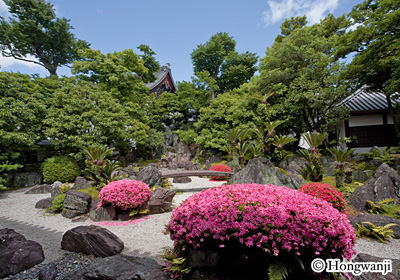
It is a Karesansui (dry landscape) garden of the inner court on the east side of the study, known as “Kokei-no-niwa.” Three central islands of different sizes are situated on white sand. The dry waterfall and rock arrangements are dynamic and strong, which is characteristic of gardens with groves and ponds in front of studies built during the Momoyama Period.
cultural property : historic sites and places of scenic beauty as natural monuments
type : places of special scenic beauty, historic sites
Hanayacho-sagaru, Horikawa-dori, Shimogyo-ku, Kyoto-fu, 600-8501
Tel:075-371-5181
This is the head temple of the Hongan-ji school (the Jodo Shinshu sect founded by Shinran Shonin). Daishoin Garden is a Karesansui (dry landscape) garden of the inner court on the east side of the study, known as “Kokei-no-niwa.”
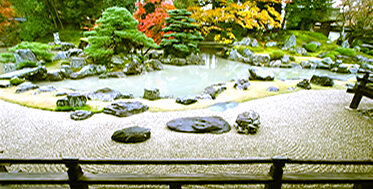
The garden is flat with a Tsukiyama on the east side. There are many Tateishi (standing stones) and five lanterns. At the center, slightly to the north, there is a magnificent stone arrangement of a dry waterfall. A dry stream represented by cobble stones leads to the ground covered with white sand, recreating a swift current pouring into the ocean. Two central islands are protected by colorful stone edging, and an arched stone bridge and a small bridge made of natural stones connect the islands. Sago palms (Cycas revoluta) planted between stone arrangements are characteristic of study gardens with groves and ponds built in the Momoyama Period. The powerful and dignified stone arrangements and dry waterfall are also great examples of this Period.
Rokuon-ji Garden
Kinkaku-ji has two ponds, Kyokochi that spreads in front of the Shariden (reliquary hall), and Anmintaku that is situated on the north side, which is elevated by one level. Water flows into the pond from Daimonji-yama. Since earth and sand flow in when heavy rain cause a large amount of drainage, Anmintaku functions as a sedimentation basin for Kyokochi.
cultural property : historic sites and places of scenic beauty as natural monuments
type : places of special scenic beauty, special historical sites
1 Kinkakujichō, Kita-ku, Kyōto-shi, Kyōto-fu 603-8361
Tel:075-461-0013
The third Shogun of the Muromachi Shogunate, Ashikaga Yoshimitsu, after passing the title to his son, Yoshimochi, and became a monk, received a mountain villa from the Saionji Family in 1397 and constructed Kitayama-dono at the villa. When Yoshimitsu passed away, Kitayama-dono was turned into a temple according to his will and named Rokuon-ji, honoring his posthumous Buddhist name “Rokuon-in.”
Kinkaku-ji has two ponds, Kyokochi that spreads in front of Shariden (a reliquary hall; Kinkaku), and Anmintaku, situated on the north side, elevated by one level.
Kyokochi is a stroll garden with a pond, and uses many ornamental stones for its shore and central island.
The pond water flows in from Daimonji-yama and receives earth and sand when there is significant amount of drainage due to heavy rain. Therefore, the water is first drawn to Anmintaku, which is located on the highest level and functions as a sedimentation basin, then discharged to Kyokochi. Anmintaku, located in the back of Kinkaku, has fewer ornamental stones and is believed to have been constructed by Saionji Kintsune during the Kamakura Period.
Daisen-in Shoin Garden
The garden was built by Kogaku, a monk who founded Daisen-in. Surrounding the main temple in all four directions, the garden is divided by a roofed bridge, etc. to create space for a mountain, a river and the ocean. It is a masterpiece Karesansui (dry landscape) garden that recreates a mountain-and-water landscape by arranging many rocks in a small area.
cultural property : historic sites and places of scenic beauty as natural monuments
type : places of special scenic beauty, historic sites
54-1 Murasakino Daitokujichō, Kita-ku, Kyōto-shi, Kyōto-fu 603-8231
Tel:075-491-8346
Daisen-in is a sub-temple (built to commemorate the death of a high-ranking Zen monk) that stands in the precinct of Daitoku-ji, the north of Kyoto’s urban area. The temple was founded in 1509 by the 76th Daisho Kokushi, Kogaku Soko. A document preserved at Daisen-in states that the garden was also made by Kogaku himself.
The garden surrounds the main temple in all four directions. The south section represents the ocean with two ceremonial piles of sand on ground covered with white sand at both sides of the entrance. The east garden has a dry waterfall arrangement of large rocks and plantings of camelias and Japanese white pines (Pinus parviflora) to recreate the scenery of a secluded mountain. A stone bridge is installed under the dry waterfall, and a stone that resembles a boat is placed on white sand down the “stream,” to represent a large river flowing to the ocean. In this way, the garden depicts a mountain, a river and the ocean.
The roofed bridge that divides the garden into two was once removed at the end of the Meiji Era, resulting in the “mountain” and the “ocean” becoming connected. In 1960, the bridge was restored, and the garden regained its original state.
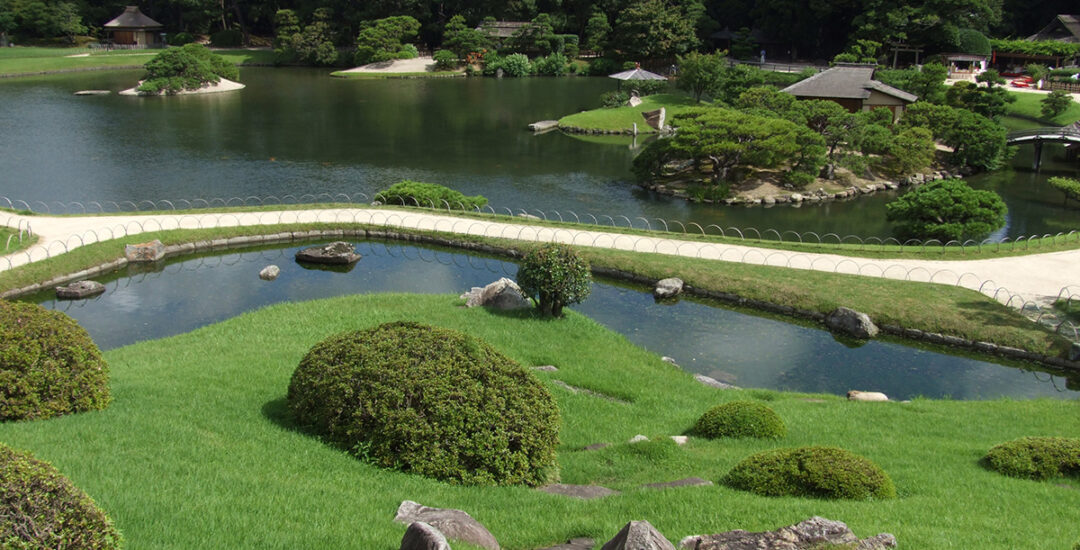
Okayama Koraku-en
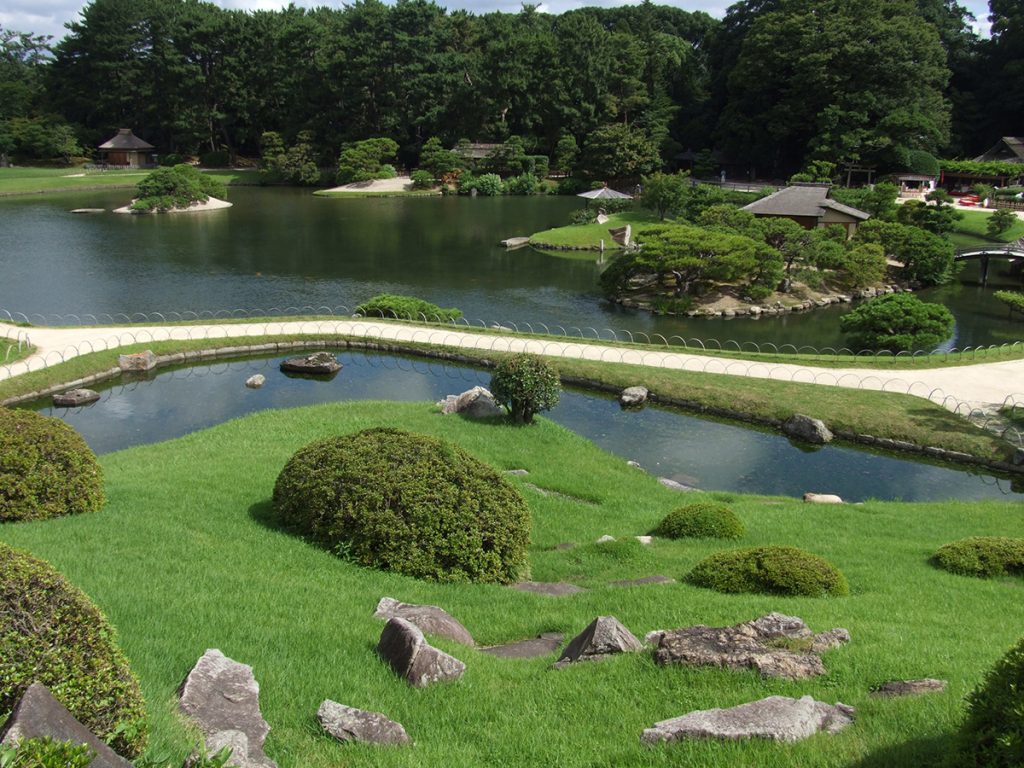
This is one of the Three Great Gardens of Japan along with Kenroku-en in Kanazawa and Kairaku-en in Mito.
It was built by the 2nd lord of the Okayama Domain, Ikeda Tsunamasa, in 1686 to create a space filled with serenity. It was originally a garden where visitors enjoyed the scenery from the buildings inside the garden, but paths for strolling were added later during the renovations by subsequent lords. The appearances of the garden from the Edo Period are very well preserved.
cultural property : historic sites and places of scenic beauty as natural monuments
type : places of special scenic beauty
1-5 Kōrakuen, Kita-ku, Okayama-shi, Okayama-ken 703-8257
Tel:086-272-1148
Home page : okayama-korakuen.jp/
It was landscaped by the 2nd lord of the Okayama Domain, Ikeda Tsunamasa, in 1686 to create a space filled with serenity. It was originally created to enjoy the view from the buildings inside the garden.
The 3rd lord, Tsugumasa, conducted a major renovation on the buildings and the garden. He adopted a landscape of stroll garden so that visitors could enjoy the garden as they walk around. A Tsukiyama (artificial hill) was created in the center of the garden and waterways were added around the bottom of the artificial hill. The Sawanoike pond and the pond of Renchi-ken were connected to create a pond shaped like a gourd. From En’yo-tei, which was used as a lounge when the lord visited, visitors can get a sweeping view of the scenic spots of the garden including the vast lawn, a large pond and the Forest of Chishio, which is a maple forest in the eastern part of the garden.
The original borrowed scenery of the Okayama Castle has been lost since the castle was burnt down during the war in the Showa Period, but Mt. Misao is still a part of the borrowed scenery in the southeast direction of the garden. The artificial hill in the middle of the garden is about 6 meters high and from the top of the hill, visitors can command a full view of Sawanoike, Enyo-tei, lawn field and Seiden (an imitation of ancient rice fields) in the garden. The old layout of a Daimyo garden is very well preserved in this garden.
Ritsurin Park
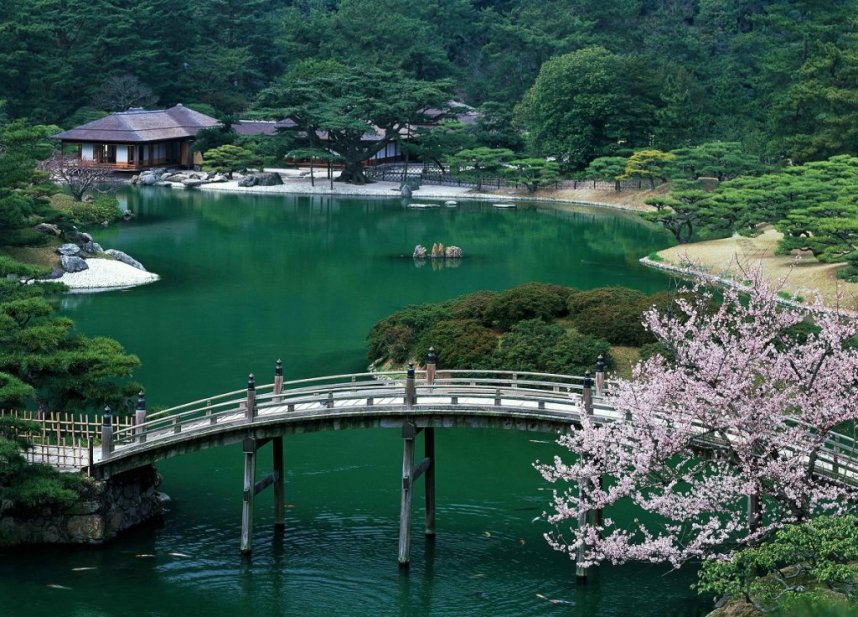
This site was originally a villa of the lord of Takamatsu, Matsudaira. It became a park managed and operated by Kagawa Prefecture in 1875 (the Meiji Era). The spacious area features 6 ponds and 13 Tsukiyama (artificial hills), making it one of the largest Daimyo gardens, and the largest among the gardens designated as Cultural Properties.
cultural property : historic sites and places of scenic beauty as natural monuments
type : places of special scenic beauty
1-20-16 Ritsurinchō, Takamatsu-shi, Kagawa-ken 760-0073
Tel:087-833-7411
Home page : my-kagawa.jp/ritsuringarden
This garden consists of South Garden and North Garden. South Garden preserves its original state as a Daimyo garden from the early Edo Period, including its Chiwari (layout) and stone arrangements typical of a stroll garden. North Garden was created in the Genroku Era as a duck hunting field but redesigned by Ichikawa Nobuo of the Department of the Imperial Household in the early Taisho Era. The garden was partially renovated again in later years. The garden is located in a vast landscape with Mt. Shiun as background. It features six ponds and 13 Tsukiyama (artificial hills).
Its pond, trees, and stone arrangements are appreciated for their elegance and garden workpieces are effectively placed throughout. Mt. Shiun’s dense foliage adds a taste of wilderness, and visitors can enjoy a picturesque view from the summit. In 1897 (the Meiji Era), a national forest on the mountain’s east slope was added to the site, which it includes today.
The area including Mt. Shiun reaches approximately 75ha, which makes it the largest garden that has been designated as a cultural property.
Shikina-en
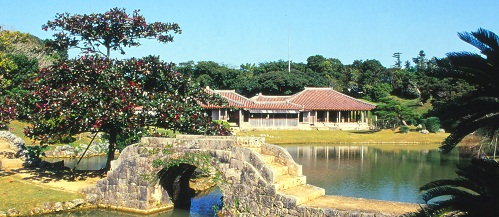
The garden was a villa of the former Ryukyu Kingdom. It was used for the royal family to retreat and to entertain foreign envoys. A spring-fed pond features two islands, and three Chinese-style bridges built across the pond. The plant landscape consists of both temperate and tropical plants. It is a stroll garden where different views can be enjoyed one after another by promenading along the path circling the pond.
cultural property : historic sites and places of scenic beauty as natural monuments
type : places of special scenic beauty
421-7 Maaji, Naha-shi, Okinawa-ken 902-0072
Tel:098-855-5936
Home page : www.city.naha.okinawa.jp/
It is a garden with a grove and a pond of a villa of the former Ryukyu Kingdom, which was built sometime prior to 1800. It was called Nan’en (south garden) because it was located to the south of Shuri-jyo castle. It was used for the royal family to retreat and to entertain foreign envoys.
A spring-fed pond features two islands and three Chinese-style bridges. An observation deck called “Kanko-dai” is located at the southern edge of the garden, commanding a panoramic view.
The garden features temperate plants, such as pines, plums, willows, and crape myrtles, as well as tropical plants, such as common garcinias (Garcinia subelliptica), Javanese bishop wood (Bischofia javanica), and Indian coral trees (Erythrina variegata). They create a plant landscape with an illusion of four seasons in tropical Okinawa. Although it is a stroll garden, a garden style often used for a Daimyo (feudal lord) garden, it shows components unique to Ryukyu, such as an S-curved stone path to ward off majimun (evil spirits), who can only move in a straight line, an oddly-shaped rock that resembles Chinese Taihu stone (porous limestone), and “funa-ageba” (a boat lift yard) where a boat could be docked.