
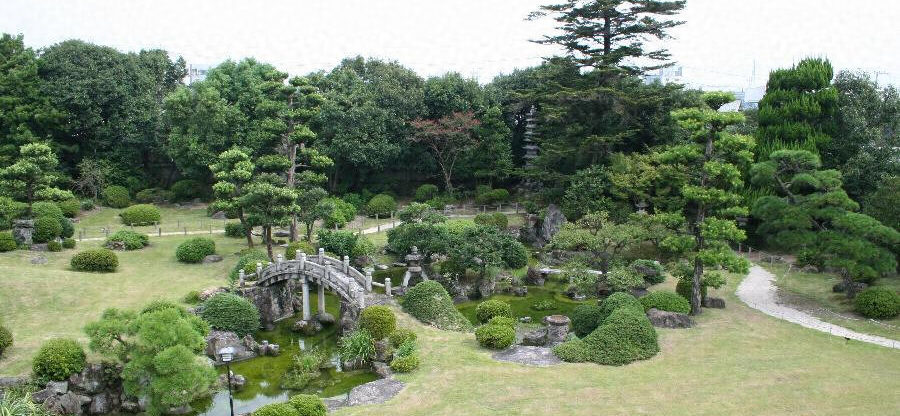
 Garden of Mr.Ito Denemon
投稿者「youko」のアーカイブ
Mukojima-Hyakka-en
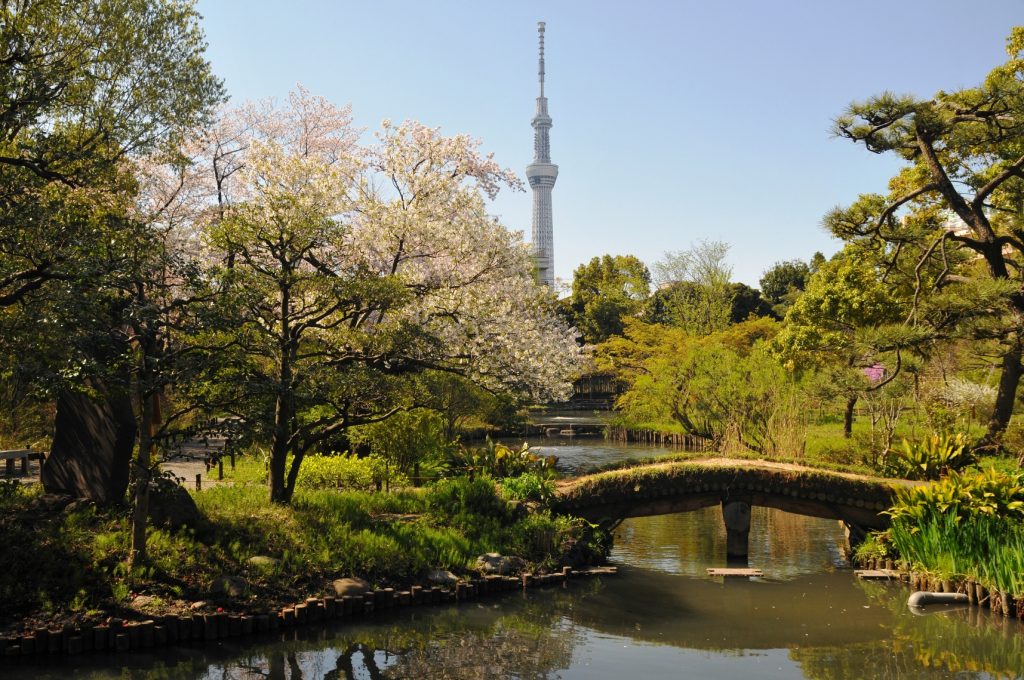
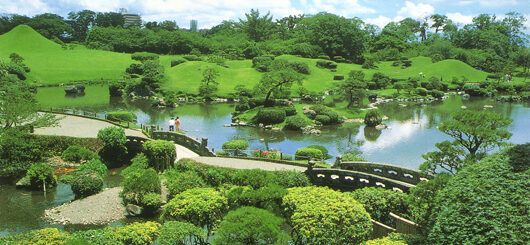
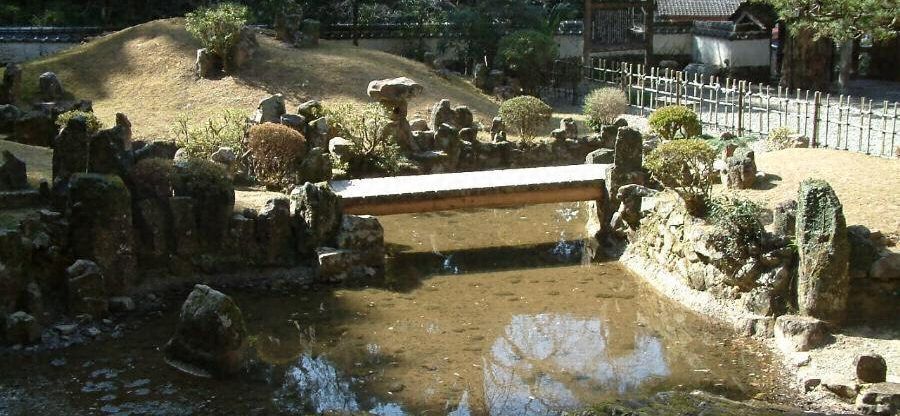
It was created in 1805 during the Bunka Bunsei Era in the Edo Period. The garden mainly constituted of plum trees when it was first opened, but later many herbaceous plants, that were noted in connection with poetries, were planted based on the ideas from the garden owners and intellectuals. This is a folksy garden different from the Daimyo gardens such as Koishikawa Koraku-en and Rikugi-en, yet it also has plenty of tasteful elements from intellectuals’ ideas.
cultural property : historic sites and places of scenic beauty as natural monuments
type : places of scenic beauty, historic sites
3-18-3 Higashimukōjima, Sumida-ku, Tōkyō-to 131-0032
Tel:03-3611-8705
Home page : https://www.tokyo-park.or.jp/park/mukojima-hyakkaen/index.html
Sawara Kiku, who was an antique dealer, created this garden in the house he purchased from a direct retainer of the Shogun in Muko-jima in the Bunka Bunsei Era, when the merchant class culture flourished. It is a privately owned flower garden which was created by common people when they became richer financially and culturally around the end of the Edo Period. It was called the “New plum mansion” because more than 300 plum trees were planted when it was first open. It was also called “Hyakka-en (a garden with a hundred flowers)” because there were always flowers and blossoms all year around. Many herbaceous plants, that were noted in connection with the Manyo-shu and poetries, were planted based on intellectuals’ ideas. The layout that includes the building, pond, paths, and more than 30 stone monuments is remarkable and it is one of a few remnants of intellectuals’ gardens from the Edo Period. The building from the Edo Period burnt down in 1945, but the landscape still has the elegance of the time and it has a different type of beauty from other remaining Daimyo gardens.
Kyu-Furukawa Gardens
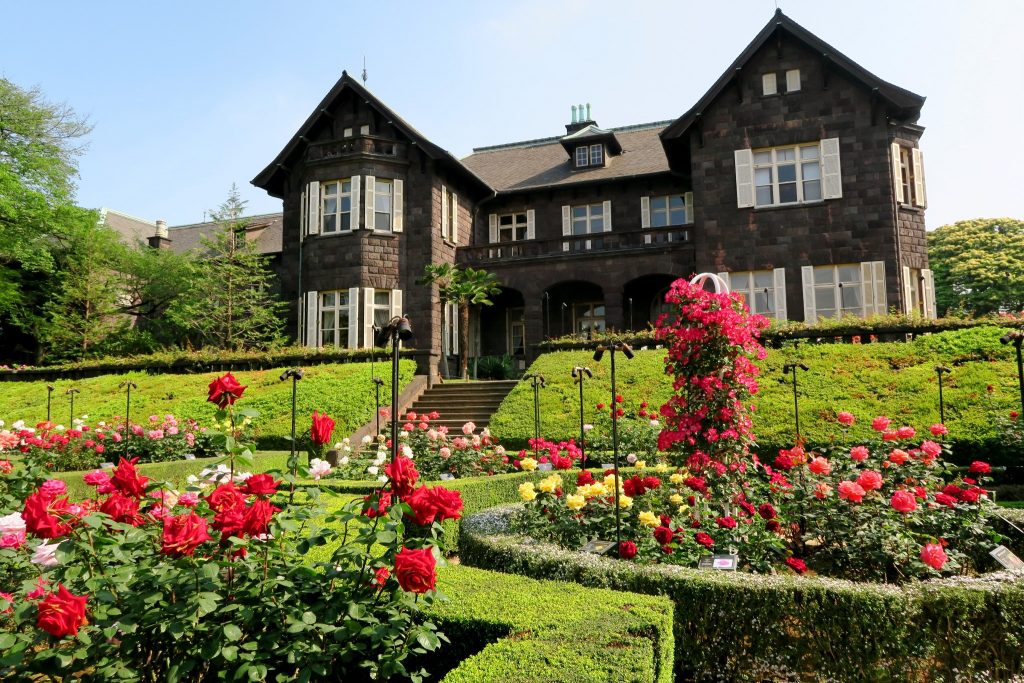
The garden uses the southeast plateau of Mt. Asuka and a slope that is part of the southern plateau. The construction started in 1917 (the Taisho Era) and it took two years to complete the stroll garden with a path on the slope at the bottom of the plateau and the lowland. It is considered to be a typical garden in modern Tokyo as it maximizes the natural geography of Tokyo such as plateau, slope and lowland.
cultural property : historic sites and places of scenic beauty as natural monuments
type : places of scenic beauty
1-27-39 Nishigahara, Kita-ku, Tōkyō-to 114-0024
Tel:03-3910-0394
Home page : https://www.tokyo-park.or.jp/park/kyu-furukawa/index.html
This is a garden created by Furukawa Toranosuke in the Taisho Era. It is located in the southeast of Mt. Asuka which is in the eastern edge of the Musashino Plateau and it skillfully uses the plateau, the slope in the south and the lowland in the garden. There is a Western-style formal garden with a European-style main building on the plateau in the north of the premises. A stroll garden is landscaped on the slope of the plateau and the lowland in the south. There are a tearoom and its tea garden in the east of the premises, thus, there are 3 elements in this garden, namely a Western garden, Japanese garden and tea garden.
The Western garden and the main building were designed by Josiah Conder and constructed in 1917. Ogawa Jihei VII (also known as Ueji) of Kyoto designed the Japanese garden. It was designed to maximize characteristic geographies of Tokyo and exhibits an amazing harmony of Japanese and Western styles by incorporating traditional methods and modern techniques. This is a valuable garden which retains original features created in the modern Tokyo.
Former ASAKURA Fumio Garden
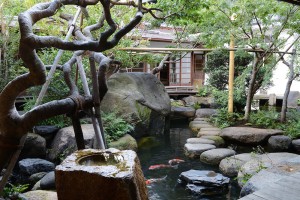
This was used as a residence and studio of ASAKURA Fumio who was a master of Japanese modern sculptures. There is a rooftop garden on the art studio building which was used for his creative work and teaching younger artists. This is a valuable example of green rooftop gardens on ferroconcrete buildings which started around the beginning of the Showa Era. The entire premises, including the buildings, received recognition as a National_designated Place of Scenic Beauty.
cultural property : historic sites and places of scenic beauty as natural monuments
type : places of scenic beauty
7-18-10 Yanaka, Taitō-ku, Tōkyō-to 110-0001
Tel:03-3821-4549
Home page : www.taitocity.net/zaidan/asakura/
ASAKURA Fumio was a master of Japanese modern sculptures and this garden is in his old residence and studio in the residential area of Yanaka, Tokyo. He lived there and used the studio for his own creative work and teaching younger artists until his death in 1964.
The current art studio and Sukiya-style residential building were constructed when the house was renovated in 1935. The courtyard is surrounded by buildings on all four sides. It is quite small (10 m long from north to south and 14 m long from east to west) and a pond (water surface) occupies most of it. Some stones are arranged in the pond and visitors can enjoy deutzia in spring and Japanese maples in fall. Various ornamental stones and plants create a profound waterscape. The rooftop garden on the art studio building is also a valuable example of green rooftop gardens on ferroconcrete buildings which started around the beginning of the Showa Era.
ASAKURA opened the ASAKURA School of Sculpture using his house and studio. The rooftop was used daily by Asakura’s students to grow vegetables and learn about gardening.
Kencho-ji Garden
According to the copper monument dated 1692, the current garden was either created or renovated in the beginning of the Tokugawa Shogunate. There is a garden with a pond shaped like the character for “heart (Kokoro)” in the middle, which is located behind the abbot’s chamber, and the Daikakuike garden in Kaishun-in. The Daikakuike pond was created when the temple was built as a regulating reservoir in order to protect the precincts of the temple from flooding.
cultural property : historic sites and places of scenic beauty as natural monuments
type : places of scenic beauty, historic sites
8 Yamanouchi, Kamakura-shi, Kanagawa-ken 247-0062
Tel:0467-22-0981
This is the head temple of the Kencho-ji school of the Rinzai sect and founded by Hojo Tokiyori in 1253, the fifth year of the Kencho Era. The precincts are symmetrically arranged and Chinese junipers (Juniperus chinensis) are planted in a row in the garden in front of the Buddhist sanctum. The style of gardens with a study can be seen in drawings from 1678. According to the copper monument dated 1692 in the garden, it is presumed that it was either created or renovated in the beginning of the Edo Period. There is a hill running from the east to the north of the garden and a curved pond is at the bottom of the hill. There is a bridge to walk across to Nakajima (the central island) in the pond. Some stones are arranged on the central island here and there along with a lantern. There are dwarf conifer trees such as pines and yew plum pines (Podocarpus macrophyllus) as well as azaleas. A large Japanese black pine (Pinus thunbergii) is towering in the middle of the garden and lush Japanese zelkova (Zelkova serrata) and maple trees can be seen on top of the hill. The garden is simple yet elegant.
Garden of the Watanabe Family
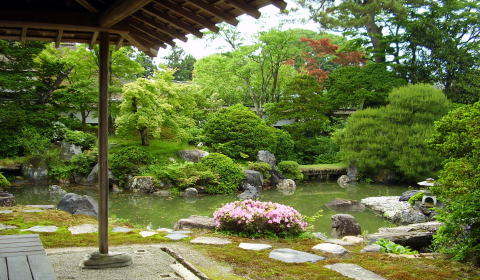
It is said that it was built around the mid-Edo Period, but an actual date is unknown. A gardener of the Enshu-ryu style was invited from Kyoto to participate in the landscaping. The landscape of the garden from the mid-Edo Period is very well preserved and there is a pond shaped like the character for “heart (Kokoro).” The garden has a beautiful arrangement of Tsukiyama (artificial hills), dry waterfall, sandy beach, and stone lanterns around the pond, as well as an enclosure of the well in the north.
cultural property : historic sites and places of scenic beauty as natural monuments
type : places of scenic beauty
904 Shimoseki, Sekikawa-mura, Iwafune-gun, Niigata-ken 959-3265
Tel:0254-64-1002
Home page : www.watanabetei.com
This was a garden in the residence of the Watanabe Family, who was a wealthy merchant, farmer and village headman in Echigo Shimonoseki. The garden is open to the east and there is a pond shaped like the character for “heart (Kokoro).” There is a writing with ink from 1769 on a ridge pole in the South Garden, thus it is presumed that the garden was made around that time. There are three Tsukiyama (artificial hills) in the west of the pond, named Ichinoyama (First Hill), Ninoyama (Second Hill) and Sannoyama (Third Hill). There is a stone of Fudo on Ichinoyama and it represents a dry waterfall. On the opposite side of the pond, in the east, there is a beach of round stones with numerous garden stones. Many stepping stones as well as some plants, that are liken to a crane and turtle, are also arranged. Visitors can enjoy views from season to season; white plum blossoms in spring, Japanese irises (Iris laevigata) in summer, Japanese maple in fall and a snowscape in winter.
The garden’s layout is the so-called Kyoto style as a stone lantern and enclosure of the well are tastefully arranged to add elegance to the garden.
The landscape of the garden from the mid-Edo Period is very well preserved and it is considered to be very important in the history of Japanese gardens as this is an example of the culture spreading from a large city to the countryside.
Kenroku-en
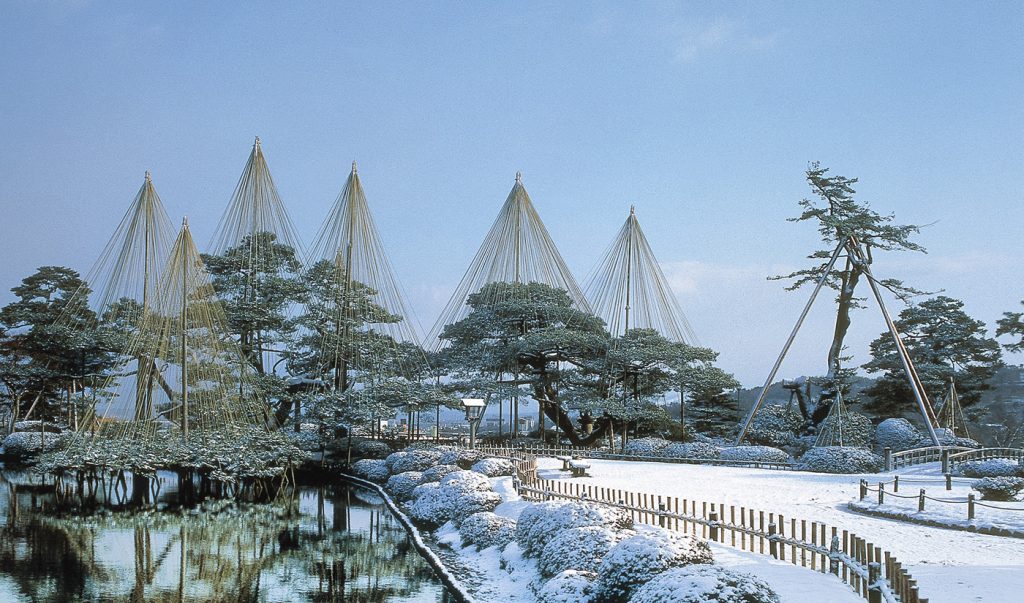
The construction of this garden started when the 5th lord of the Kaga Domain, Maeda Tsunanori, created Renchi-tei (a lotus pond and garden) in 1676. The construction continued over many years by the successive lords of the Kaga Domain. The garden was significantly renovated during the time of the 13th lord, Maeda Nariyasu, to draw water from a distant Tatsumi water channel to the pond. Diverse waterscapes including a waterfall, a meandering stream and a fountain were also added to the garden.
cultural property : historic sites and places of scenic beauty as natural monuments
type : places of special scenic beauty
1 Kenrokumachi, Kanazawa-shi, Ishikawa-ken 920-0936
Tel:076-221-5508
This is one of the Three Great Gardens of Japan. Its construction started when the 5th lord of the Kaga Domain, Maeda Tsunanori, created Renchi-tei (lotus pond and garden) in 1676. The construction continued over many years by the successive lords of the Kaga Domain. It was created by adopting the components of a stroll garden while utilizing garden techniques of various eras. The design takes advantage of the size of the site by placing a large pond in the middle, creating a Tsukiyama (artificial hill), and placing an arbor and a tea house where visitors can take a break while enjoying the garden. The foundation of the garden design came from Shenxian thought (ancient Chinese folk belief in the existence of immortal hermits in the mountain). A large pond was made to resemble the ocean, placing an island representing one where immortal mountain hermits would live, and adding various trees to create seasonal beauty.
The garden was significantly renovated during the time of the 13th lord, Maeda Nariyasu, to draw water from a distant Tatsumi water channel to the pond. Diverse waterscapes including a waterfall, a meandering stream and a fountain were also added to the garden.