
niigata」タグアーカイブ

Teikan-en

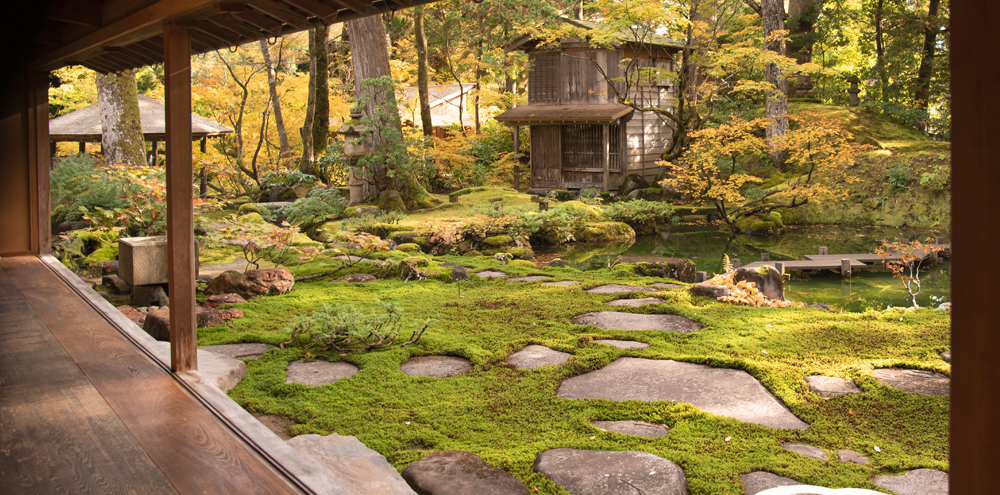
This is a garden with a grove and pond created in the mid-Edo Period. The landscaping method is from Kyoto, but local characteristics, such as an ample usage of Sado’s Akadama (red ball earth), can be seen in the garden. There are more than one hundred varieties of moss such as haircap moss (Polytrichum) and great scented liverwort (Conocephalum conicum) in the garden, and it is truly a rare moss garden only after Saiho-ji in Kyoto, which is famous for its moss garden.
cultural property : historic sites and places of scenic beauty as natural monuments 
type : places of scenic beauty, historic sites

593 Takayanagichō Okanomachi, Kashiwazaki-shi, Niigata-ken 945-1502
Tel:0257-41-2100

Home page : www.teikanen.jp/


This is a garden with a grove and pond from the mid-Edo Period. This was a garden of the Murayama Family, who was a powerful village headman. Kameishi, the 8th head of the family, invited Kudan Niemon and Fujii Tomonoshin, who were the gardeners retained by the Shogunate, to work on the landscape.
In 1843, Aizawa Nanjo, a Confucian scholar from Echigo, named the garden after a segment of a poetry by Xie Lingyun, who was a poet from the Six Dynasties of China. It reads “he leaves a traditional formal court dress behind and admires beautiful scenery of hills and valleys.” It is said that Xie Lingyun was a poet who often created poetries to admire the beauty of mountains and water with delicate expressions. There is a pond with waterfalls in front of a hall called Teikan-do. There are buildings such as tearooms called Kanbaku-tei, Yotsutoki-an, Hogetsu-ro and Kansui-ken, as well as numerous garden stones around the garden. It is in a Kyoto style of gardening as the Kobori Enshu style was implemented and it was modeled after the Katsura-rikyu palace, but the garden also has a local flavor such as an ample usage of Sado’s Akadama (red ball earth). There are more than one hundred varieties of moss such as haircap moss (Polytrichum) and great scented liverwort (Conocephalum conicum) in the garden, and it is truly a rare moss garden only after Saiho-ji in Kyoto, which is famous for its moss garden.

Garden of the Watanabe Family

It is said that it was built around the mid-Edo Period, but an actual date is unknown. A gardener of the Enshu-ryu style was invited from Kyoto to participate in the landscaping. The landscape of the garden from the mid-Edo Period is very well preserved and there is a pond shaped like the character for “heart (Kokoro).” The garden has a beautiful arrangement of Tsukiyama (artificial hills), dry waterfall, sandy beach, and stone lanterns around the pond, as well as an enclosure of the well in the north.


cultural property : historic sites and places of scenic beauty as natural monuments 
type : places of scenic beauty

904 Shimoseki, Sekikawa-mura, Iwafune-gun, Niigata-ken 959-3265
Tel:0254-64-1002

Home page : www.watanabetei.com


This was a garden in the residence of the Watanabe Family, who was a wealthy merchant, farmer and village headman in Echigo Shimonoseki. The garden is open to the east and there is a pond shaped like the character for “heart (Kokoro).” There is a writing with ink from 1769 on a ridge pole in the South Garden, thus it is presumed that the garden was made around that time. There are three Tsukiyama (artificial hills) in the west of the pond, named Ichinoyama (First Hill), Ninoyama (Second Hill) and Sannoyama (Third Hill). There is a stone of Fudo on Ichinoyama and it represents a dry waterfall. On the opposite side of the pond, in the east, there is a beach of round stones with numerous garden stones. Many stepping stones as well as some plants, that are liken to a crane and turtle, are also arranged. Visitors can enjoy views from season to season; white plum blossoms in spring, Japanese irises (Iris laevigata) in summer, Japanese maple in fall and a snowscape in winter.
The garden’s layout is the so-called Kyoto style as a stone lantern and enclosure of the well are tastefully arranged to add elegance to the garden.
The landscape of the garden from the mid-Edo Period is very well preserved and it is considered to be very important in the history of Japanese gardens as this is an example of the culture spreading from a large city to the countryside.

Kyu Shibata-han villa of the Mizoguchi Family(Shimizudani Palace)Daimyo garden

This is a Daimyo garden that represents Echigo (Niigata). It was built in the Genroku Era (1688-1704), as part of the Shimizudani Palace, a villa of the Mizoguchi Family. The villa itself was built in 1658 in the early Edo Period. Shimizudani Garden and nearby Ijimino-ochaya well preserve uniquely different gardens. They are valuable in the sense that they were built under the instructions of a leader of Buke Sado (the art of the tea ceremony of samurai families), who visited the sites frequently.


cultural property : historic sites and places of scenic beauty as natural monuments 
type : places of scenic beauty

7-9-32 Daieichō, Shibata-shi, Niigata-ken 957-0056
0254-22-2659


his garden was built at a villa of the Mizoguchi Family, who controlled the Kanbara Plain. The construction started in 1598, and the garden continued to evolve well into the Edo Period.
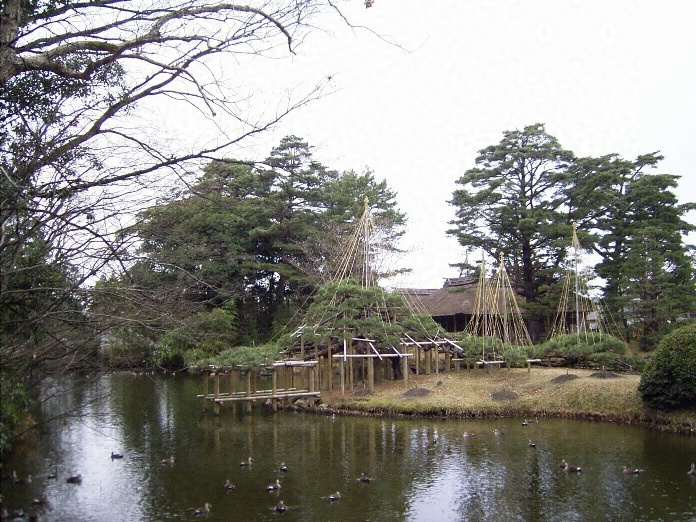
After building the Shimizudani Palace, the family invited Agata Sochi, a tea ceremony master of the Shogunate, to receive instructions for garden design, and completed Shimizudani and Ijimino Gardens as well as a garden at Hokke-ji during the Genroku Era (1688-1704). Shimizudani Garden is a stroll garden with a large pond at the center. A Tsukiyama (artificial hill) is located at the southern-most point of the garden, and the pond meanders at both sides to broaden the water surface. There are Suhama (a sandy beach) to the left and a stone arrangement representing a steep cape to the right at the pond shore. Large and small Nakajima (central islands) are placed in the pond, where an arbor is built in such a way that part of the structure  overcasts the water surface. The pond is narrower in the middle, which has the effect of broadening the front and back portions of the water surface. This is a good example of the layout of a Daimyo garden from the past.
Ijimino-ochaya is a villa of the lord, where he and his group made preparations for the alternate attendance in Edo. It was also open to senior statesmen as an amusement facility, such as a tea room. The garden places its focus on viewing plants, such as Japanese cedars (Cryptomeria japonica) and pines around the pond and on a gently-sloped Tsukiyama (artificial hill), Japanese white pines (Pinus parviflora) on Dejima (peninsula), and plum trees near the tea house. The garden is designed spaciously by placing only a few stone arrangements.