
 Saioku-ji Garden
「Tokai」カテゴリーアーカイブ
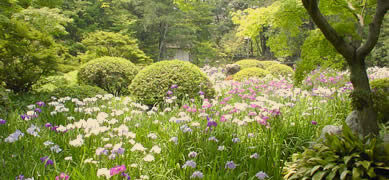
Eiho-ji Garden
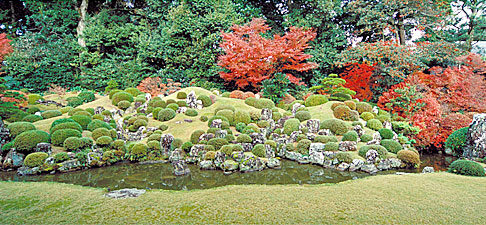
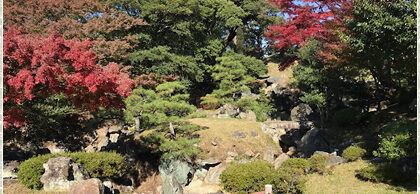
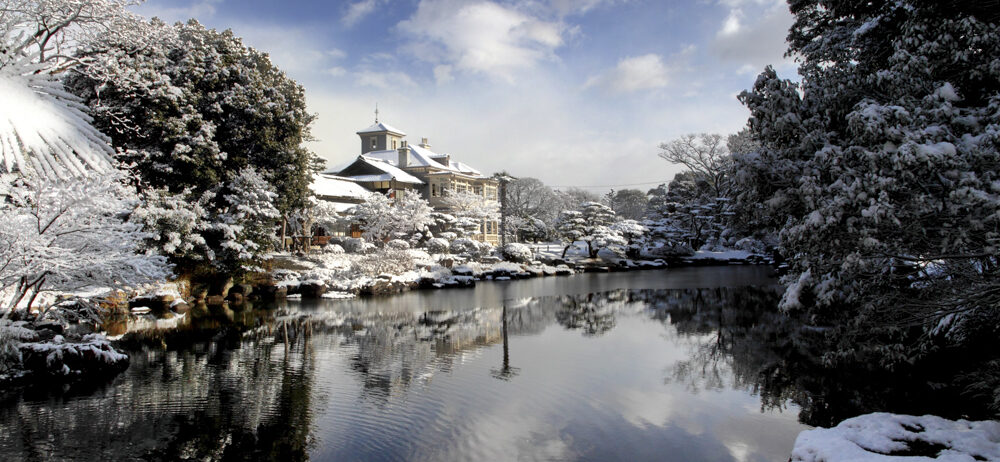
This is a garden with a pond as its main feature that covers the south side of Kan’non-do (a hall dedicated to the Goddess of Mercy) at Eiho-ji, located in Kokeizan-cho, Tajimi City. The garden is an excellent example of the style of Muso Soseki, the most representative gardener in the garden culture history of the Middle Ages in Japan. Views from any spot along the pond edge are outstanding. The garden is typical of the Zen-temple style of the Muromachi Period.
cultural property : historic sites and places of scenic beauty as natural monuments
type : places of scenic beauty
1-40 Kokeizanchō, Tajimi-shi, Gifu-ken 507-0014
Tel:0572-22-0351
This is a garden with a pond as its main feature that covers the south side of Kan’non-do (a hall dedicated to the Goddess of Mercy) at Eiho-ji, located in Kokeizan-cho, Tajimi City. After Muso Soseki founded the temple in 1314, the temple ground was improved and the garden was created as the temple added the Kan’non-do.
On the west of Kan’non-do, which is the main building of the temple, water falls from a rocky mountain “Bon’ongan” down its wall, to the pond built directly beneath the waterfall. There are two islands in the pond.
Musai-kyo, is a rainbow-shaped bridge that crosses the pond to Kan’non-do, ending directly in front of Kannon-do. The temple ground is flanked by Mt. Nagase’s hilly landscapes from north to west. From south to east, it is adjacent to the west bank of the winding flow of the Toki River. The garden creates outstanding scenery utilizing such natural landforms. The garden is an excellent example of the style of Muso Soseki, the most representative gardener in garden culture history of the Middle Ages in Japan. Views from any spot along the pond edge are outstanding. The garden is an example of the Zen-temple style of the Muromachi Period.
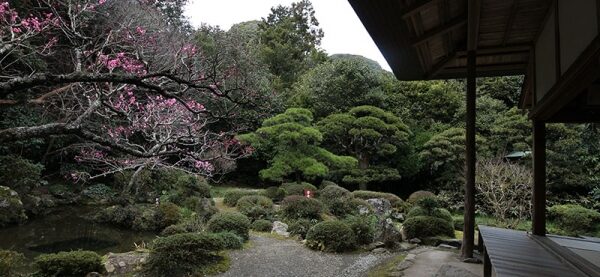
Saioku-ji Garden
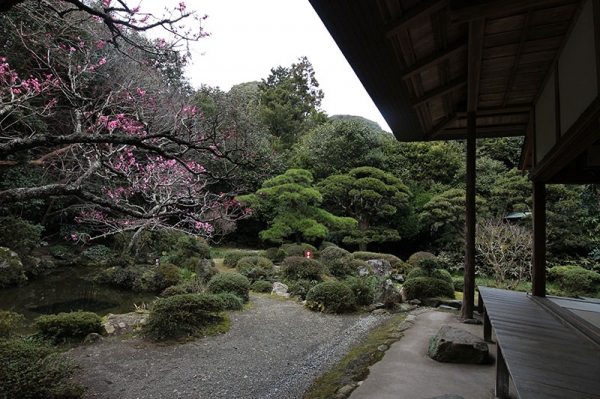
Saioku-ji was originally built as a thatched hut by Socho, a renga (linked poems) poet who worked for the Imagawa Family. Its garden was made by Socho himself. The garden was designated as a National Place of Scenic Beauty and Historic Site in 1936. In 1956, the areas around the waterfall and the front gate were added to the designation in order to protect the forests behind the temple as well as Mt. Tenchu, which is essential to the borrowed scenery.
cultural property : historic sites and places of scenic beauty as natural monuments
type : places of scenic beauty, historic sites
3316 Mariko, Suruga-ku, Shizuoka-shi, Shizuoka-ken 421-0103
Tel:054-259-3686
It is believed that renga poet, Socho, who worked for the Imagawa Family, built a thatched hut Saioku-ken in his later years, which Imagawa Ujichika renovated to a temple, Saioku-ji. It is also called Togeppo Saioku-ji. The garden was made by Socho, which is written about in his notes. West of the main temple building lies flat land where a small pond is situated and filled with fresh water springing from the north-eastern side.
A variety of trees are planted, and various Tateishi (vertical stones) are arranged along the edge of the pond. The garden utilizes Mt. Tenchu in the west as borrowed scenery.
The garden also has a moon-viewing stone, which is said to be a stone Socho would sit on to enjoy the moon. Behind the moon-viewing stone are the tombs of Socho and his teacher, Sogi, side by side. The garden had been designated as a Historic Site/Place of Scenic Beauty in 1936, but in order to protect the bamboo forest behind the temple and Mt. Tenchu—which is essential for the borrowed scenery—from changes of the environment surrounding Togeppo, the areas around the waterfall and the front gate were added to the designation in 1956.
Ryotan-ji Garden
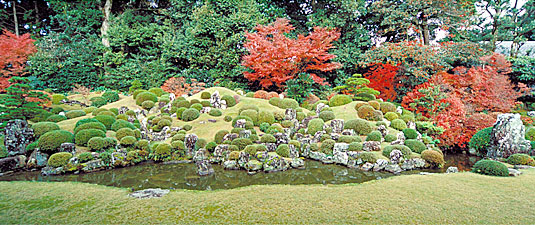
The garden is located north of the main hall of Ryotan-ji, a famous temple believed to have been founded by Gyoki. The garden was built by Kobori Enshu in the early Edo Period, and is considered to be an exemplary temple garden. Made of locally found chert, a number of its rock arrangements and a Tsukiyama, together represent a crane and a turtle.
cultural property : historic sites and places of scenic beauty as natural monuments
type : places of scenic beauty
1989 Inasachō Iinoya, Kita-ku, Hamamatsu-shi, Shizuoka-ken 431-2212
Tel:053-542-0480
Home page : www.ryotanji.com
The garden is located north of the main building of Ryotan-ji, which is believed to have been founded by Gyoki in the Nara Period. Its garden is an exemplary piece built by Kobori Enshu in the early Edo Period.
When viewed from the front, the garden has a pond in the center that is shaped like the Chinese character representing “heart” (Shinji-ike). The other side of the pond edge is a gently undulating Tsukiyama. On the Tsukiyama, various stone arrangements of locally found chert form a crane and a turtle. A guardian stone is installed halfway up, in the middle of the Tsukiyama. Nio-seki, two Tateishi (vertical stones) representing the Nio guardians, are situated on both sides of the pond. The front edge of the pond features a flat worshiping stone that faces the guardian stone across the pond. A number of dwarf azaleas are planted between the stone arrangements, and together with trees throughout the garden, create elegant and tasteful scenes that change over the seasons. Ryotan-ji also has a Karesansui (dry landscape) garden south of the main building. This garden depicts the Hamana Lake and represents Kan’non’s paradise, known as “Fudaraku.”
Rinzai-ji Garden
Rinzai-ji is a Zen temple of the Myoshin-ji group, Rinzai sect, and a family temple for the Imagawas. The garden is believed to have been created when Tokugawa Ieyasu rebuilt the main temple buildings during the Tensho Era. This stroll garden with a central pond consists of three levels by utilizing the slope of Mt. Shizuhata. The temple buildings and the garden are not open to the public except on two days per year, one in spring and another in fall.
cultural property : historic sites and places of scenic beauty as natural monuments
type : places of scenic beauty
7-1 Ōiwachō, Aoi-ku, Shizuoka-shi, Shizuoka-ken 420-0885
Tel:054-245-2740
Rinzai-ji is a guardian temple of Imagawa Ujiteru, a brother of Imagawa Yoshimoto. It is a Zen temple of the Myoshin-ji group of the Rinzai sect, and was founded when Yoshimoto’s senior strategist, Taigen Sessai invited Daikyu Zenji. It is believed that the garden was built when Tokugawa Ieyasu rebuilt the main temple buildings during the Tensho Period. This stroll garden with a central pond consists of three levels by utilizing the slope of Mt. Shizuhata behind the temple.
It is built by using a foothill slope of Mt. Shizuhata, which is used as borrowed scenery, north of the temple building. Water falls from the top of the cliff to recreate a valley and flows into the pond in front of the main study on the east side, which is elevated by one level. Water spilling from the eastern pond creates a waterfall flowing into the western pond.
Garden plantings consist mainly of Japanese red pines (Pinus densiflora), yews (Podocarpus macrophyllus var. maki), Japanese white pines (Pinus parviflora), and sago palms (Cycas revoluta). Between the main trees, Selaginella tarariscina plants are found in clusters, in addition to low-height dwarf azaleas (Rhododendron indicum). The temple buildings and the garden are not open to the public except on two days a year, one in spring and another in fall.
Nagoya castle Ninomaru Garden
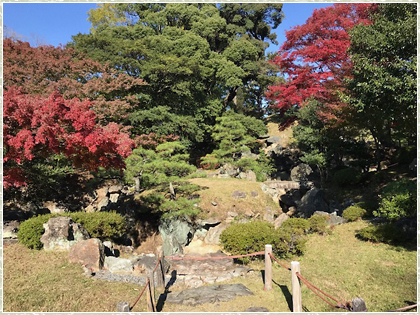
The garden was constructed at the north side of the Ninomaru Palace of the Nagoya Castle in early 17th century, sometime after the castle was built. Although the garden was re-worked during the Edo Period and Meiji Era, it is considered valuable as a castle garden with its Tsukiyama, large garden stones, and a waterfall arrangement using blue-green stones from the Edo Period.
cultural property : historic sites and places of scenic beauty as natural monuments
type : places of scenic beauty
1 Ninomaru, Naka-ku, Nagoya-shi, Aichi-ken 460-0032
Tel:052-231-1700
Home page : www.nagoyajo.city.nagoya.jp
The garden is located in Ninomaru, inside the Nagoya castle. It was significantly changed twice after its initial construction. The garden was first created during the construction of the Ninomaru Palace. It adopted Confucian philosophies which the first lord of the Owari Domain, Yoshinao, was inclined to. The image depicting the garden at the beginning of the Edo Period shows large stones and sparsely arranged Chinese-style buildings.
During the Bunsei Era (1818-1830), the tenth lord Saicho, who acceded to the Owari Domain from the Hitotsubashi Family, changed and expanded the garden into an authentic Japanese-style stroll garden with a central pond, a tea room, and a Tsukiyama. During the Meiji Era, the Japanese Imperial Army took over the site and the Edo-Period building and the garden were removed. However, the north-western section, which was the main feature of the garden, survived and a new front garden was built on its south side.
In 1953, the north-western section and front garden were designated as Places of Scenic Beauty. The excavation and literature research later found that the original garden site was preserved underground in good condition. Almost the entirety of the garden was additionally designated a Place of Scenic Beauty in 2018.
The Edo-Period features such as a Tsukiyama, large garden stones, and a waterfall arrangement using blue-green stones remain today. This is Japan’s largest of the gardens built at lords’ palaces.
Kyu Garden of Mr. Moroto
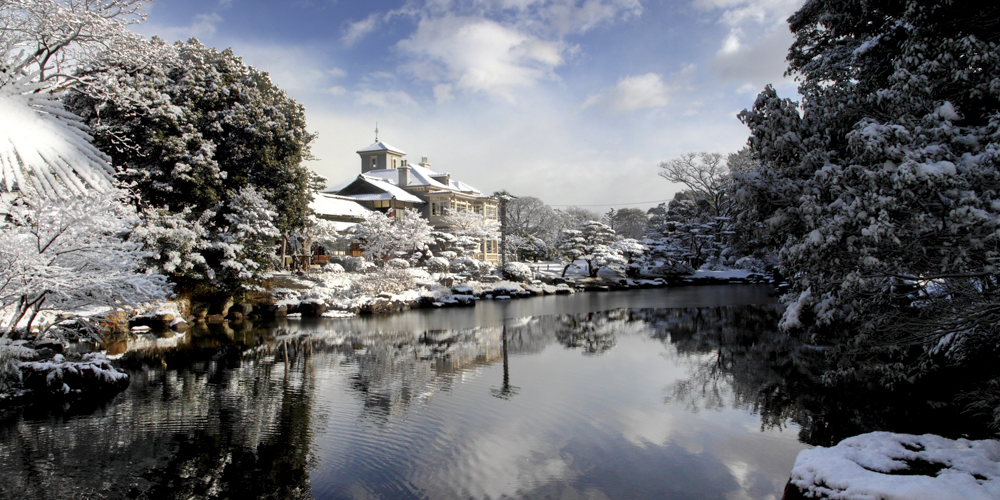
The site was completed in Karoto Shinden (currently Kisosaki-cho, Kuwana-gun, Mie Prefecture) in 1914 as a residence of the second Moroto Seiroku, who acceded to his family position as the village headman. The area spreads from east to west with a lawn, a garden pond, and a Tsukiyama that give depth to the garden, emphasizing its open space. The site holds extremely important academic value as a garden built by a wealty rural merchant in Japan’s modern times.
cultural property : historic sites and places of scenic beauty as natural monuments
type : places of scenic beauty
663−5 Kuwana, Kuwana-shi, Mie-ken511-0009
Tel:0594-24-4466
Home page : www.intsurf.ne.jp/~rokkam/
The site was completed in Karoto Shinden (currently Kisosaki-cho, Kuwana-gun, Mie Prefecture) in 1914 as a residence of the second Moroto Seiroku, who acceded to his family position as the village headman. The residence stands at the right-hand side of the Ibi River, which flows from south to east in the north-eastern section of Kuwana City, Gifu Prefecture. When walking through Nagaya-mon (a gate built into row houses – Nagaya – at the entrance of a high-ranking samurai) adjacent to the river bank, and proceeding along the walking path meandering to the left, visitors can see a Western-style building designed by Josiah Conder to the front, and a unique Japanese-style building to the west, which is connected to the first building. The main garden is located at the south of these buildings. The area spreads from east to west with a lawn, a garden pond, and a Tsukiyama that give depth to the garden, emphasizing its open space.
There is also an inner courtyard in the back of the Japanese-style building. This yard originally had a tea room and a tea garden. The tea room was transferred to another location in the early Showa Era. The tea garden no longer maintains its original form but the structural remains still exist. The site carries extremely important academic value as a garden built by a wealty rural merchant in Japan’s modern era.
Garden of Mr. Moroto
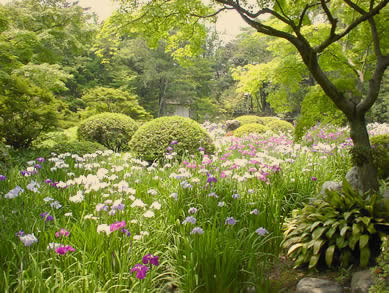
The garden was built in Karoto Shinden (currently Kisosaki-cho, Kuwana-gun, Mie Prefecture) in 1906 by the first Moroto Seiroku, who acceded to his family position as the village headman. The pond in the garden takes in water from a canal and is called a “tidal pond.” The pond originally created varying landscapes as the tide changed, but it no longer uses seawater.
cultural property : historic sites and places of scenic beauty as natural monuments
type : places of scenic beauty
18 Taichimaru, Kuwana-shi, Mie-ken 511-0005
Tel:0594-25-1004
Home page : www.moroto.jp
The garden was built in Karoto Shinden (currently Kisosaki-cho, Kuwana-gun, Mie Prefecture) in 1906, by the first Moroto Seiroku, who acceded to his family position as the village headman.
The garden mainly consists of two sections, which are the garden with a grove and a pond in front of the former Yamada residence, and the palace garden in front of the palace’s study. The west and north borders of the site are marked by a moat.
The garden of the former Yamada residence is a stroll garden centered around a shallow pond stretching east and west. In the mid-section of the pond, zigzag stone bridges are installed to connect the southern edge with Nakajima (the central island) and Mt. Sotetsu on the northern edge. Suiko-tei, which was built in the Edo Period, stands at the western edge of the pond. It is believed that the area around Suiko-tei includes the oldest features of the garden. The palace garden is meant to be viewed from a zashiki (a sitting room). It consists of a pond in the center in front of the study, and dynamic stone arrangements that remind viewers of a rough seashore or deep mountains protect the pond edges. The shore has two levels, and the sandy bottom level submerges and reappears depending on the tide.
The garden at the former Yamada residence retains many of its original characteristics, while the palace garden is valuable as a unique garden built by a wealthy rural merchant in Japan’s modern time.