
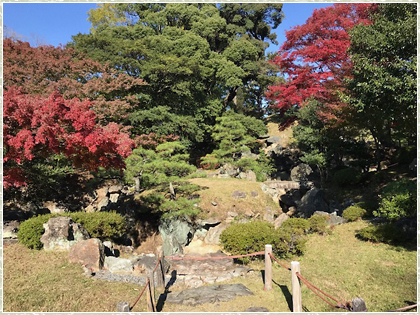
The garden was constructed at the north side of the Ninomaru Palace of the Nagoya Castle in early 17th century, sometime after the castle was built. Although the garden was re-worked during the Edo Period and Meiji Era, it is considered valuable as a castle garden with its Tsukiyama, large garden stones, and a waterfall arrangement using blue-green stones from the Edo Period.
cultural property : historic sites and places of scenic beauty as natural monuments
type : places of scenic beauty
1 Ninomaru, Naka-ku, Nagoya-shi, Aichi-ken 460-0032
Tel:052-231-1700
Home page : www.nagoyajo.city.nagoya.jp
The garden is located in Ninomaru, inside the Nagoya castle. It was significantly changed twice after its initial construction. The garden was first created during the construction of the Ninomaru Palace. It adopted Confucian philosophies which the first lord of the Owari Domain, Yoshinao, was inclined to. The image depicting the garden at the beginning of the Edo Period shows large stones and sparsely arranged Chinese-style buildings.
During the Bunsei Era (1818-1830), the tenth lord Saicho, who acceded to the Owari Domain from the Hitotsubashi Family, changed and expanded the garden into an authentic Japanese-style stroll garden with a central pond, a tea room, and a Tsukiyama. During the Meiji Era, the Japanese Imperial Army took over the site and the Edo-Period building and the garden were removed. However, the north-western section, which was the main feature of the garden, survived and a new front garden was built on its south side.
In 1953, the north-western section and front garden were designated as Places of Scenic Beauty. The excavation and literature research later found that the original garden site was preserved underground in good condition. Almost the entirety of the garden was additionally designated a Place of Scenic Beauty in 2018.
The Edo-Period features such as a Tsukiyama, large garden stones, and a waterfall arrangement using blue-green stones remain today. This is Japan’s largest of the gardens built at lords’ palaces.