
 Garden of Mr.Ito Denemon
「Kyushu, Okinawa」カテゴリーアーカイブ
Garden of Mr.Ito Denemon
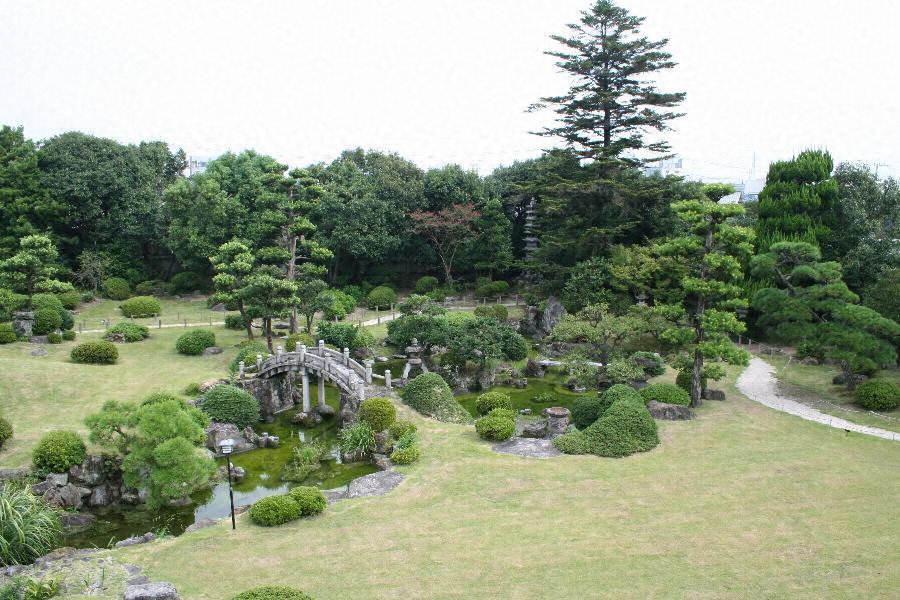
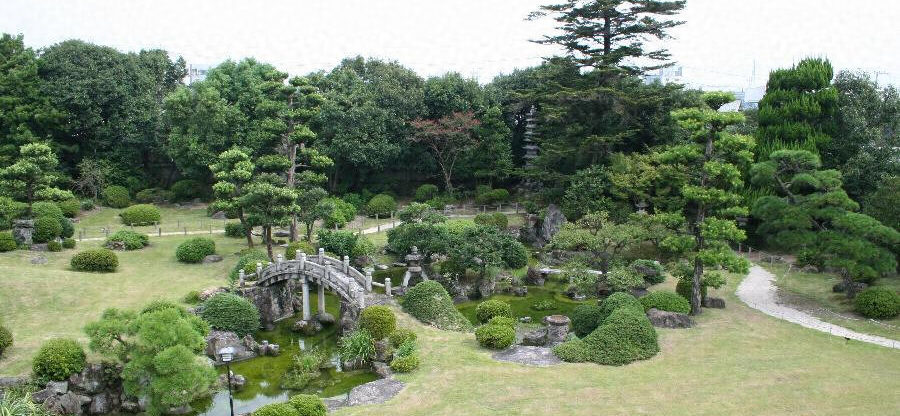
The garden was made by coal magnate, Ito Den’emon of Chikuho in the northern Kyushu, for his main residence. It consists of three sections: The entry to the entrance of the residence, two small courtyards between buildings including the main house, and a spacious garden with a pond encompassing the northern half of the land.
cultural property : historic sites and places of scenic beauty as natural monuments
type : places of scenic beauty
300 Kōbukuro, Iizuka-shi, Fukuoka-ken 820-0066
Tel:0948-22-9700
Home page : www.city.iizuka.lg.jp/shokokanko/kyoiku/leisure/kanko/dennemon/shite.html
Home page : www.kankou-iizuka.jp/denemon/
The garden was made by a coal magnate, Ito Den’emon of Chikuho in the northern Kyushu, for his main residence. While operating coal mines, Den’emon also completed two terms as a member of the Lower House of the Diet, where he worked to improve legal systems related to the mining industry and advanced the improvement works for the Onga River, where floods were recurring. Den’emon’s main residence, built on slightly higher ground close to the left levee in the midstream of the Onga River, added buildings as his coal mining business grew. In the early Taisho Era, the garden, with ponds on the north side of the main residence, was almost finished. By the early Showa Era, the buildings and gardens that remain today were mostly completed.
The garden largely consists of three areas: The entry section in front of the entrance of the residence where unique landscape design can be seen, two small courtyards made between the buildings, and a spacious garden with ponds built on the northern side of the land. The two ponds in the garden are equipped with fountain facilities made of granite (east) and tuff (west). All the streams of the garden have cement mortar floors, characteristics of garden design and structure that were popular in the early Showa Era.
Gyoraku-en of Mr.Fujie
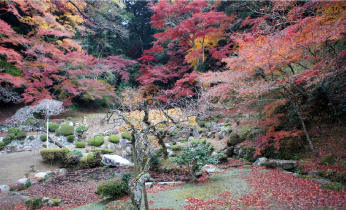
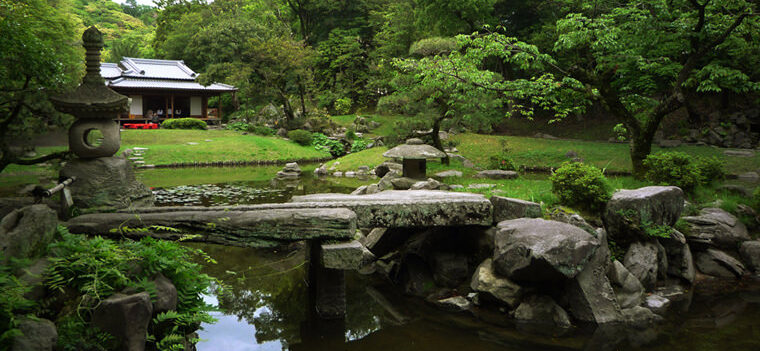
Although the date of its creation is not known, based on a record indicating that the garden was named in 1862, it is believed that the garden was built in the mid-Edo Period. The garden is situated at the foot of a mountain with a pond at the center. There is a waterfall stone arrangement placed in the part of the pond closer to the hill. The pond also features a Nakajima (central island) and three stone bridges.
cultural property : historic sites and places of scenic beauty as natural monuments
type : places of scenic beauty
6388 Amagi, Oaza Kawasaki-machi, Tagawa-gun, Fukuoka-ken 827-0001
Tel:0947-72-7777
It is thought that the name “Gyoraku-en” was taken from a verse of a Chinese book of poetry, “Major Festal Song,” by a scholar of Chinese classics, Murakami Butsuzan, in 1862 (the Bunkyu Era of the Edo Period). Although the date of its creation is not known, based on the record indicating the garden naming, it is believed that the garden was built in the mid-Edo Period.
The garden was built at the foot of a mountain based on the Shinsen Horai philosophy. The main feature of the garden is the pond, and an island representing Horai island is placed in the pond. A waterfall stone arrangement is placed closer to the mountain, and stone bridges are installed in three places. Maples, camelias, sweet osmanthus (Osmanthus fragrans), and Sago palms (Cycas revoluta) are planted around the pond, with azaleas around these trees. Visitors can enjoy a quiet view with forests of maples, Japanese red pines (Pinus densiflora), and Japanese cedars (Cryptomeria japonica) in the background. In 2018, the garden was hit by heavy rain in western Japan. It was extensively damaged and is currently impossible to visit. Reconstruction is expected.
Suizen-ji Joju-en
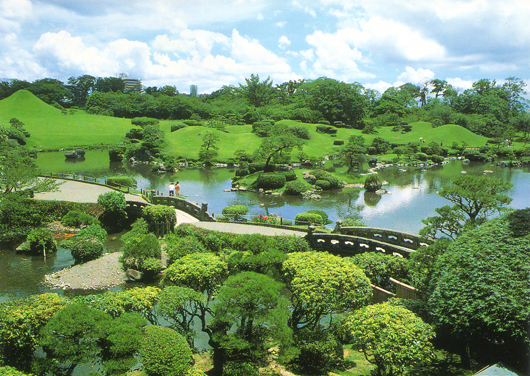
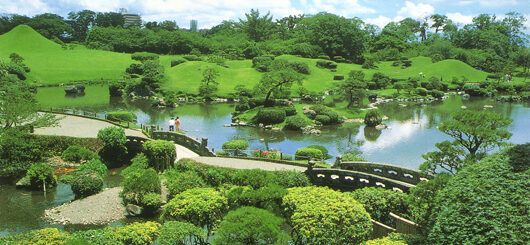
This is a Tsukiyama Sansui (mountain-and-water landscape) garden. A pond simulating a lake has a small island. In the back of a line of stepping stones, there is a gentle slope of a Tsukiyama (artificial hill). Clean spring water bubbles and flows freely into the pond. The garden’s name, “Joju-en” originates from “Gui Qu Lai Ci” (Come Away Home), a Chinese poem by Tao Yuanmng (365 – 427 CE).
cultural property : historic sites and places of scenic beauty as natural monuments
type : places of scenic beauty, historic sites
8-1 Suizenji Kōen, Chūō-ku, Kumamoto-shi, Kumamoto-ken 862-0956
Tel:096-383-0074
Home page : www.suizenji.or.jp
In 1632, Hosokawa Tadatoshi, the first lord of the Hosokawa Family (Higo Domain), enjoyed the area while he was practicing falconry and built a teahouse there. Later, the garden was completed during the era of Hosokawa Tsunatoshi, the third lord of the Hosokawa Family. It is a stroll garden and was named Joju-en based on “Gui Qu Lai Ci” (Come Away Home), a Chinese poem by Tao Yuanmng (365 – 427 CE). The garden features a pond simulating a lake that includes an island. In the back of the line of stepping stone, a gentle slope of a Tsukiyama (artificial hill) is created. Clean spring water bubbles and flows freely into the pond.
In the Genroku Era (1688 – 1707), many arbors were built and enjoyed. Due to the Horeki Reform (for the Domain’s fiscal reconstruction), however, all buildings except Suigetsu-tei were removed and of many kinds of trees, only pine trees remain now. When the Meiji Era began (in 1869), lands and people were returned to the emperor (“Hanseki Hokan”). The garden temporarily became government land. On the north side of the garden is the Izumi-jinja Shrine that honors the lords of the Hosokawa Family, including Hosokawa Tadaiju and Fujitaka.
Myokoku-ji Garden
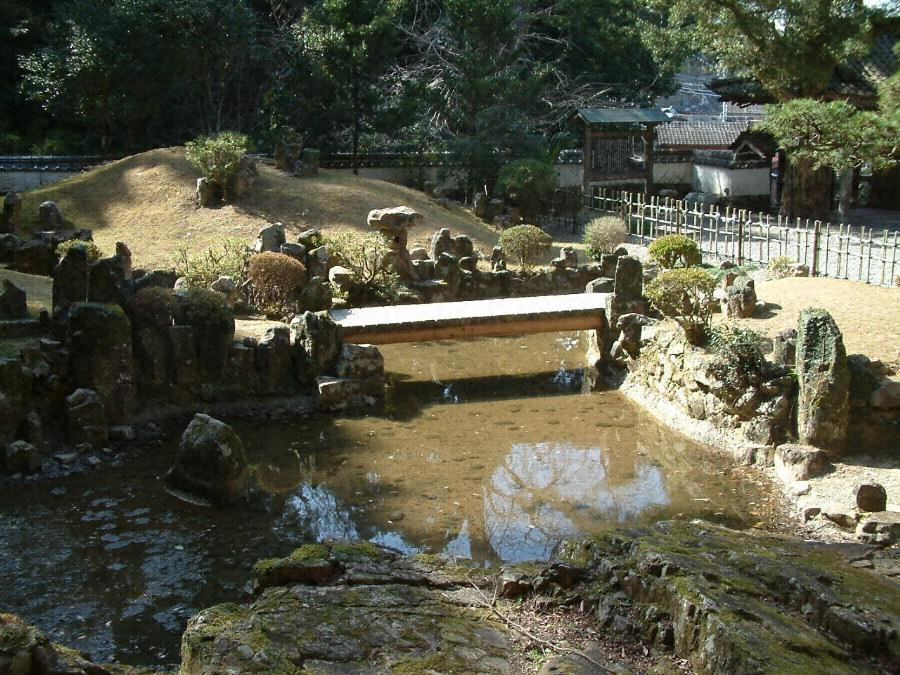
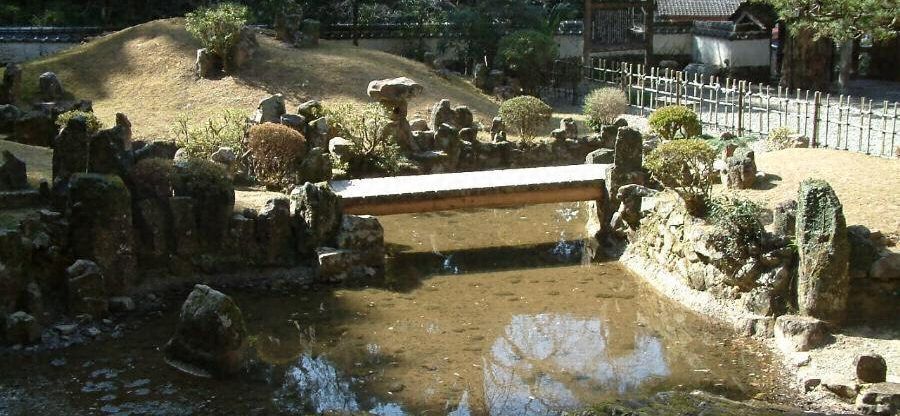
The garden is built at the south side of the Hondo (the main temple). With the natural forest of Komeno-yama mountain in the background as borrowed scenery, the garden features three Tsukiyama (artificial hills), a pond with a central island, a wooden bridge across the pond, and garden stones arranged at intervals. Chinquapins (Castanopsis sieboldii) grow thickly mixed with a few enormous Japanese red pines (Pinus densiflora) from the east to south of the garden.
cultural property : historic sites and places of scenic beauty as natural monuments
type : places of scenic beauty
373 Hososhima, Hyuga, Miyazaki 883-0001
Tel:0982-52-2486
Myokoku-ji is a famous temple of the Nichiren sect and is said to be founded by Satsuma Ajari Nichiren shonin (a Nichiren sect priest) in the Koei period (1342 – 1345). The garden is built at the south side of the Hondo (the main temple). From the east side to the south side, the garden includes an inclined plane at the foot of Komeno-yama mountain in the background, featuring three Tsukiyama (artificial hills), a central island at the center of a pond, and a wooden bridge across the pond. Various stones are arranged around the pond. Notably, standing stone arrangements surround the central island. On the east side of the pond, an inclined plane at the foot of the mountain is incorporated into the garden landscape. A granite wall makes up the narrow part of the inclined slope, forming a terrace allowing water from the mountain to flow into the garden. Water from the mountain flows directly down to the pond. The inclined plane where chinquapins (Castanopsis sieboldii) grow thickly mixed with a few enormousJapanese red pines (Pinus densiflora) give a sense of depth in the rather small garden.
Sengan-en Kekura Okari-ya Garden
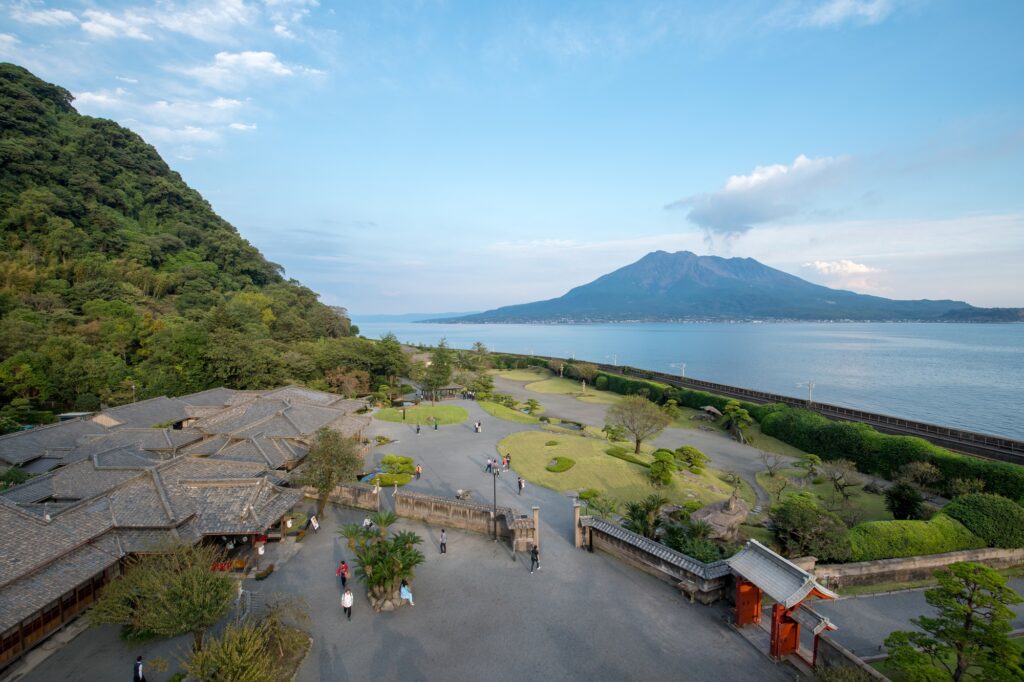
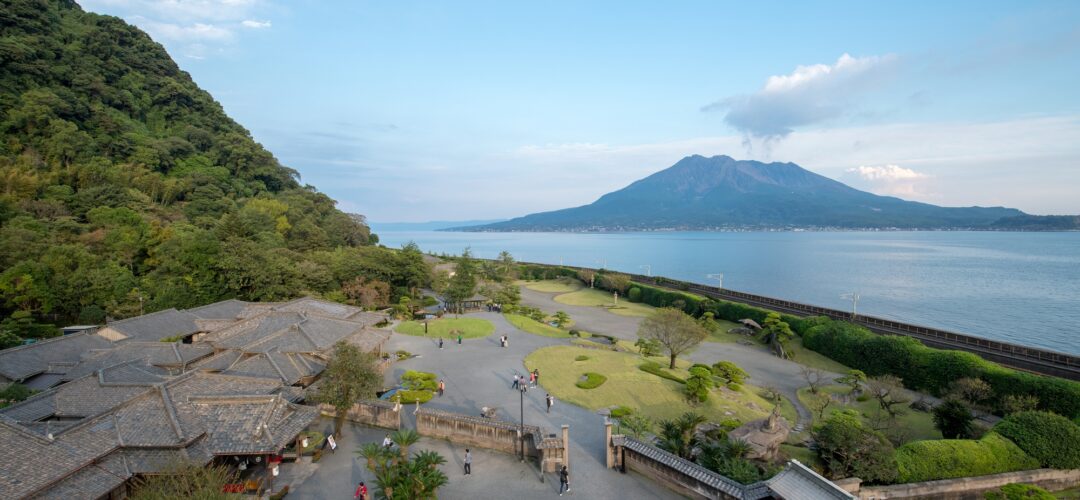
Sengan-en was a villa of the Shimazu Family, the lords of the Satsuma Domain. The garden is built at the bottom of the Isoyama Park with a thick broad-leaved forest on the north side. The south front side of the garden commands a panoramic view of Mt. Sakurajima across Kinko Bay. The waterfall, river wall of a mountain torrent, and splendid stone arrangements using boulders such as a stone bridge have been preserved without any major alteration.
cultural property : historic sites and places of scenic beauty as natural monuments
type : places of scenic beauty
9700-1 Yoshinochō, Kagoshima-shi, Kagoshima-ken 892-0871
Tel:099-247-1551
The garden originated in 1658, when an Okariya (rest house of shogun and lord) was built on the Oiso Shimotsu Hamamon mansion, which was the former residence of Karo (chief retainer) Kamata Izumo-no-kami as a villa of Shimazu Mitsuhisa, the 19th lord of the Shimazu Family. The name “Sengan-en” is said to originate from its resemblance to Ryuko-san-sengen (龍虎山仙巌), a scenic site in the Jiangxi Province in China.
The garden is built at the bottom of the Isoyama Park with a thick broad-leaved forest on the north. The south front side of the garden commands a panoramic view of Mt. Sakurajima across Kinko Bay. The garden occupies a wide two-terraced space in front of the building facing the ocean, featuring stone arrangements and stone lanterns. A partial reformation was carried out prior to the first year of the Meiji period. Since then the garden has remained almost intact without suffering from a major change.
Kekura Okari-ya is located approximately 500 meters east of Sengan-en. It was built as an annex of the Shimazu Family. The building survived only for a short period of time. However, the waterfalls, river wall of the mountain stream, stone arrangements using boulders such as stone bridges remained without significant alterations, conveying the landscapes of the end of Edo Period (1853 – 1869). (Kekura Okari-ya is currently not open to the general public.)
Tamasato residential garden of Mr. Shimazu
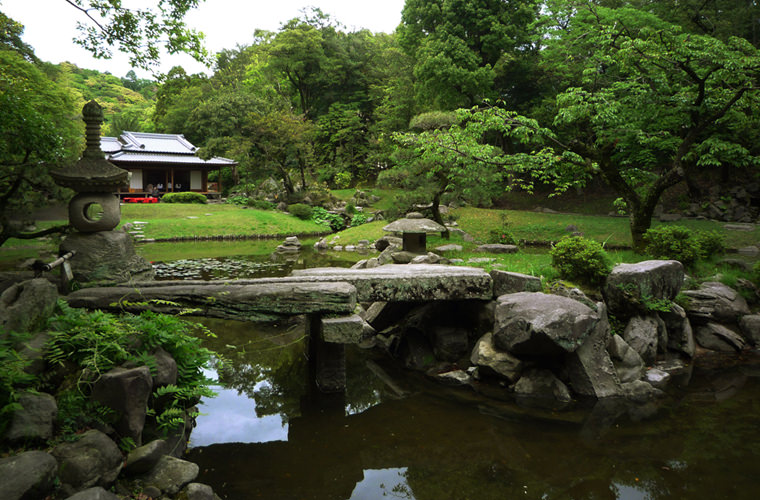
There is also a pond garden called “Ueoniwa” (upper garden) and a garden with a teahouse called “Shitaoniwa” (lower garden) at the western side on the lower level. Ueoniwa was built as a southern garden of a shoin (study) parlor. It features three Tsukiyamas and an oval pond on the east side. Shitaoniwa features a teahouse to the north, overlooking the wide pond garden on the south side.
cultural property : historic sites and places of scenic beauty as natural monuments
type : places of scenic beauty
27-20 Tamazatochō, Kagoshima-shi, Kagoshima-ken 890-0012
Tel:099-222-2627
Home page : www.tamazatotei-teien.jp
The garden is located at the west side of Atagoyama, the north hill in Kagoshima city. It is believed to have been built in 1835 by Shimazu Nariakira, the 27th lord of the Simazu Family. At the eastern side of the premises, there is a flat area where a group of main buildings once stood. A pond garden called “Ue-oniwa” (upper garden) was built there, and a garden with a teahouse called “Shita-oniwa” (lower garden) was built at the western side on the lower level. Ue-oniwa was built as the southern garden of a shoin (study) parlor, featuring three Tsukiyama (artificial hills) and an oval pond on the east side. Eroded beach stones were used in the arrangement of the stream flowing into the pond, simulating a mountain stream consisting of multiple branches. The central island is a turtle-shaped rock, which gave the pond its other name of “Kame-no-ike” (turtle pond). The teahouse commands a view of the mountains over trees toward the south. In the Shita-oniwa, a waterfall stream is created symbolizing a gorge on the east side of the teahouse, from which it flows around the southeast corner of the teahouse, goes under the big natural stone bridge, and becomes a waterfall flowing into the pond. The garden has a unique design, such as the central island, boulders, and a dozen of stone lanterns.
Shikina-en
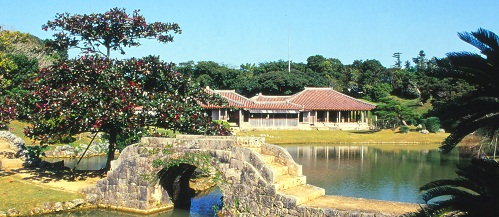
The garden was a villa of the former Ryukyu Kingdom. It was used for the royal family to retreat and to entertain foreign envoys. A spring-fed pond features two islands, and three Chinese-style bridges built across the pond. The plant landscape consists of both temperate and tropical plants. It is a stroll garden where different views can be enjoyed one after another by promenading along the path circling the pond.
cultural property : historic sites and places of scenic beauty as natural monuments
type : places of special scenic beauty
421-7 Maaji, Naha-shi, Okinawa-ken 902-0072
Tel:098-855-5936
Home page : www.city.naha.okinawa.jp/
It is a garden with a grove and a pond of a villa of the former Ryukyu Kingdom, which was built sometime prior to 1800. It was called Nan’en (south garden) because it was located to the south of Shuri-jyo castle. It was used for the royal family to retreat and to entertain foreign envoys.
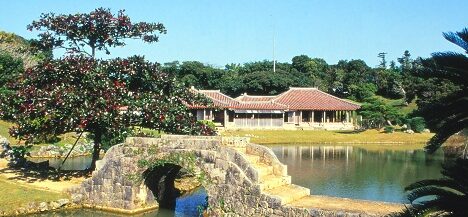
A spring-fed pond features two islands and three Chinese-style bridges. An observation deck called “Kanko-dai” is located at the southern edge of the garden, commanding a panoramic view.
The garden features temperate plants, such as pines, plums, willows, and crape myrtles, as well as tropical plants, such as common garcinias (Garcinia subelliptica), Javanese bishop wood (Bischofia javanica), and Indian coral trees (Erythrina variegata). They create a plant landscape with an illusion of four seasons in tropical Okinawa. Although it is a stroll garden, a garden style often used for a Daimyo (feudal lord) garden, it shows components unique to Ryukyu, such as an S-curved stone path to ward off majimun (evil spirits), who can only move in a straight line, an oddly-shaped rock that resembles Chinese Taihu stone (porous limestone), and “funa-ageba” (a boat lift yard) where a boat could be docked.
Garden of Mr.Ishigaki
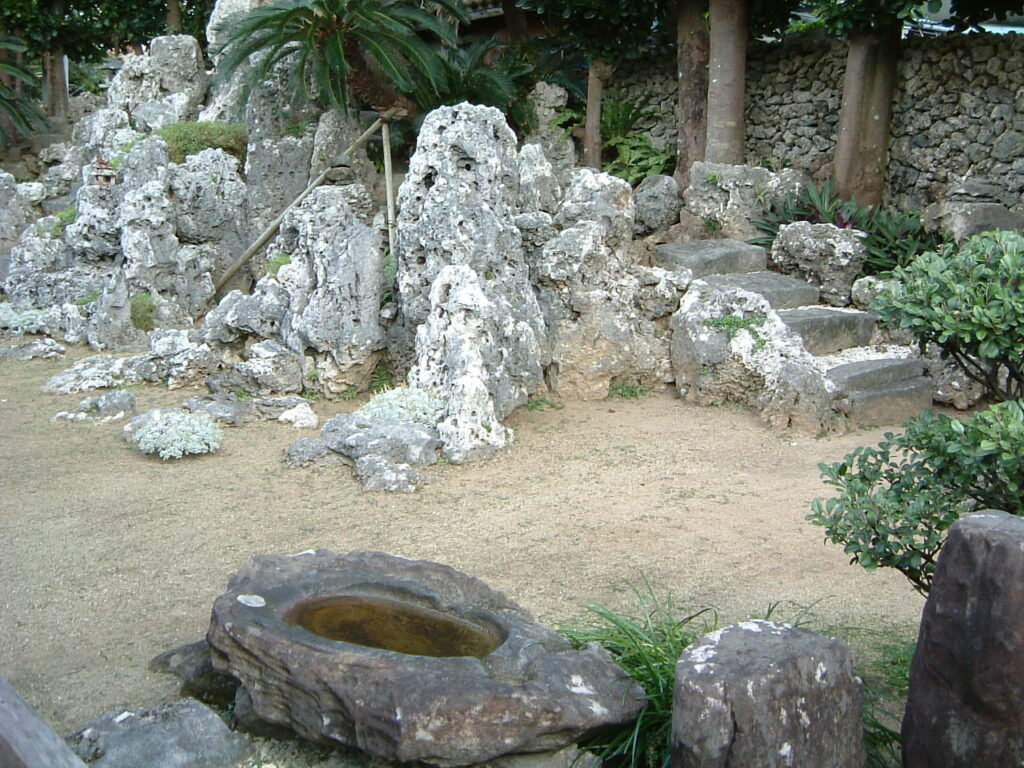
Peechin (rank order) Ohama, an ancestor of the Ishigaki Family, built the garden based on adesign by Peechin Gusukuma, a gardener in Shuri in 1819. Ryukyu limestone is the main stone used in the garden. Based on the style of the Japanese garden—such as five sets of stone arrangements that slope down from the north to south, a stone bridge, and a dry waterfall—the garden is a Karesansui (dry landscape) that incorporates local colors, for example, plantings of Sago palms (Cycas revoluta) on a Tsukiyama (artificial hill).
cultural property : historic sites and places of scenic beauty as natural monuments
type : places of scenic beauty
287 Arakawa, Ishigaki-shi, Okinawa-ken 907-0024
Tel:0980-82-2720
It is a garden of the Ishigaki Family located in Ishigaki City. The Ishigaki Family is an old family that produced appointed officials sent to administer the Ohama Magiri region in the Ryukyu Kingdom. The Ohama Magiri region includes the central area of Ishigaki Island, the western area of Iriomote Island, and Hateruma Island. It is not clear when the garden was built. Based on the description of the garden’s design specification, called “Niwa-zukuri-fushin-sho” (庭作不審書), which was handed down in the Ishigaki Family, it is estimated to have been created around 1819. It is believed that the garden was designed by Peechin (rank order) Gusukuma, a gardener in Shuri, the same gardener who also designed the garden of Miyara Dunchi (the residence of the government official in charge of the Miyara District).
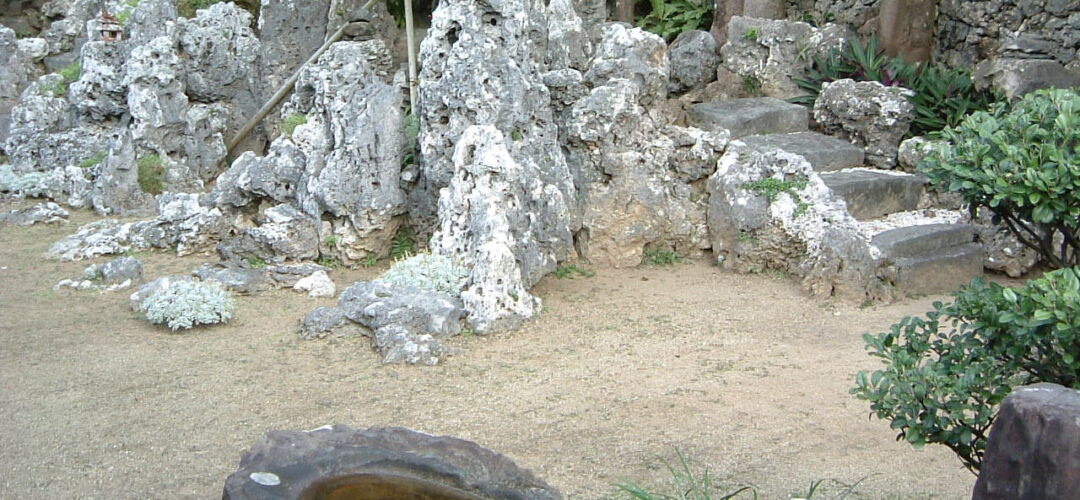
The garden is a Karesansui (dry landscape) garden that features Tsukiyama (artificial hills), five sets of stone arrangements that slope down from the north to south, a dry waterfall, and a stone bridge. The stone arrangements use Ryukyu limestones, natural stones that are locally produced. Plants native to the Yaeyama Islands, such as common garcinias (Garcinia subelliptica) and screw pines (Pandanus odorifer) are used in the plantings. The garden offers the atmosphere of a southern country.