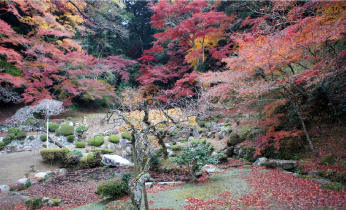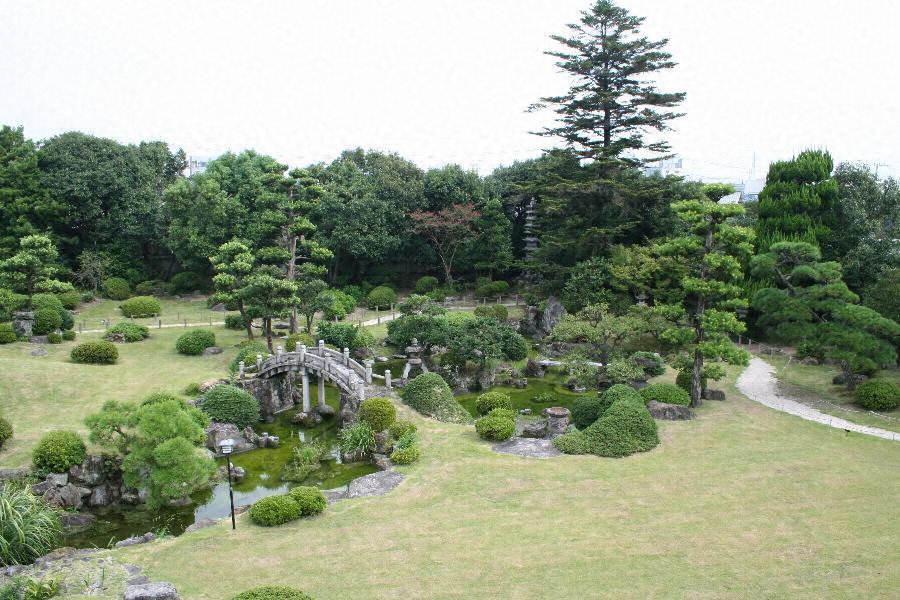
The garden was made by coal magnate, Ito Den’emon of Chikuho in the northern Kyushu, for his main residence. It consists of three sections: The entry to the entrance of the residence, two small courtyards between buildings including the main house, and a spacious garden with a pond encompassing the northern half of the land.
cultural property : historic sites and places of scenic beauty as natural monuments
type : places of scenic beauty
300 Kōbukuro, Iizuka-shi, Fukuoka-ken 820-0066
Tel:0948-22-9700
Home page : www.city.iizuka.lg.jp/shokokanko/kyoiku/leisure/kanko/dennemon/shite.html
Home page : www.kankou-iizuka.jp/denemon/
The garden was made by a coal magnate, Ito Den’emon of Chikuho in the northern Kyushu, for his main residence. While operating coal mines, Den’emon also completed two terms as a member of the Lower House of the Diet, where he worked to improve legal systems related to the mining industry and advanced the improvement works for the Onga River, where floods were recurring. Den’emon’s main residence, built on slightly higher ground close to the left levee in the midstream of the Onga River, added buildings as his coal mining business grew. In the early Taisho Era, the garden, with ponds on the north side of the main residence, was almost finished. By the early Showa Era, the buildings and gardens that remain today were mostly completed.
The garden largely consists of three areas: The entry section in front of the entrance of the residence where unique landscape design can be seen, two small courtyards made between the buildings, and a spacious garden with ponds built on the northern side of the land. The two ponds in the garden are equipped with fountain facilities made of granite (east) and tuff (west). All the streams of the garden have cement mortar floors, characteristics of garden design and structure that were popular in the early Showa Era.