
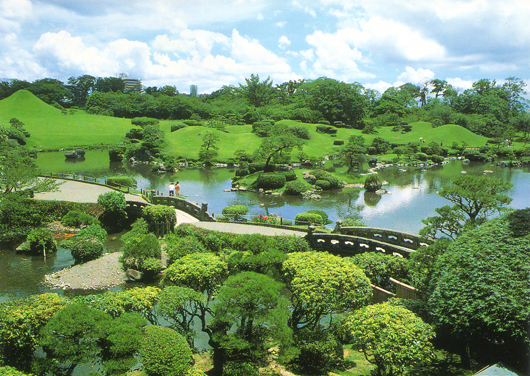
This is a Tsukiyama Sansui (mountain-and-water landscape) garden. A pond simulating a lake has a small island. In the back of a line of stepping stones, there is a gentle slope of a Tsukiyama (artificial hill). Clean spring water bubbles and flows freely into the pond. The garden’s name, “Joju-en” originates from “Gui Qu Lai Ci” (Come Away Home), a Chinese poem by Tao Yuanmng (365 – 427 CE).
cultural property : historic sites and places of scenic beauty as natural monuments
type : places of scenic beauty, historic sites
8-1 Suizenji Kōen, Chūō-ku, Kumamoto-shi, Kumamoto-ken 862-0956
Tel:096-383-0074
Home page : www.suizenji.or.jp
In 1632, Hosokawa Tadatoshi, the first lord of the Hosokawa Family (Higo Domain), enjoyed the area while he was practicing falconry and built a teahouse there. Later, the garden was completed during the era of Hosokawa Tsunatoshi, the third lord of the Hosokawa Family. It is a stroll garden and was named Joju-en based on “Gui Qu Lai Ci” (Come Away Home), a Chinese poem by Tao Yuanmng (365 – 427 CE). The garden features a pond simulating a lake that includes an island. In the back of the line of stepping stone, a gentle slope of a Tsukiyama (artificial hill) is created. Clean spring water bubbles and flows freely into the pond.
In the Genroku Era (1688 – 1707), many arbors were built and enjoyed. Due to the Horeki Reform (for the Domain’s fiscal reconstruction), however, all buildings except Suigetsu-tei were removed and of many kinds of trees, only pine trees remain now. When the Meiji Era began (in 1869), lands and people were returned to the emperor (“Hanseki Hokan”). The garden temporarily became government land. On the north side of the garden is the Izumi-jinja Shrine that honors the lords of the Hosokawa Family, including Hosokawa Tadaiju and Fujitaka.