
shizuoka」タグアーカイブ

Saioku-ji Garden

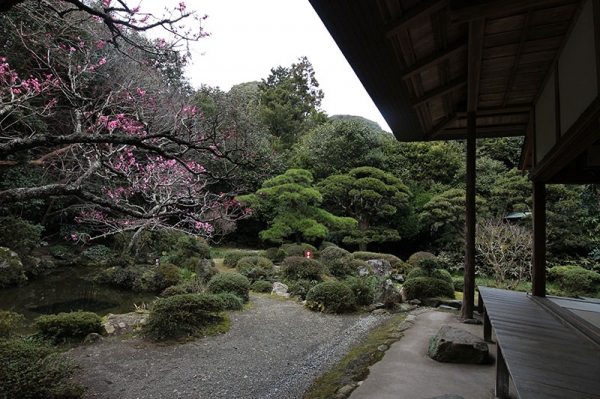
Saioku-ji was originally built as a thatched hut by Socho, a renga (linked poems) poet who worked for the Imagawa Family. Its garden was made by Socho himself. The garden was designated as a National Place of Scenic Beauty and Historic Site in 1936. In 1956, the areas around the waterfall and the front gate were added to the designation in order to protect the forests behind the temple as well as Mt. Tenchu, which is essential to the borrowed scenery.


cultural property : historic sites and places of scenic beauty as natural monuments 
type : places of scenic beauty, historic sites

3316 Mariko, Suruga-ku, Shizuoka-shi, Shizuoka-ken 421-0103
Tel:054-259-3686


It is believed that renga poet, Socho, who worked for the Imagawa Family, built a thatched hut Saioku-ken in his later years, which Imagawa Ujichika renovated to a temple, Saioku-ji.  It is also called Togeppo Saioku-ji. The garden was made by Socho, which is written about in his notes.  West of the main temple building lies flat land where a small pond is situated and filled with fresh water springing from the north-eastern side.
A variety of trees are planted, and various Tateishi (vertical stones) are arranged along the edge of the pond. The garden utilizes Mt. Tenchu in the west as borrowed scenery.
The garden also has a moon-viewing stone, which is said to be a stone Socho would sit on to enjoy the moon. Behind the moon-viewing stone are the tombs of Socho and his teacher, Sogi, side by side. The garden had been designated as a Historic Site/Place of Scenic Beauty in 1936, but in order to protect the bamboo forest behind the temple and Mt. Tenchu—which is essential for the borrowed scenery—from changes of the environment surrounding Togeppo, the areas around the waterfall and the front gate were added to the designation in 1956. 
Ryotan-ji Garden

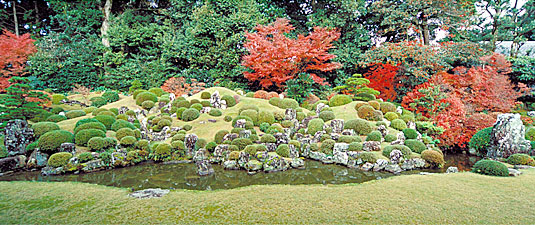
The garden is located north of the main hall of Ryotan-ji, a famous temple believed to have been founded by Gyoki. The garden was built by Kobori Enshu in the early Edo Period, and is considered to be an exemplary temple garden. Made of locally found chert, a number of its rock arrangements and a Tsukiyama, together represent a crane and a turtle.


cultural property : historic sites and places of scenic beauty as natural monuments 
type : places of scenic beauty

1989 Inasachō Iinoya, Kita-ku, Hamamatsu-shi, Shizuoka-ken 431-2212
Tel:053-542-0480

Home page : www.ryotanji.com


The garden is located north of the main building of Ryotan-ji, which is believed to have been founded by Gyoki in the Nara Period. Its garden is an exemplary piece built by Kobori Enshu in the early Edo Period.
When viewed from the front, the garden has a pond in the center that is shaped like the Chinese character representing “heart” (Shinji-ike). The other side of the pond edge is a gently undulating Tsukiyama.  On the Tsukiyama, various stone arrangements of locally found chert form a crane and a turtle. A guardian stone is installed halfway up, in the middle of the Tsukiyama. Nio-seki, two Tateishi (vertical stones) representing the Nio guardians, are situated on both sides of the pond. The front edge of the pond features a flat worshiping stone that faces the guardian stone across the pond. A number of dwarf azaleas are planted between the stone arrangements, and together with trees throughout the garden, create elegant and tasteful scenes that change over the seasons.  Ryotan-ji also has a Karesansui (dry landscape) garden south of the main building. This garden depicts the Hamana Lake and represents Kan’non’s paradise, known as “Fudaraku.”

Rinzai-ji Garden

Rinzai-ji is a Zen temple of the Myoshin-ji group, Rinzai sect, and a family temple for the Imagawas. The garden is believed to have been created when Tokugawa Ieyasu rebuilt the main temple buildings during the Tensho Era. This stroll garden with a central pond consists of three levels by utilizing the slope of Mt. Shizuhata. The temple buildings and the garden are not open to the public except on two days per year, one in spring and another in fall.


cultural property : historic sites and places of scenic beauty as natural monuments 
type : places of scenic beauty

7-1 Ōiwachō, Aoi-ku, Shizuoka-shi, Shizuoka-ken 420-0885
Tel:054-245-2740


Rinzai-ji is a guardian temple of Imagawa Ujiteru, a brother of Imagawa Yoshimoto. It is a Zen temple of the Myoshin-ji group of the Rinzai sect, and was founded when Yoshimoto’s senior strategist, Taigen Sessai invited Daikyu Zenji. It is believed that the garden was built when Tokugawa Ieyasu rebuilt the main temple buildings during the Tensho Period. This stroll garden with a central pond consists of three levels by utilizing the slope of Mt. Shizuhata behind the temple.
It is built by using a foothill slope of Mt. Shizuhata, which is used as borrowed scenery, north of the temple building.  Water falls from the top of the cliff to recreate a valley and flows into the pond in front of the main study on the east side, which is elevated by one level. Water spilling from the eastern pond creates a waterfall flowing into the western pond.
Garden plantings consist mainly of Japanese red pines (Pinus densiflora), yews (Podocarpus macrophyllus var. maki), Japanese white pines (Pinus parviflora), and sago palms (Cycas revoluta). Between the main trees, Selaginella tarariscina plants are found in clusters, in addition to low-height dwarf azaleas (Rhododendron indicum). The temple buildings and the garden are not open to the public except on two days a year, one in spring and another in fall.