
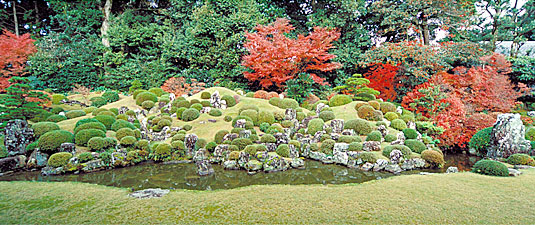
The garden is located north of the main hall of Ryotan-ji, a famous temple believed to have been founded by Gyoki. The garden was built by Kobori Enshu in the early Edo Period, and is considered to be an exemplary temple garden. Made of locally found chert, a number of its rock arrangements and a Tsukiyama, together represent a crane and a turtle.
cultural property : historic sites and places of scenic beauty as natural monuments
type : places of scenic beauty
1989 Inasachō Iinoya, Kita-ku, Hamamatsu-shi, Shizuoka-ken 431-2212
Tel:053-542-0480
Home page : www.ryotanji.com
The garden is located north of the main building of Ryotan-ji, which is believed to have been founded by Gyoki in the Nara Period. Its garden is an exemplary piece built by Kobori Enshu in the early Edo Period.
When viewed from the front, the garden has a pond in the center that is shaped like the Chinese character representing “heart” (Shinji-ike). The other side of the pond edge is a gently undulating Tsukiyama. On the Tsukiyama, various stone arrangements of locally found chert form a crane and a turtle. A guardian stone is installed halfway up, in the middle of the Tsukiyama. Nio-seki, two Tateishi (vertical stones) representing the Nio guardians, are situated on both sides of the pond. The front edge of the pond features a flat worshiping stone that faces the guardian stone across the pond. A number of dwarf azaleas are planted between the stone arrangements, and together with trees throughout the garden, create elegant and tasteful scenes that change over the seasons. Ryotan-ji also has a Karesansui (dry landscape) garden south of the main building. This garden depicts the Hamana Lake and represents Kan’non’s paradise, known as “Fudaraku.”