
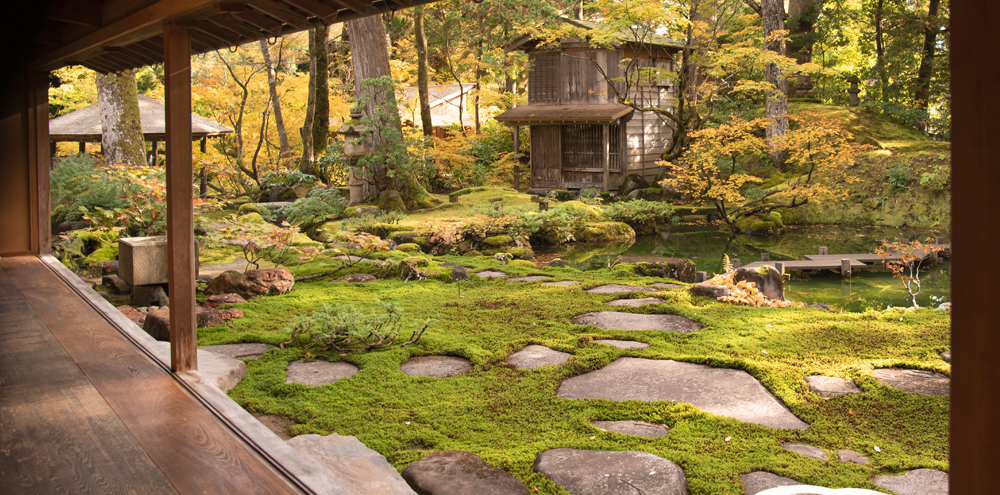
This is a garden with a grove and pond created in the mid-Edo Period. The landscaping method is from Kyoto, but local characteristics, such as an ample usage of Sado’s Akadama (red ball earth), can be seen in the garden. There are more than one hundred varieties of moss such as haircap moss (Polytrichum) and great scented liverwort (Conocephalum conicum) in the garden, and it is truly a rare moss garden only after Saiho-ji in Kyoto, which is famous for its moss garden.
cultural property : historic sites and places of scenic beauty as natural monuments
type : places of scenic beauty, historic sites
593 Takayanagichō Okanomachi, Kashiwazaki-shi, Niigata-ken 945-1502
Tel:0257-41-2100
Home page : www.teikanen.jp/
This is a garden with a grove and pond from the mid-Edo Period. This was a garden of the Murayama Family, who was a powerful village headman. Kameishi, the 8th head of the family, invited Kudan Niemon and Fujii Tomonoshin, who were the gardeners retained by the Shogunate, to work on the landscape.
In 1843, Aizawa Nanjo, a Confucian scholar from Echigo, named the garden after a segment of a poetry by Xie Lingyun, who was a poet from the Six Dynasties of China. It reads “he leaves a traditional formal court dress behind and admires beautiful scenery of hills and valleys.” It is said that Xie Lingyun was a poet who often created poetries to admire the beauty of mountains and water with delicate expressions. There is a pond with waterfalls in front of a hall called Teikan-do. There are buildings such as tearooms called Kanbaku-tei, Yotsutoki-an, Hogetsu-ro and Kansui-ken, as well as numerous garden stones around the garden. It is in a Kyoto style of gardening as the Kobori Enshu style was implemented and it was modeled after the Katsura-rikyu palace, but the garden also has a local flavor such as an ample usage of Sado’s Akadama (red ball earth). There are more than one hundred varieties of moss such as haircap moss (Polytrichum) and great scented liverwort (Conocephalum conicum) in the garden, and it is truly a rare moss garden only after Saiho-ji in Kyoto, which is famous for its moss garden.