
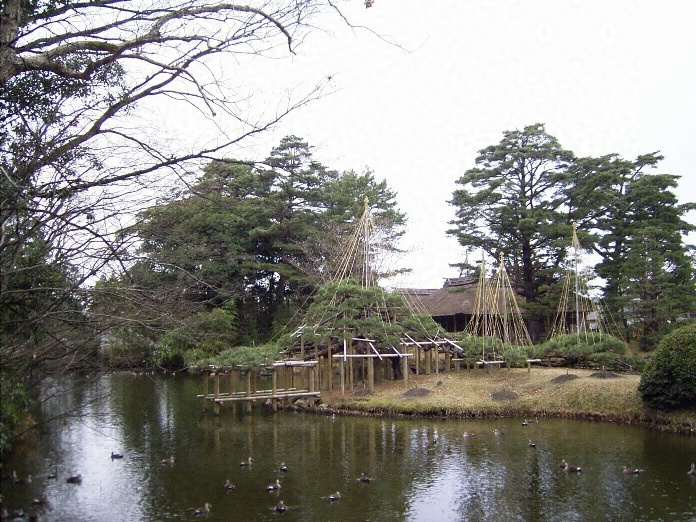
This is a Daimyo garden that represents Echigo (Niigata). It was built in the Genroku Era (1688-1704), as part of the Shimizudani Palace, a villa of the Mizoguchi Family. The villa itself was built in 1658 in the early Edo Period. Shimizudani Garden and nearby Ijimino-ochaya well preserve uniquely different gardens. They are valuable in the sense that they were built under the instructions of a leader of Buke Sado (the art of the tea ceremony of samurai families), who visited the sites frequently.
cultural property : historic sites and places of scenic beauty as natural monuments
type : places of scenic beauty
7-9-32 Daieichō, Shibata-shi, Niigata-ken 957-0056
0254-22-2659
his garden was built at a villa of the Mizoguchi Family, who controlled the Kanbara Plain. The construction started in 1598, and the garden continued to evolve well into the Edo Period.
After building the Shimizudani Palace, the family invited Agata Sochi, a tea ceremony master of the Shogunate, to receive instructions for garden design, and completed Shimizudani and Ijimino Gardens as well as a garden at Hokke-ji during the Genroku Era (1688-1704). Shimizudani Garden is a stroll garden with a large pond at the center. A Tsukiyama (artificial hill) is located at the southern-most point of the garden, and the pond meanders at both sides to broaden the water surface. There are Suhama (a sandy beach) to the left and a stone arrangement representing a steep cape to the right at the pond shore. Large and small Nakajima (central islands) are placed in the pond, where an arbor is built in such a way that part of the structure overcasts the water surface. The pond is narrower in the middle, which has the effect of broadening the front and back portions of the water surface. This is a good example of the layout of a Daimyo garden from the past.
Ijimino-ochaya is a villa of the lord, where he and his group made preparations for the alternate attendance in Edo. It was also open to senior statesmen as an amusement facility, such as a tea room. The garden places its focus on viewing plants, such as Japanese cedars (Cryptomeria japonica) and pines around the pond and on a gently-sloped Tsukiyama (artificial hill), Japanese white pines (Pinus parviflora) on Dejima (peninsula), and plum trees near the tea house. The garden is designed spaciously by placing only a few stone arrangements.