
ishikawa」タグアーカイブ

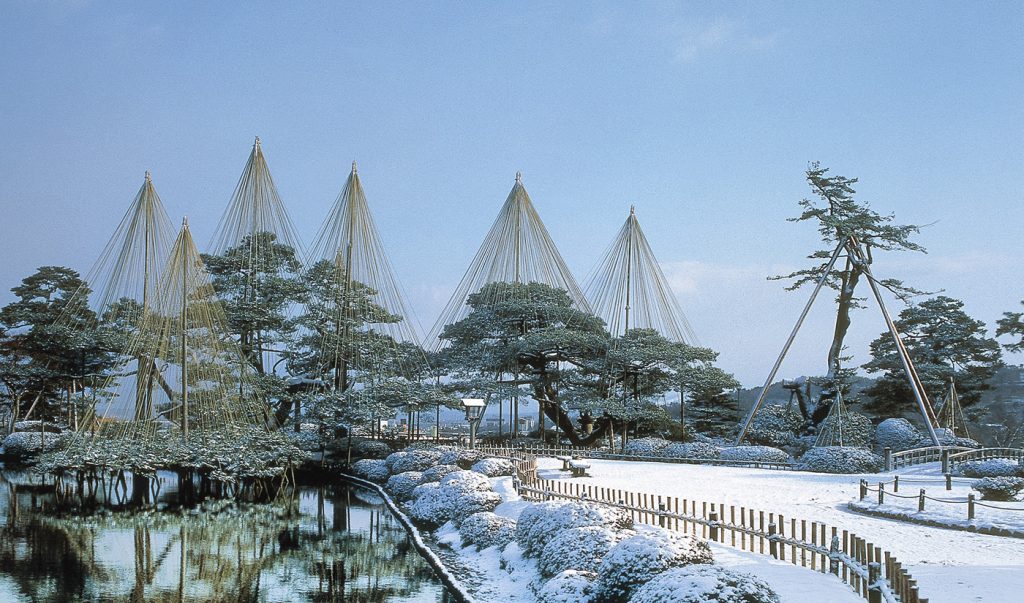
Kenroku-en

The construction of this garden started when the 5th lord of the Kaga Domain, Maeda Tsunanori, created Renchi-tei (a lotus pond and garden) in 1676. The construction continued over many years by the successive lords of the Kaga Domain. The garden was significantly renovated during the time of the 13th lord, Maeda Nariyasu, to draw water from a distant Tatsumi water channel to the pond. Diverse waterscapes including a waterfall, a meandering stream and a fountain were also added to the garden.
cultural property : historic sites and places of scenic beauty as natural monuments 
type : places of special scenic beauty

1 Kenrokumachi, Kanazawa-shi, Ishikawa-ken 920-0936
Tel:076-221-5508


This is one of the Three Great Gardens of Japan. Its construction started when the 5th lord of the Kaga Domain, Maeda Tsunanori, created Renchi-tei (lotus pond and garden) in 1676. The construction continued over many years by the successive lords of the Kaga Domain. It was created by adopting the components of a stroll garden while utilizing garden techniques of various eras. The design takes advantage of the size of the site by placing a large pond in the middle, creating a Tsukiyama (artificial hill), and placing an arbor and a tea house where visitors can take a break while enjoying the garden. The foundation of the garden design came from Shenxian thought (ancient Chinese folk belief in the existence of immortal hermits in the mountain). A large pond was made to resemble the ocean, placing an island representing one where immortal mountain hermits would live, and adding various trees to create seasonal beauty.
The garden was significantly renovated during the time of the 13th lord, Maeda Nariyasu, to draw water from a distant Tatsumi water channel to the pond. Diverse waterscapes including a waterfall, a meandering stream and a fountain were also added to the garden.

Seison-kaku Garden

It was built at the south of Kenroku-en as the main garden of Tatsumi Palace in 1863 (the Bunkyu Era of the Edo Period). From the end of the Shogunate throughout the Meiji and Taisho Eras to the Showa Era, the garden continued to be improved by adding a Tsukiyama (artificial hill) and rebuilding the waterway. It is a flat garden that has outstanding harmony with a clean stream.


cultural property : historic sites and places of scenic beauty as natural monuments 
type : places of scenic beauty

1-2 Kenrokumachi, Kanazawa-shi, Ishikawa-ken 920-0936
Tel:076-221-0580

Home page : www.seisonkaku.com


Seison-kaku Garden is adjacent to the south of Kenroku-en, a Special Place of Scenic Beauty. It originated in Tatsumi Palace and its main garden was built as a retirement villa for Shinryuin, mother of the 13th lord of the Kaga Domain, Maeda Nariyasu in 1863.
The main garden Hikaku-tei is a serene flat garden with a stream, facing Seika-ken with a study, a tea room and Mizuya (a washing place for a tea ceremony).
Tatsumi Palace was renamed to Seison-kaku in 1874. Around this time, water was drawn from the main garden to create a stream flowing through a courtyard facing the veranda of the “Corridor of Omoto (Japanese sacred lily),” and a Tsukiyama (artificial hill) was placed to create a serene landscape.
In 1909 (the Meiji Era), when Togu (Taisho Emperor) visited the Hokuriku area, a main gate, a carriage driveway, and an entrance were added to the front garden. Also, in the courtyard facing the veranda of the “Tsukushi-no Corridor,” the existing Noh stage was removed and the waterway from the main garden was changed from a straight line to a curve to create a simple landscape.  
It is said that the current Seison-kaku layout consisting of the main garden, courtyard, and front yard was completed in 1949.  It is a flat garden that has evolved over time to create outstanding harmony with a clean stream.

Kuri at Natadera temple Garden

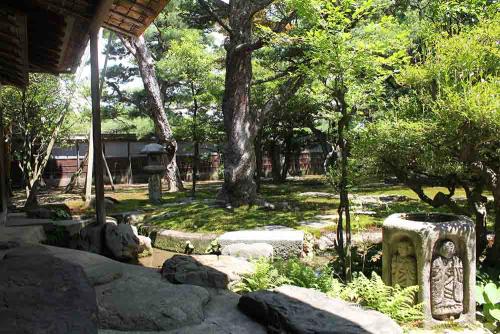
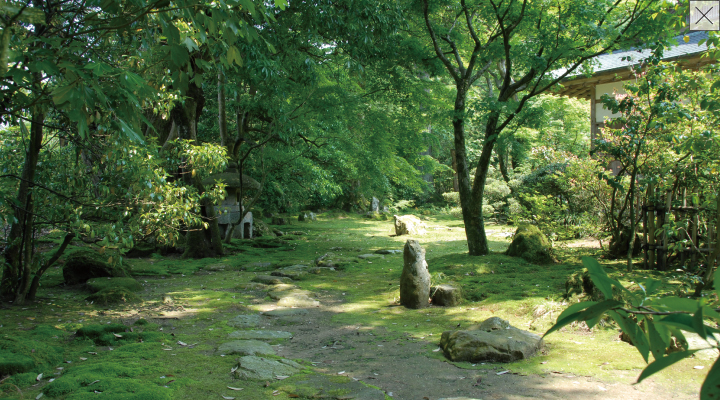
The garden was built at the same time as the construction of Kuri (living quarters of monks) at Natadera temple in 1635. Stepping stones are arranged from Nyoze-an (tea room) at the west side to a small pond at the east side, and rocks are placed at intervals. The garden also has old trees such as a large chinquapin (Castanopsis sieboldii) in the northern corner and tall Japanese cedars (Cryptomeria japonica) on the opposite side of the east pond. This is a garden with absolutely serene scenery.


cultural property : historic sites and places of scenic beauty as natural monuments 
type : places of scenic beauty

122 Natamachi yu, Komatsu-shi, Ishikawa-ken 923-0336
Tel:0761-65-2111

Home page : www.natadera.com/spot/#shointeien


Natadera is a well-known temple of the Shingon sect that is said to have been founded when Taicho Daishi placed a Thousand-armed Kan’non in a stone cave. The temple fell into ruin due to fires during the Azuchi and Momoyama Period, but it was reconstructed by the 3rd lord of the Kaga Domain, Maeda Toshitsune, in Kan’ei 1836. The garden and Kuri (living quarters of monks) were constructed at the same time. It is told that they received instructions from Kobori Enshu and a Commissioner of Garden Design, 別部ト斉, took charge of building the garden.
The main section is located in the north, behind the study and the main temple. Stepping stones are arranged to connect a tea room Nyoze-an in the northwest corner with the east garden along with a pond via the back of the study. Rocks are placed at intervals along the path. At the northeast of the garden and at the corner of the study, triad stones are arranged to create the main scenery of the garden.
Old trees densely grow in the garden, including a large chinquapin (Castanopsis sieboldii) at the north corner and tall Japanese cedars (Cryptomeria japonica) on the opposite side of the east pond. When a poet Matsuo Basho visited Natadera during his trip to Komatsu, he created a famous poem, “Autumn wind, whiter than white stones of the stone mountain.