
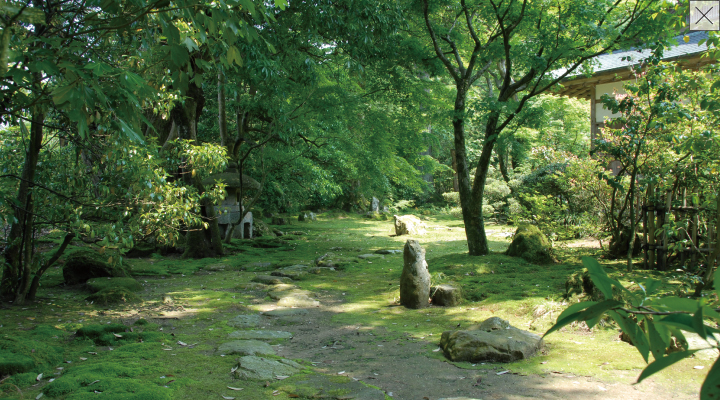
The garden was built at the same time as the construction of Kuri (living quarters of monks) at Natadera temple in 1635. Stepping stones are arranged from Nyoze-an (tea room) at the west side to a small pond at the east side, and rocks are placed at intervals. The garden also has old trees such as a large chinquapin (Castanopsis sieboldii) in the northern corner and tall Japanese cedars (Cryptomeria japonica) on the opposite side of the east pond. This is a garden with absolutely serene scenery.
cultural property : historic sites and places of scenic beauty as natural monuments
type : places of scenic beauty
122 Natamachi yu, Komatsu-shi, Ishikawa-ken 923-0336
Tel:0761-65-2111
Home page : www.natadera.com/spot/#shointeien
Natadera is a well-known temple of the Shingon sect that is said to have been founded when Taicho Daishi placed a Thousand-armed Kan’non in a stone cave. The temple fell into ruin due to fires during the Azuchi and Momoyama Period, but it was reconstructed by the 3rd lord of the Kaga Domain, Maeda Toshitsune, in Kan’ei 1836. The garden and Kuri (living quarters of monks) were constructed at the same time. It is told that they received instructions from Kobori Enshu and a Commissioner of Garden Design, 別部ト斉, took charge of building the garden.
The main section is located in the north, behind the study and the main temple. Stepping stones are arranged to connect a tea room Nyoze-an in the northwest corner with the east garden along with a pond via the back of the study. Rocks are placed at intervals along the path. At the northeast of the garden and at the corner of the study, triad stones are arranged to create the main scenery of the garden.
Old trees densely grow in the garden, including a large chinquapin (Castanopsis sieboldii) at the north corner and tall Japanese cedars (Cryptomeria japonica) on the opposite side of the east pond. When a poet Matsuo Basho visited Natadera during his trip to Komatsu, he created a famous poem, “Autumn wind, whiter than white stones of the stone mountain.