
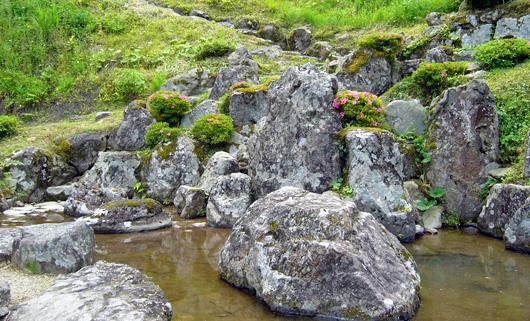
This is a collection of garden remains discovered along with the remnants of the Ichijodani Asakura Family historic site dating back to the Warring States Period during the excavation. They are located in Kidonouchi-cho, a southern suburb of Fukui City. Although the gardens are excavated remains, they are valuable materials that preserve the outstanding culture of warlords at the end of the Muromachi Period.
cultural property : historic sites and places of scenic beauty as natural monuments
type : places of special scenic beauty
28-37 Kidonouchicho, Fukui-shi, Fukui-ken 910-2153
Tel:0776-41-2173
Home page : www.fukuisan.jp/ja/asakura/index.html
This is a collection of gardens that were excavated along with building remains of the Warring States Period during the survey of the Ichijodani Asakura Family historic site. The site is located in the Kidonouchi community, in the southern suburb of Fukui City, that includes the Ichijodani River. The remains include three-dimensional stone (tuff breccia) arrangements with mountains as its background. A number of garden remnants include a garden with a grove and a pond where garden stone arrangements are placed around the pond, a simple and refined flat Karesansui (dry landscape) garden with a few Tateishi (standing stones)/Fuseishi (reclining stones) and pebbles, and more. The three gardens that belonged to the remains of Yudono, Suwa-yakata, Nan’yo-ji had stone arrangements exposed to the ground and had been known as outstanding gardens. They were designated as the Places of Scenic Beauty in 1930, but fell into ruin again. In 1967, the three gardens were improved by removing bushes and accumulated debris in the ponds. In 1987, stone channels and culverts for drawing water to the ponds were excavated at the remains of Yudono and Suwa-yakata. Four gardens have been excavated, and the one at the Yudono remains is believed to be the oldest, while the other three were built in the time of Asakura Yoshikage (1533-1573). Although these are excavated remains, they are valuable materials that preserve the outstanding culture of warlords at the end of the Muromachi Period.