fukui」タグアーカイブ

Garden of the Ito Family

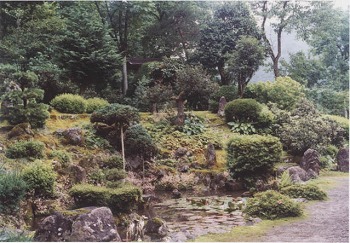
This garden was built by Ito Sukezaemon, doctor and head of the Ito Family who were the village headmen over multiple generations. The garden was designed based on a garden picture book that became popular during the Kyoho Era of the Edo Period. Since it well preserves the original state, it is an important piece not only for its esthetic value but also as historical material concerning gardens.


cultural property : historic sites and places of scenic beauty as natural monuments 
type : places of scenic beauty

29−2 Seto, Minamiechizen-cho, Nanjo- gun, Fukui-ken 919-0113

Home page : www.town.minamiechizen.lg.jp/kurasi/103/128/p001179.html


This garden was designed based on a garden design book “Tsukiyama-niwatsukuri-den,” which was compiled and became popular from the mid- to late Edo Period. It was built by Ito Sukezaemon, doctor and the 10th head of the Ito Family who were the village headmen over multiple generations.
The garden features the principal stone on the front Tsukiyama (artificial hill), a lotus stone in the front, a mountain slope stone to the right, and a stone of Fudo to the left. A Dejima (peninsula), Nakajima (central island), Funaishi (boat stone) and a stone bridge are placed in the garden pond at the foot of the Tsukiyama.The pond shore along the building has a worshipping stone in the middle and two deity stones on both ends. This is a Tsukiyama garden with a grove and a pond that is meant to be viewed while sitting in the building. An enormous Japanese yew (Taxus cuspidata) grows at the east side of the garden, and maples, rhododendrons, and sasanquas are planted throughout.
The garden is believed to have preserved the original state, and visitors can see the authentic design of a traditional Japanese garden as it faithfully followed the instructions of the garden design book at the time.
Jofuku-ji Garden

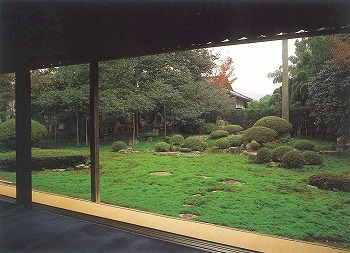
The garden was built at Kuri (living quarters of monks) of Jofuku-ji, a temple of the Izumoji school of the Shin sect, in the mid-Edo Period. It is a Karesansui garden at the south of the temple and uses the view of Mt. Fumuro and other Hino mountains as borrowed scenery over the front hedge. The garden is an excellent example of landscape techniques during the mid-Edo Period.


cultural property : historic sites and places of scenic beauty as natural monuments 
type : places of scenic beauty

11-26 Gobuichichō, Echizen-shi, Fukui-ken 915-0026
Tel:0778-27-1773


This is a garden built for Kuri (living quarters of monks) at Jofuku-ji, a temple of the Izumoji school (the Shin sect), in the mid-Edo Period. It is told that Jofuku-ji and its precinct were relocated to the current location in 1624.
The garden is located at the south of the Kuri. It is a Karesansui (dry landscape) garden with borrowed scenery of the Hino mountains, such as Mt. Fumuro,  which can be enjoyed over the front hedge. The garden well preserves landscape techniques of the mid-Edo Period.
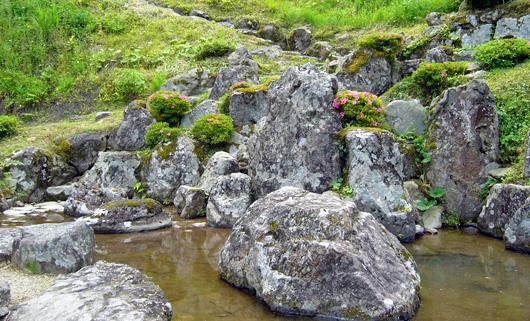
A low Tsukiyama (artificial hill) is placed at the south of the study, and the principal stone is installed  at the center of the Tsukiyama. The foot of the Tsukiyama has flat stone arrangements representing the pond shore, and Tateishi (standing stones) are placed as deity stones on both ends.
The area in the front is flat and covered with moss. The worshipping stone is located at the center, and a turtle island, a crane island, and a boat island are arranged in the area.
The Tsukiyama has a large tree of false holly (Osmanthus heterophyllus) on top.
There are not many materials that indicate when the garden was built, but it is a good example of a flat Karesansui garden created in the mid-Edo Period.

Garden of the Ichijōdani Asakura Family

This is a collection of garden remains discovered along with the remnants of the Ichijodani Asakura Family historic site dating back to the Warring States Period during the excavation. They are located in Kidonouchi-cho, a southern suburb of Fukui City. Although the gardens are excavated remains, they are valuable materials that preserve the outstanding culture of warlords at the end of the Muromachi Period.


cultural property : historic sites and places of scenic beauty as natural monuments 
type : places of special scenic beauty

28-37 Kidonouchicho, Fukui-shi, Fukui-ken 910-2153
Tel:0776-41-2173

Home page : www.fukuisan.jp/ja/asakura/index.html


This is a collection of gardens that were excavated along with building remains of the Warring States Period during the survey of the Ichijodani Asakura Family historic site. The site is located in the Kidonouchi community, in the southern suburb of Fukui City, that includes the Ichijodani River. The remains include three-dimensional stone (tuff breccia) arrangements with mountains as its background. A number of garden remnants include a garden with a grove and a pond where garden stone arrangements are placed around the pond, a simple and refined flat Karesansui (dry landscape) garden with a few Tateishi (standing stones)/Fuseishi (reclining stones) and pebbles, and more. The three gardens that belonged to the remains of Yudono, Suwa-yakata, Nan’yo-ji had stone arrangements exposed to the ground and had been known as outstanding gardens. They were designated as the Places of Scenic Beauty in 1930, but fell into ruin again. In 1967, the three gardens were improved by removing bushes and accumulated debris in the ponds. In 1987, stone channels and culverts for drawing water to the ponds were excavated at the remains of Yudono and Suwa-yakata. Four gardens have been excavated, and the one at the Yudono remains is believed to be the oldest, while the other three were built in the time of Asakura Yoshikage (1533-1573). Although these are excavated remains, they are valuable materials that preserve the outstanding culture of warlords at the end of the Muromachi Period.

Garden of the Umeda Family

This is a garden with a grove and a pond at the residence of the Umeda Family, a local ruling family who were the powerful village headmen of Ikeda-go. The garden features old growth of Japanese cedars (Cryptomeria japonica), Japanese red pines (Pinus densiflora), and Japanese firs (Abies firma) with Mt. Takao and Mt. Atago as borrowed scenery, creating a serene landscape. The garden preserves the characteristic features of the late Muromachi Period, and is important for understanding the diffusion of garden culture in this region.


cultural property : historic sites and places of scenic beauty as natural monuments 
type : places of scenic beauty

33-8-1 Taniguchi, Ikeda-machi, Imadate District, Fukui-ken 910-2503
Tel:0778-44-6106

Home page : https://umeda-teien.jp


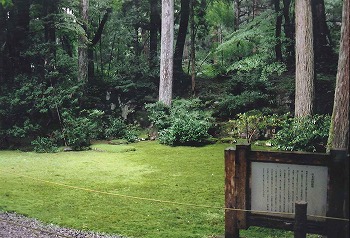
This is a garden with a grove and a pond at the residence of the Umeda Family, a local ruling family who were the powerful village headmen of Ikeda-go. The garden features a curved pond in the front, and water-crossing stones and a natural stone bridge are placed in the middle of the pond. A waterway is drawn from the far right, which is then divided into two streams to form waterfalls on both sides of Nakajima (a central island). A large boulder is placed at the front left as the center of the scenery, and stones are arranged at key points around the boulder. The streams and the pond have edges protected by stone arrangements. Large stepping stones are placed between the building and the pond at wide intervals.
There is a high mountain to the right, and the far-left section of the garden has old growth of Japanese cedars (Cryptomeria japonica), Japanese red pines (Pinus densiflora), and Japanese firs (Abies firma) with Mt. Takao and Mt. Atago as borrowed scenery. Many parts of the garden are covered with moss, creating a mystic landscape. The garden preserves the characteristic features of the late Muromachi Period, and is important for understanding the diffusion of garden culture in this region.

Takidan-ji Garden

This garden belongs to a temple of the Chizan school (the Shingon sect) built in 1375 during the Eiwa Era of the period of the Northern and Southern Dynasties. The garden itself was believed to have been made between the Keicho Era and the mid-Edo Period. It is built on a hillside, and each of its four sides is designed to serve as a front.


cultural property : historic sites and places of scenic beauty as natural monuments 
type : places of scenic beauty

1-7-15 Mikunichō Takidani, Sakai-shi, Fukui-ken 913-0054
Tel:0776-82-0216


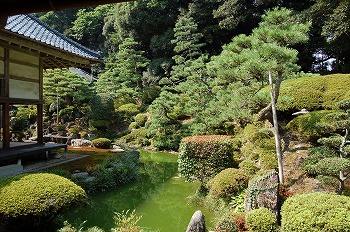
Takidan-ji is a temple of the Chizan school (the Shingon sect) founded in 1375 during the period of the Northern and Southern Dynasties. The garden stretches from the main temple to the study, and is a Sansui (mountain-and-water) garden that utilizes the south hillside at the north of the main temple.
This garden is unique in a way that all sides are designed to be the front. A pond was made by curbing an exposed rock at the foot of the slope in the front of the building. Viewing the pond from the building, visitors can see large chinquapins (Castanopsis sieboldii), Japanese firs (Abies firma), and Japanese umbrella trees (Sciadopitys verticillata) in the back as well as old pines scattering on the front slope. Azaleas that are trimmed low are planted among the pines. There are also rocks with lanterns on top.
Takidan-ji has old buildings such as Chinju-do (a hall of Tutelary Deities of Land). Literature related to the temple and a number of cultural properties including a Buddhist sound instrument (金銅毛彫宝相華唐草文磬; National Treasure) and statues of Buddha are displayed in the repository.

Seifuku-ji Shoin Garden

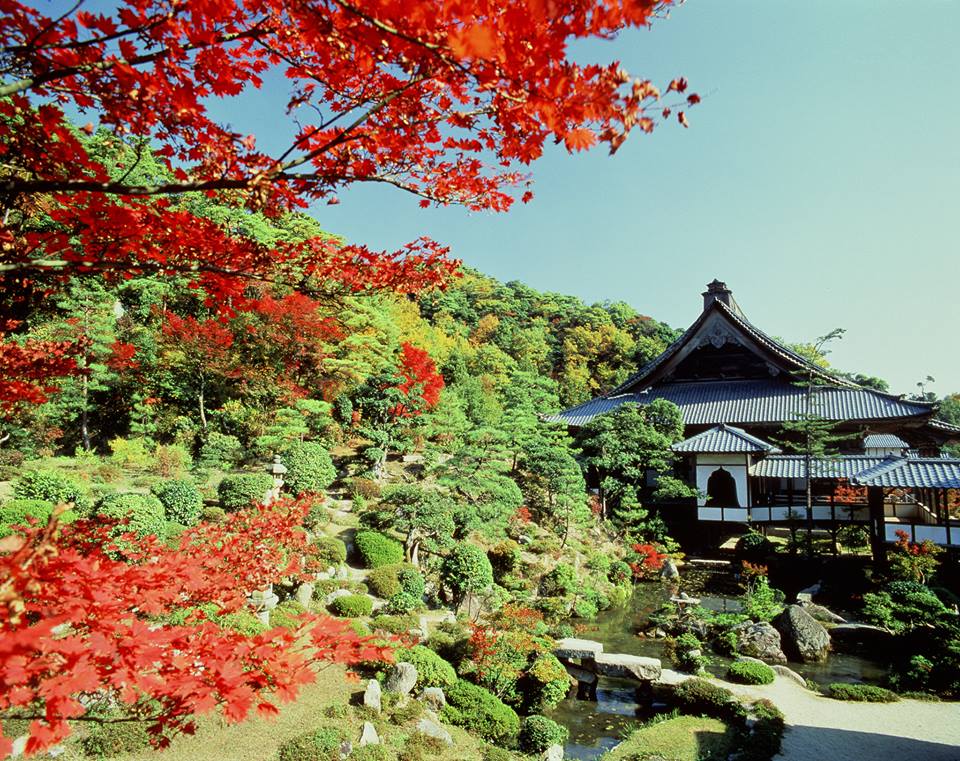
This is a garden at Seifuku-ji, a temple said to have been founded by Ryonyo Shonin of the Chinzei school of the Jodo sect. Although the date of its creation is not known, it is believed that the garden was built around 1747 (the Enkyo Era of the Edo Period) when its closely-related Amida Hall was reconstructed. It is told that this Shoin-style garden (garden that belongs to a traditional Japanese residential architecture with a study) represents the Pure Land of Bliss. The garden is famous for its beautiful fall colors.


cultural property : historic sites and places of scenic beauty as natural monuments 
type : places of scenic beauty

13−7 Hara, Tsuruga-shi, Fukui-ken 914-0824
Tel:0770-22-3926

Home page:http://www.saifukuji.jp/


This is a garden at Seifuku-ji, a temple said to have been founded by Ryonyo Shonin of the Chinzei school of the Jodo sect. There is a basin in the mid-section of the mountain behind the garden, where large boulders of granite are clustered and a pine forest as well as a mixed forest with pines densely grow in the northwest and the northeast respectively. Low shrubs such as azaleas and other trees such as chinquapins (Castanopsis sieboldii) and Chinese bayberries (Morella rubra) are planted in the basin.
The garden uses the form of the mountain as its background and there is a pond at the foot of the mountain. The pond has an elongated shape and is located along the Amida Hall. There are three Nakajima (central islands) and stone bridges in the pond. In the northwest section of the pond, there are two large natural boulders instead of a waterfall stone arrangement. Water goes through a conduit placed on a wall made by piling up stones on top of the two natural stones. There is no Mizuwake-ishi (water-dividing stone). Water drains from the northeastern corner.
Although the date of its creation is not known, it is believed that the garden was built around 1747 when its closely-related Amida Hall was reconstructed. It is told that this Shoin-style garden (garden that belongs to a traditional Japanese residential architecture with a study) represents the Pure Land of Bliss. The garden is famous for its beautiful fall colors.

Kyu Gensei-in Garden

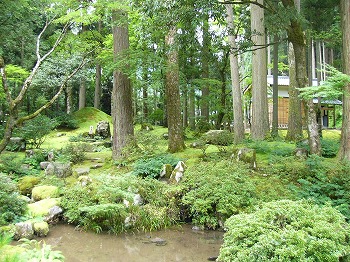
The garden is believed to have been built by Governor Hosokawa Musahi-no-kami Takakuni in 1531 (the Kyoroku Era of the Muromachi Period). This is a garden of Gensei-in, a sub-temple of the former Heisen-ji of the Tendai sect, and the oldest existing garden in the Hokuriku region. More than 200 species of moss grow throughout the garden, creating a mystic landscape.


cultural property : historic sites and places of scenic beauty as natural monuments 
type : places of scenic beauty

56-63 Heisenji Heisenjicho, Katsuyama-shi, Fukui-ken 911-0822
Tel:0779-88-1591


This is a garden of Gensei-in, a sub-temple of former Heisen-ji of the Tendai sect, and it is believed that the garden was built by Governor Hosokawa Musashi-no-kami Takakuni in 1531 in the Muromachi Period. It is a stroll Karesansui (dry landscape) garden located at the east of the building. There is a Tsukiyama (artificial hill) on the front upper level, and a dry pond is placed in front of the Tsukiyama. The principal stone is set on the highest point of the Tsukiyama. Stones are arranged in a spiral with the principal stone at the center to represent a waterfall. There is a stone arrangement to the far left of the pond, which also represents a waterfall. In the dry pond, a crane island and a turtle island are placed, and a stone bridge is installed near the turtle island. More than 200 species of moss carpet the entire garden, creating a mystic landscape. Behind the garden, old trees of Japanese cedar (Cryptomeria japonica), Japanese fir (Abies firma), and maple grow densely. The slope halfway up the hill is dotted with young cedars, among which stand azaleas and a few stone lanterns. Altogether, they give the garden a quiet and elegant appearance.