
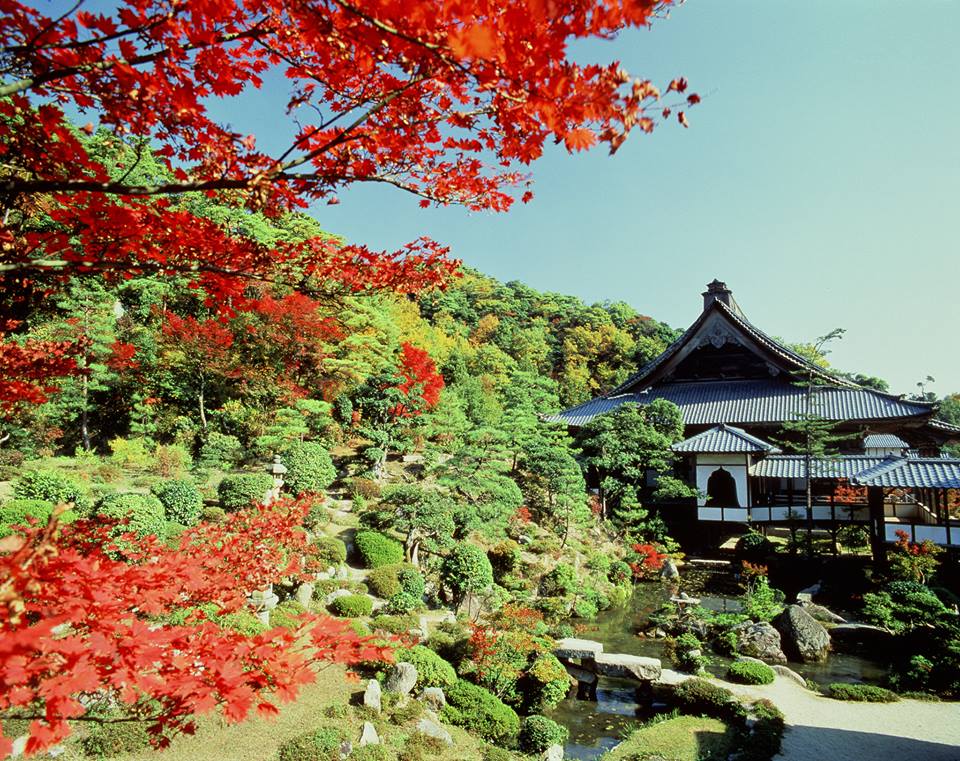
This is a garden at Seifuku-ji, a temple said to have been founded by Ryonyo Shonin of the Chinzei school of the Jodo sect. Although the date of its creation is not known, it is believed that the garden was built around 1747 (the Enkyo Era of the Edo Period) when its closely-related Amida Hall was reconstructed. It is told that this Shoin-style garden (garden that belongs to a traditional Japanese residential architecture with a study) represents the Pure Land of Bliss. The garden is famous for its beautiful fall colors.
cultural property : historic sites and places of scenic beauty as natural monuments
type : places of scenic beauty
13−7 Hara, Tsuruga-shi, Fukui-ken 914-0824
Tel:0770-22-3926
Home page:http://www.saifukuji.jp/
This is a garden at Seifuku-ji, a temple said to have been founded by Ryonyo Shonin of the Chinzei school of the Jodo sect. There is a basin in the mid-section of the mountain behind the garden, where large boulders of granite are clustered and a pine forest as well as a mixed forest with pines densely grow in the northwest and the northeast respectively. Low shrubs such as azaleas and other trees such as chinquapins (Castanopsis sieboldii) and Chinese bayberries (Morella rubra) are planted in the basin.
The garden uses the form of the mountain as its background and there is a pond at the foot of the mountain. The pond has an elongated shape and is located along the Amida Hall. There are three Nakajima (central islands) and stone bridges in the pond. In the northwest section of the pond, there are two large natural boulders instead of a waterfall stone arrangement. Water goes through a conduit placed on a wall made by piling up stones on top of the two natural stones. There is no Mizuwake-ishi (water-dividing stone). Water drains from the northeastern corner.
Although the date of its creation is not known, it is believed that the garden was built around 1747 when its closely-related Amida Hall was reconstructed. It is told that this Shoin-style garden (garden that belongs to a traditional Japanese residential architecture with a study) represents the Pure Land of Bliss. The garden is famous for its beautiful fall colors.