
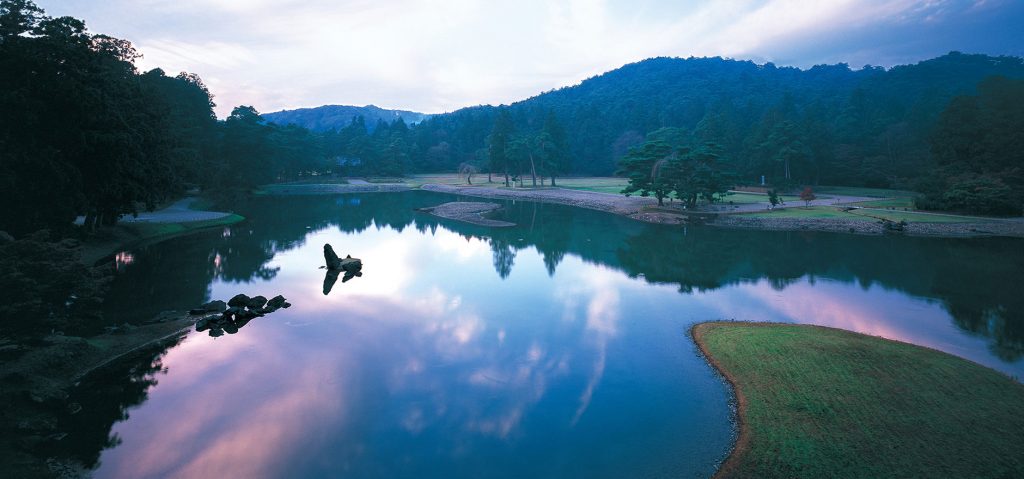
A Jodo (Pure Land)-style garden. Natural sceneries are expressed including stone arrangements such as Tsukiyama in a dry landscape garden style and Yarimizu (curved brook) to draw water to the pond. The park still retains the shape of its elegant landscape from the Heian Period with the Oizumigaike pond in the middle. This precious garden will bring ideas and techniques from Sakuteiki, Japan’s oldest landscaping book, to the modern world.
cultural property : historic sites and places of scenic beauty as natural monuments
type : places of special scenic beauty
58,Hiraizumi Aza Oosawa, Hiraizumi-chō, Nishiiwai-gun, Iwate-ken 029-4102
Tel : 0191-46-2331
Home page : www.motsuji.or.jp
Motsu-ji was founded by Jikaku Daishi En’nin and it reached the height of its prosperity during the second and third lords of the Northern Fujiwara Family, Motohira and Hidehira. During that time, numbers of pagodas and living quarters for monks were constructed. After the fall of the Fujiwara Family, the temple met with natural calamities and all the buildings were burnt down. However, the old foundations of the garden and main temple were found after an excavation and the former landscape was restored.
If you look toward the north from the main temple, a vast “Oizumigaike pond” filled with pure water can be seen in front of a small mountain called Tou-yama. Along with the edge of the “Oizumigaike pond”, natural sceneries such as a Mizuwake (water-divider) simulating a sandbank and rough seashore, a Tateishi (standing rock) which serves as a Namigaeshi (turning waves), a rockwork of Tsukiyama (artificial hill), a Yarimizu (curved brook) to draw water can be seen.
Jodo (Pure Land)-style gardens influenced by the Jodo tradition of Buddhism were created from the Heian Period to the Kamakura Period. The Motsu-ji Garden created during the Heian Period brings ideas and techniques from “Sakuteiki” (Japan’s oldest landscaping book) to the modern world. Combined with the scenery of the surrounding forest, it reminds visitors of the beauty from the past.