
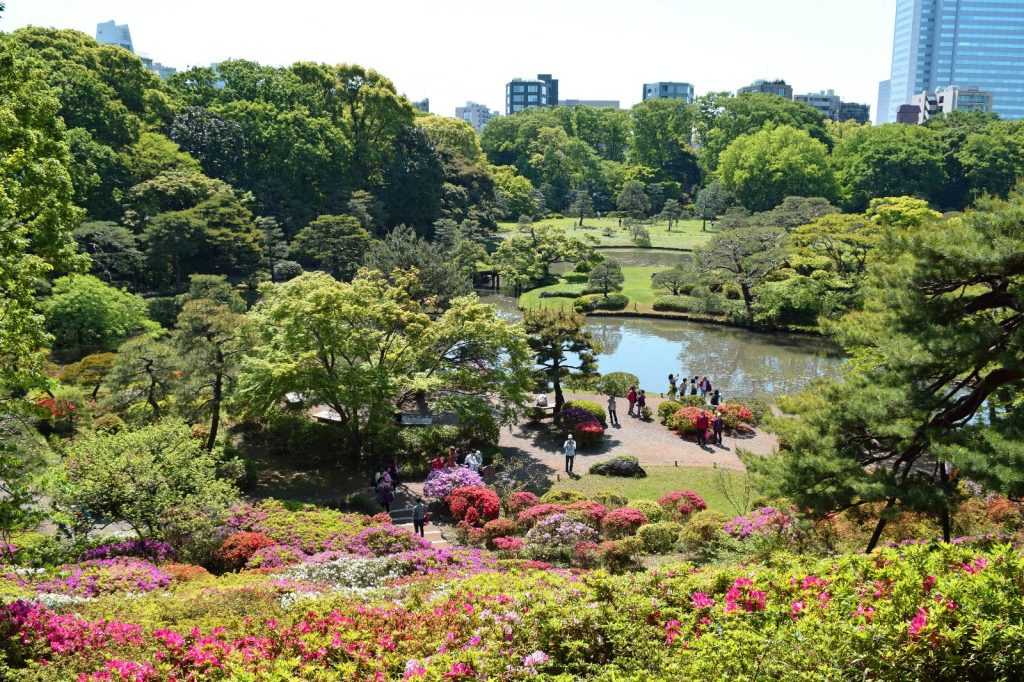
It is considered to be one of the Two Great Gardens of Edo along with Koishikawa Koraku-en. It was built by Yanagisawa Yoshiyasu who was a grand chamberlain of the 5th Shogun, Tokugawa Tsunayoshi, in 1695 and it took 7 years to complete. This is a stroll garden with a path around Tsukiyama (artificial hills) and ponds. It is famous for its “Eighty Eight Places” which recreates landscapes of beautiful places such as Wakanoura and other places that were so beautiful people wrote tanka poems about them. It was designated as a National Special Place of Scenic Beauty in 1953.
cultural property : historic sites and places of scenic beauty as natural monuments
type : places of special scenic beauty
6-16-3 Honkomagome, Bunkyō-ku, Tōkyō-to 113-0021
Tel:03-3941-2222
Home page : https://www.tokyo-park.or.jp/park/rikugien/index.html
Yanagisawa Yoshiyasu created this garden during the Genroku Era in the Edo Period. In 1702, he named the garden “Rikugi-en” and the building “Rikugi-kan” from “Rikugi” in the Classic of Poetry. It is a stroll garden with a path around Tsukiyama (artificial hills) and ponds with a style of the Katsura-rikyu garden created in the beginning of the Edo Period. It is famous for its “Eighty Eight Places” which recreates landscapes of beautiful places such as Kishu Wakanoura that were so beautiful people wrote tanka poems about them. It is one of the Two Great Gardens of Edo along with Koishikawa Koraku-en.
The garden became dilapidated after Yanagisawa Yoshiyasu retired from the government work. It was reconstructed during the Bunka Era at the end of the Edo Period, but part of the buildings were already lost by then.
The Iwasaki Family of Mitsubishi bought the premises in the Meiji Era and the scenery was restored after renovation. Although there were many areas modified during that time, but the main portion still remains. It is considered to be one of the major Daimyo gardens that exist today.