This is one of the Three Great Gardens of Japan along with Kenroku-en in Kanazawa and Kairaku-en in Mito.
It was built by the 2nd lord of the Okayama Domain, Ikeda Tsunamasa, in 1686 to create a space filled with serenity. It was originally a garden where visitors enjoyed the scenery from the buildings inside the garden, but paths for strolling were added later during the renovations by subsequent lords. The appearances of the garden from the Edo Period are very well preserved.
cultural property : historic sites and places of scenic beauty as natural monuments
type : places of special scenic beauty
1-5 Kōrakuen, Kita-ku, Okayama-shi, Okayama-ken 703-8257
Tel:086-272-1148
Home page : okayama-korakuen.jp/
It was landscaped by the 2nd lord of the Okayama Domain, Ikeda Tsunamasa, in 1686 to create a space filled with serenity. It was originally created to enjoy the view from the buildings inside the garden.
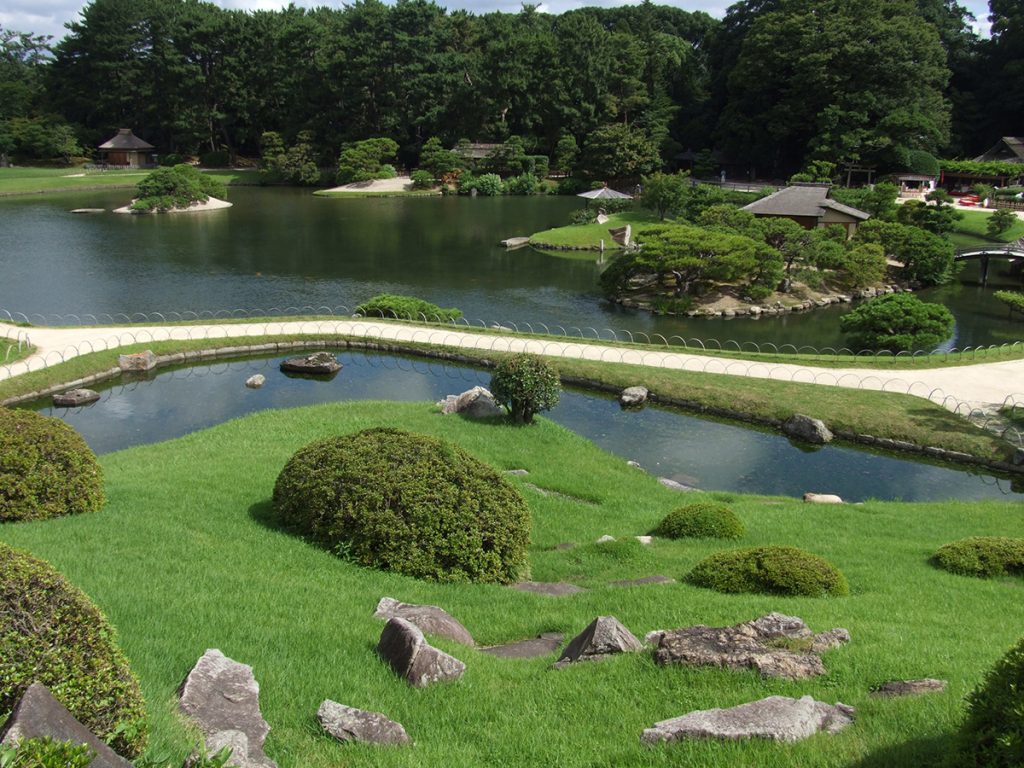
The 3rd lord, Tsugumasa, conducted a major renovation on the buildings and the garden. He adopted a landscape of stroll garden so that visitors could enjoy the garden as they walk around. A Tsukiyama (artificial hill) was created in the center of the garden and waterways were added around the bottom of the artificial hill. The Sawanoike pond and the pond of Renchi-ken were connected to create a pond shaped like a gourd. From En’yo-tei, which was used as a lounge when the lord visited, visitors can get a sweeping view of the scenic spots of the garden including the vast lawn, a large pond and the Forest of Chishio, which is a maple forest in the eastern part of the garden.
The original borrowed scenery of the Okayama Castle has been lost since the castle was burnt down during the war in the Showa Period, but Mt. Misao is still a part of the borrowed scenery in the southeast direction of the garden. The artificial hill in the middle of the garden is about 6 meters high and from the top of the hill, visitors can command a full view of Sawanoike, Enyo-tei, lawn field and Seiden (an imitation of ancient rice fields) in the garden. The old layout of a Daimyo garden is very well preserved in this garden.