yamagata」タグアーカイブ

Sakai Family Garden

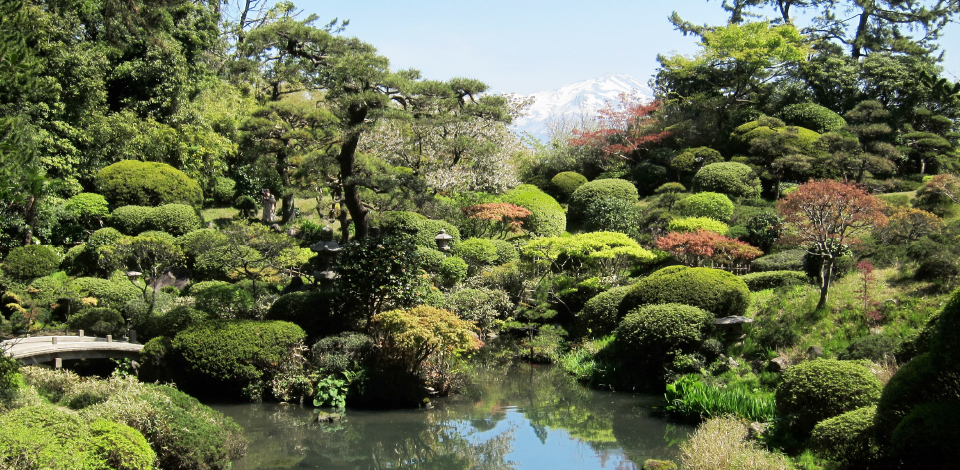
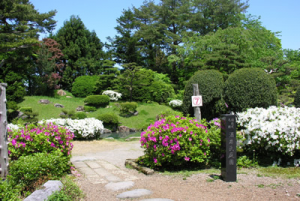
This is a Tsukiyama (artificial hill) and pond garden in the north of the old Goinden building for Sakai, the lord of Shonai and it is located inside the Chido Museum. It preserves a style and technique of gardens with a study which were popular during the mid-Edo Period. It was designated as a National Place of Scenic Beauty in 1976 because of its importance as an exemplary garden with a study which is very rare in the Tohoku region.


cultural property : historic sites and places of scenic beauty as natural monuments 
type : places of scenic beauty

10-18 Kachūshinmachi, Tsuruoka-shi, Yamagata-ken 997-0036
Chido Museum
Tel:0235-22-1199

Home page : http://www.chido.jp/


It is currently located inside the Chido Museum premises. This is a Tsukiyama (artificial hill) and pond garden in the north of the old Goinden building for Sakai, the lord of Shonai. There is a Tsukiyama on the opposite shore of the pond. A stone standing in the middle of the Tsukiyama is the center of the garden and other landscaping elements are positioned around it.
A dry waterfall is assembled on the left side of the garden in order to create scenery simulating a valley. The area under the waterfall is landscaped to look like a rough seashore. A pine tree with overhanging branches is planted on the peninsula on the right side of the garden. In front of the pine tree, slightly to the left, there is a Tateishi (standing rock) made of silicified wood, which is shaped like a turtle head, in the water. A deep cove is created in the back in order to create a serene scene with trees for shade.
When it was originally built, Mt. Chokai in the far distance was used as borrowed scenery behind the Tsukiyama.
It preserves a style and technique of gardens with a study which were popular during the mid-Edo Period, and this garden is considered to be an exemplary garden with a study which is very rare in the Tohoku region.
Gyokusen-ji Garden

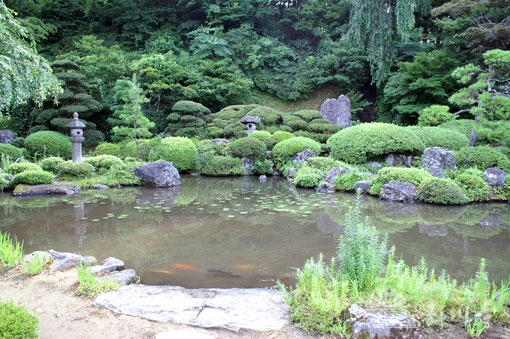
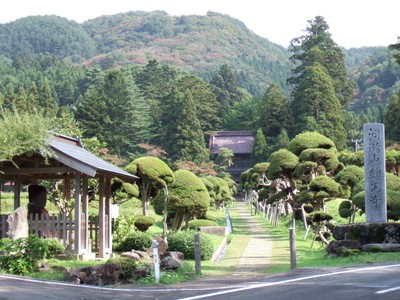
The Gyokusen-ji Garden was created in the 1450s and improved in the 1650s. This is a Horai-style garden with a path around a large pond in the middle. There is a waterfall which flows from a natural mountain. Pure stands of Japanese primrose (Primula japonica) grow in the garden, which are very rare, even in Japan. It was designated as a Cultural Property and Scenic Site of Japan in 1987.


cultural property : historic sites and places of scenic beauty as natural monuments 
type : places of scenic beauty

35, Haguromachi Tamagawa, Tsuruoka-shi, Yamagata-ken 997-0121
Tel:0235-62-2746


Gyokusen-ji is located at the northwest base of the Three Mountains of Dewa and it is told that it was founded in 1251 during the Kamakura Period by Ryonen Homyo, a Zen monk who was the leading pupil of Dogen Zenji (a Zen master) who was a founder of the Soto sect. The garden was created in 1450 during the Muromachi Period and improved in 1650 during the Edo Period. This is a Horai-style garden with a path around a large pond in the middle. The waterfall is designed to flow into the garden from a natural mountain. There are many stone arrangements around the pond and shrubs that are trimmed in a round shape are planted without any gaps between the stones. The soil around the stepping stones is mossy which adds elegance to the garden’s scenery. This garden is also called the “temple of Japanese primrose” because of its pure stands, which are very rare, even in Japan.

Soko-ji Garden

A Tsukiyama garden with grove and pond. The Tsukiyama and the pond can be viewed from the main temple and the Kuri study. In the distance you can see “Mine no Yakushi-do” at the top, and “Naka no Yakushi-do” at the middle of the mountain to the east. Pure water from the Furou no Taki waterfall pours into the pond passing through the Namiwake-ishi (wave-dividing stone). It is called the “Hourai-en” garden and was designated as a Scenic Site of Japan in 1996.


cultural property : historic sites and places of scenic beauty as natural 
type : places of scenic beauty

8,Sokojisawa, Sakata-shi, Yamagata-ken 999-6831
Tel:0234-62-2170

Home page : www.sokoji-sakata.com


Soko-ji is a Zen temple of the Soto Zen sect and it is told that it was founded by the venerable Zen monk, Getsuan Ryoin, during the period of the Northern and Southern Dynasties by enshrining a statue of Yakushi (the healing Buddha) on the summit of the mountain. The front of the precinct is facing west and the garden is landscaped in the Tsukiyama (artificial hill) garden style with the grove and pond behind the main temple and the Kuri building (living quarters for monks). The view of the garden from the study is comprised of a Taki-ishigumi (a waterfall with assembled rocks) on the top left side. The water coming down from that waterfall flows next to the Tsukiyama in the middle and pours into the pond. There is a flat Nakajima (central island) in the pond and the water from the pond falls by the Kuri from the southwest corner. If you go out to the garden from the study, you can walk to the central island from the retaining stone of the pond via water-crossing stones made with five millstones. There are large stones on both the south and north sides of the central island. It is narrow between the central island and the eastern shore of the pond and there is a bridge made of a single stone. After crossing to the opposite shore, you will find sparsely-positioned stepping stones in a diagonally upward direction and that is also a path leading to the grassland in the heart of the Tsukiyama on the left.
This is a typical Japanese garden perfected in the second half of the Edo Period which is an elegant Zen temple garden.

Villa of Mr. Honma (Kakubu-en) Garden

The garden was created by the fourth head of the Honma Family, Kodo, and it is in a style of Japanese garden with a path around the central pond. A complete view of the pond garden with a rich variety of landscape and Mt. Chokai as borrowed scenery can be enjoyed. The lord Sakai named the building overlooking graceful Mt. Chokai as “Seien-kaku” as well as “Kakubu-en” because a crane flew toward a pine tree on the central island of the pond.


cultural property : historic sites and places of scenic beauty as natural monuments 
type : places of scenic beauty

7-7 Onarichō, Sakata-shi, Yamagata-ken 998-0024
Public interest foundation, Homma Museum of Art
Tel:0234-24-4311

Home page : www.homma-museum.or.jp


The Honma Family is known as one of the three major landowners in the Tohoku region. They became wealthy merchants mainly due to the shipping business in the Japan Sea from the second half of early modern times to recent modern times. Originally, the garden started out as a villa which was built in 1813 (the Edo Period) by the fourth head of the Honma Family, Honma Kodo. It was created as a rest area for the lord of Shonai, Sakai Tadakata, prior to the lord’s inspection trip to his territory. It was constructed by using the labor of stevedores during the winter time. The stevedores in the early modern period supported the seaport city, Sakata. The garden is in a style of Japanese garden with a path around the main building and a pond and colorful ornamental stones of red and blue are used. A complete view of the pond garden with a rich variety of landscape and Mt. Chokai as borrowed scenery can be enjoyed from the second floor of Seien-kaku. The lord Sakai Tadakata, who visited the garden during his inspection trip, named the building overlooking Mt. Chokai as “Seien-kaku”.
Also, it is said that the garden is named “Kakubu-en (a garden with a dancing crane)” because a crane landed on a pine tree on Nakajima (the central island) of the pond.