
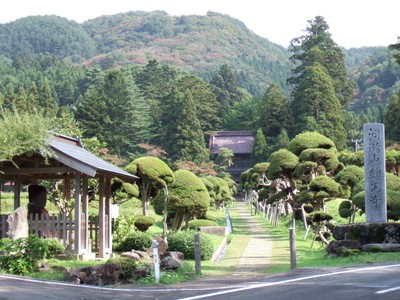
A Tsukiyama garden with grove and pond. The Tsukiyama and the pond can be viewed from the main temple and the Kuri study. In the distance you can see “Mine no Yakushi-do” at the top, and “Naka no Yakushi-do” at the middle of the mountain to the east. Pure water from the Furou no Taki waterfall pours into the pond passing through the Namiwake-ishi (wave-dividing stone). It is called the “Hourai-en” garden and was designated as a Scenic Site of Japan in 1996.
cultural property : historic sites and places of scenic beauty as natural
type : places of scenic beauty
8,Sokojisawa, Sakata-shi, Yamagata-ken 999-6831
Tel:0234-62-2170
Home page : www.sokoji-sakata.com
Soko-ji is a Zen temple of the Soto Zen sect and it is told that it was founded by the venerable Zen monk, Getsuan Ryoin, during the period of the Northern and Southern Dynasties by enshrining a statue of Yakushi (the healing Buddha) on the summit of the mountain. The front of the precinct is facing west and the garden is landscaped in the Tsukiyama (artificial hill) garden style with the grove and pond behind the main temple and the Kuri building (living quarters for monks). The view of the garden from the study is comprised of a Taki-ishigumi (a waterfall with assembled rocks) on the top left side. The water coming down from that waterfall flows next to the Tsukiyama in the middle and pours into the pond. There is a flat Nakajima (central island) in the pond and the water from the pond falls by the Kuri from the southwest corner. If you go out to the garden from the study, you can walk to the central island from the retaining stone of the pond via water-crossing stones made with five millstones. There are large stones on both the south and north sides of the central island. It is narrow between the central island and the eastern shore of the pond and there is a bridge made of a single stone. After crossing to the opposite shore, you will find sparsely-positioned stepping stones in a diagonally upward direction and that is also a path leading to the grassland in the heart of the Tsukiyama on the left.
This is a typical Japanese garden perfected in the second half of the Edo Period which is an elegant Zen temple garden.