
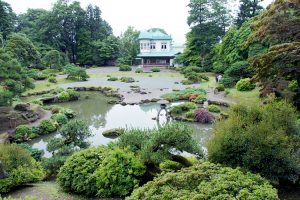
This garden was created by Seito Moriyoshi, the 24th head of the Seito Family, who served as Dai Shoya (a village official) in the Meiji Era. The garden is one of the three outstanding gardens of the Meiji Era (1868 – 1912). The garden has a pond at its center, featuring Tsukiyama representing “shin” (formal) and another Tsukiyama representing “gyo” (semiformal). “So” (informal), is a flat garden. A Western-style building commands a great view of the countryside of the Tsugaru plain with distant mountains as borrowed scenery.
cultural property:historic sites and places of scenic beauty as natural monuments
type:places of scenic beauty
1, Sarukaisibayashi, Hirakawa-shi, Aomori-ken 036-0242
Tel:0172-57-2020
Home page:www.seibien.jp
Seito Moriyoshi, the 24th head of the Seito Family, a wealthy farmer in the Tsugaru region, invited Master Obata Teiju to create the garden. It was completed in 1902, after nine years of work. It features a pond at its center, consisting of three levels classified by formality: “shin” (formal), “gyo” (semiformal), and “so” (informal).
There is a dry pond in front of the Seibi-kan building, and a pond at a lower level. The pond features Shinsen-to and Ni-to islands, where pines representing Horai (Mount Penglai) pines are planted. Two Tsukiyamas (artificial hills) are created on both sides of the pond, representing “shin” and “gyo” respectively. “So” is a flat garden located at the south side of the Tsukiyama of “gyo” and the northeast side of the Seibi-kan building, featuring a splendid pruned Japanese yew (Taxus cuspidata).
The Seibi-kan building commands distant seasonal views of the countryside of the Tsugaru Plain and mountains as borrowed scenery. Seibi-en is an outstanding example of the Oishi Bugaku gardening school. The Oishi Bugaku gardening school is one of the garden schools primarily developed in the Tsugaru Domain in the late Edo period (1850s – 1868). It is said that the school originated when court nobles who left Kyoto (the ancient capital city of Japan) combined Kyoto-style Buddhist culture and ancient Shinto culture in the region. The name of the school comes from Oishi Bugaku, who is believed to be the founder of the school.