aomori」タグアーカイブ

Seibi-en

This garden was created by Seito Moriyoshi, the 24th head of the Seito Family, who served as Dai Shoya (a village official) in the Meiji Era. The garden is one of the three outstanding gardens of the Meiji Era (1868 – 1912). The garden has a pond at its center, featuring Tsukiyama representing “shin” (formal) and another Tsukiyama representing “gyo” (semiformal). “So” (informal), is a flat garden. A Western-style building commands a great view of the countryside of the Tsugaru plain with distant mountains as borrowed scenery. 


cultural property:historic sites and places of scenic beauty as natural monuments 
type:places of scenic beauty

1, Sarukaisibayashi, Hirakawa-shi, Aomori-ken 036-0242
Tel:0172-57-2020

Home page:www.seibien.jp


Seito Moriyoshi, the 24th head of the Seito Family, a wealthy farmer in the Tsugaru region, invited Master Obata Teiju to create the garden. It was completed in 1902, after nine years of work. It features a pond at its center, consisting of three levels classified by formality: “shin” (formal), “gyo” (semiformal), and “so” (informal).
There is a dry pond in front of the Seibi-kan building, and a pond at a lower level. The pond features Shinsen-to and Ni-to islands, where pines representing Horai (Mount Penglai) pines are planted. Two Tsukiyamas (artificial hills) are created on both sides of the pond, representing “shin” and “gyo” respectively. “So” is a flat garden located at the south side of the Tsukiyama of “gyo” and the northeast side of the Seibi-kan building, featuring a splendid pruned Japanese yew (Taxus cuspidata).
The Seibi-kan building commands distant seasonal views of the countryside of the Tsugaru Plain and mountains as borrowed scenery. Seibi-en is an outstanding example of the Oishi Bugaku gardening school. The Oishi Bugaku gardening school is one of the garden schools primarily developed in the Tsugaru Domain in the late Edo period (1850s – 1868). It is said that the school originated when court nobles who left Kyoto (the ancient capital city of Japan) combined Kyoto-style Buddhist culture and ancient Shinto culture in the region. The name of the school comes from Oishi Bugaku, who is believed to be the founder of the school.  
Zuiraku-en

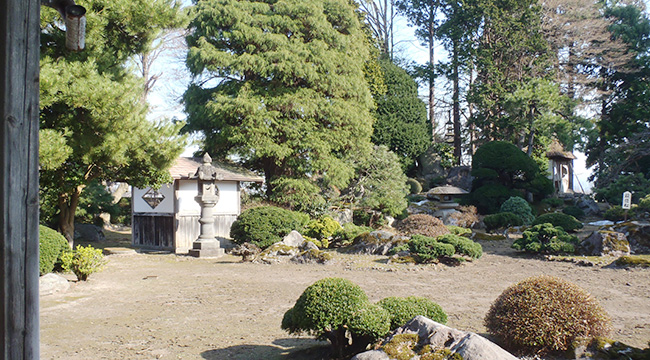
This garden is a good reflection of the gardening techniques of the Oishi Bugaku gardening school that have been handed down in the Tsugaru region, such as creating Tsukiyama (artificial hills), arranging large rocks, a dry waterfall, a dry pond, and a stone bridge across the pond. Sketches drawn when creating the garden, and an inscription describing the modification work are archived at the garden. Visitors can learn about the history of the garden creation and its transitions afterwards. 


cultural property : historic sites and places of scenic beauty as natural monuments 
type : places of scenic beauty

26-2, Ooaza Miyadate Aza Miyadate Sawa, Hirosaki-shi, Aomori-ken 036-8384
Tel:0172-82-1642

Home page : http://zuirakuen.com/


This is the garden of a wealthy farming family in the Miyadate area, the Tsushima Family. The Tsushima family ran Dai Shoya (a village official) for generations during the era of Tsugaru Domain. It is a Karesansui (dry landscape) garden occupying a wide space in front of the south side of the building.
The garden includes an arrangement of two paths of large stepping stones, a worship stone, and a water basin. Further inside, the garden features a dry waterfall, a dry pond, and a stone bridge across the pond. A low miniature hill sits at the far back on the right (west) side and a taller hill at the left (east) side, along with spontaneously arranged large rocks. A small arbor and stone lantern are placed in between.
Takahashi Teizan started building the garden in 1890 and worked on it for the following 15 years. Later his two apprentices, Ikeda Teigetsu and Tonosaki Teiyo, resumed addition and modification work at the beginning of the Showa Period. It was finally completed in 1936. There is a description of the origin of the garden on the back of a Tateishi (standing rock) in front of an Inari (goddess of rice) shrine at the right back of the garden.  Design drawings created during the addition and modification work are archived. This is one of the outstanding gardens displaying the gardening techniques of the Oishi Bugaku gardening school that have been handed down in the Tsugaru region. 

Kanehiranari-en

Kanehiranari-en is recognized as an important garden that perfectly conveys the unique style of the Oishi Bugaku gardening school that dominated the Tsugaru region from the end of the Edo Period (approx. 1750 – 1850) through modern times. The overall premises, including the main building and garden, are all preserved in good condition. The garden was designated as a Historic Site, Place of Scenic Beauty, and Natural Monument on January 26, 2006.


cultural property : historic sites and places of scenic beauty as natural monuments 
type : places of scenic beauty

2−1, Uchimachi, Kuroishi-shi, Aomori-ken 036-0306
Tel:0172-52-2111
City of Kuroishi Board of education Cultural properties section


The third Takahashi Teizan was invited by Kato Uhei, a politician and business man, to create this garden in 1882. He died before completing the garden. His apprentices, Obata Teijyu and Ikeda Teigetsu, succeeded him in the work and completed the garden in 1902. The garden is also known as “Sawanari-en” because of the first trade name of “Sawaya Narinosuke” in the sake-brewing industry, which was Uhei’s family business.
“Kanehiranari-en” was started by Kato Uhei as one of his measures against unemployment. In the spirit of his belief that “money should be distributed to all people, leading to a peaceful society,” the garden was named “Kanehiranari-en (money peace-making garden).” The garden has a large pond located at the far back on the east side of the main building. The shape of the premises gives depth to this garden, with its three ponds whose shorelines are created with intricate stone arrangements, Tsukiyama behind the shorelines, and a dry waterfall created by dynamic stone arrangements. The style of the “Oishi Bugaku gardening school” can be seen in the unique usage of stones and detailed design. It is one of the great gardens that convey the unique style of the “Oishi Bugaku gardening school,” which dominated the Tsugaru region from the end of the Edo period (approx. 1750 – 1850) and modern times.