
fukushima」タグアーカイブ

Nanko Park

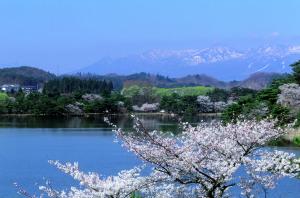
The Japanese park system was established in 1873, at the beginning of the Meiji Era. This park was created prior to that, at the end of the Edo Period, by Matsudaira Sadanobu, the 12th lord of the Shirakawa domain, with an idea of “samurai and commoners sharing a joy” and the public being able to take a rest regardless of their social status. It was constructed in 1801 with elements of gardens and designated as a National Historic Site/Place of Scenic Beauty in 1924.


cultural property : historic sites and places of scenic beauty as natural monuments 
type : places of scenic beauty, historic sites

1 hoka, Nanko, Shirakawa-shi, Fukushima-ken 961-0812
Shirakawa-city Construction department Cultural Property Division
Tel:0248-27-2310 

Home page : http://www.city.shirakawa.fukushima.jp/page/page001385.html


This park was constructed by Matsudaira Sadanobu, who is known for the Kansei Reforms during the Edo Period. Sadanobu intended to create a place without a wall where anybody can take a rest regardless of their social status and visit anytime. It is said to be the oldest place called “park” in Japan.
There are gently sloping hills in the north of the park and a pond (Nanko) in the south, and both create an expansive view around the park. There are various kinds of trees among lush pine trees on the hills. Visitors can enjoy a wide variety of seasonal flowering plants in the forest.
The island in the middle of the pond is also covered with trees and flowers. There are fish and birds in the pond that are a pleasure to the eyes of visitors.
Among scenic spots that are created for nature outings, there are only a few of them that are landscaped with a pond as a center piece. The park was named after a lakeside park described in the old Chinese book, “Famous Gardens of Luoyang,” as it tried to replicate the essence of the Chinese park.
Garden for the lord of Aizu, Matsudaira (Oyaku-en)

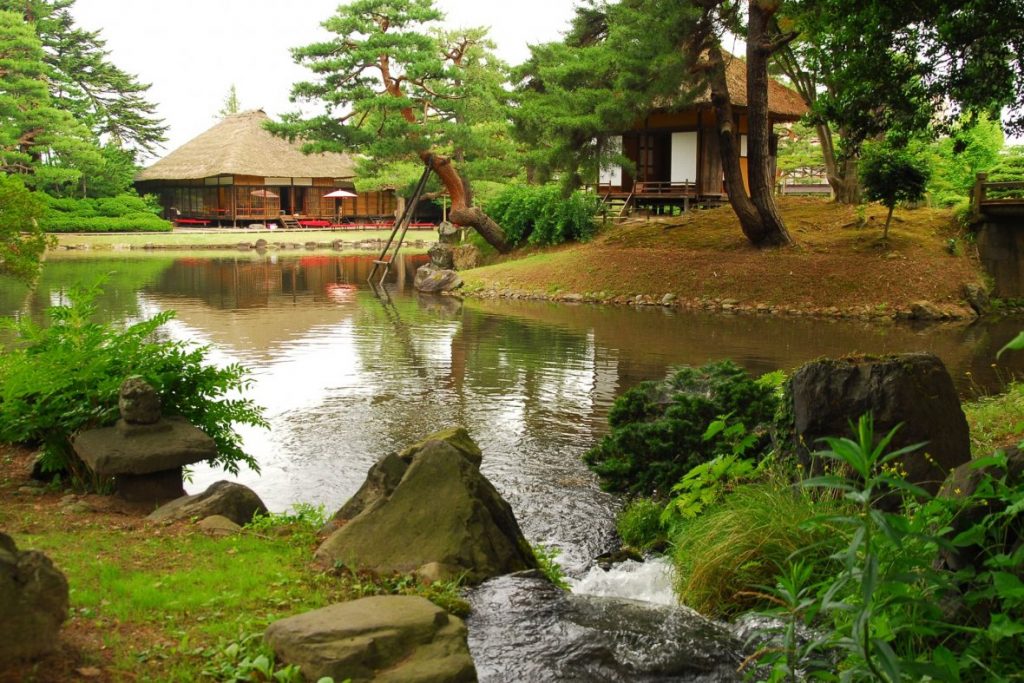
It is said that the garden started out as a villa built by a lord of Aizu about 600 years ago. This is in a style of Japanese garden with a path around a pond, which is in the middle, shaped like the character for “heart (Kokoro).” It was named “Oyaku-en (a herb garden)” because various medicinal herbs were cultivated here. It was designated as a National Place of Scenic Beauty in 1932.


cultural property : historic sites and places of scenic beauty as natural monuments 
type : places of scenic beauty

8-1 Hanaharumachi, Aizuwakamatsu-shi, Fukushima-ken 965-0804
Tel:0242-27-2472

Home page : http://www.tsurugajo.com/oyakuen/


The garden has borrowed scenery with the mountains on the east side of the garden and it is considered to be an exemplary Daimyo garden during the Edo Period with a path around a pond. Originally, it was a villa built by Ashina Morihisa during the Muromachi Period. It is said that he built the villa because there was a spring with miraculous powers. It later became a villa for the lord of Aizu, Matsudaira, and started to be called “Oyaku-en” because various medicinal herbs were planted. It is said that it was built around the mid-Edo Period, but an actual date is unknown.
There is a pond shaped like the Chinese character for “heart (Kokoro)” in the middle of the garden with an island at the center. There is a bridge to the island, and a gazebo called “Rakuju-tei” is on the island.
There is a waterfall on the southeast edge of the pond and a path paved with stones on the south side. There are some stones arranged along the waterside. Large trees such as Japanese firs (Abies firma), Japanese cedars (Cryptomeria japonica) and pines are spread in the south and east part of the garden. There are Japanese red pines (Pinus densiflora) here and there in the north side.
It was used as a sanatorium for the new government forces during the Boshin War, thus it was preserved without being destroyed.