
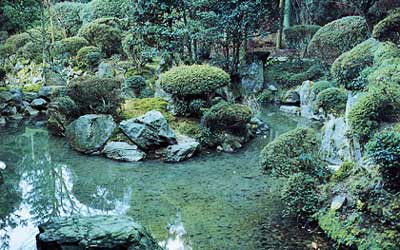
This is a garden at Kojo-in, which is one of the sub-temples of Mii-dera. Azaleas (Rhododendron spp., Rhododendron indicum) are planted densely in various locations, and Japanese cedars (Cryptomeria japonica), Japanese cypress (Chamaecyparis obtusa), and pines form dense forests on the hillside. It is considered to be an outstanding example of of gardens in the Omi region due to its small but dense composition that gives depth to the garden.
cultural property : historic sites and places of scenic beauty as natural monuments
type : places of scenic beauty, historic sites
246 Onjōjichō, Ōtsu-shi, Shiga-ken 520-0036
Tel:077-522-2238
Home page : www.shiga-miidera.or.jp/index.htm
This is a garden at Kojo-in, which is one of the sub-temples of Mii-dera. The timeframe in which the temple was constructed is unclear, but it is thought that the temple was built around 1601 when the Kyakuden (reception hall) was completed.
This view garden with a large pond is integrated with the Kyakuden. Since the Kyakuden’s pillars supporting the southern veranda stand on rocks protecting the pond shore, the pond can be seen directly under the veranda. With water approaching visitors’ feet, the Kyakuden creates a sense of elegance similar to the charm of floating architecture.
The pond stretches from east to west. A natural stone bridge is installed at a turtle island, and an old waterfall on the opposite shore is made of two Tateishi (standing stones) while three large Yodomari-ishi (stones representing boats) also grace the pond. Natural stones are arranged around the pond.
The southwestern section of the pond ends at a steep slope. Japanese cedars (Cryptomeria japonica), Japanese cypresses (Chamaecyparis obtusa), and pines grow densely on the hillside.Thick groupings of azaleas and dwarf azaleas are planted on the slope.
It is considered to be a representative garden of the Omi region due to its small but dense composition that gives it depth.