shimane」タグアーカイブ

Manpuku-ji Garden

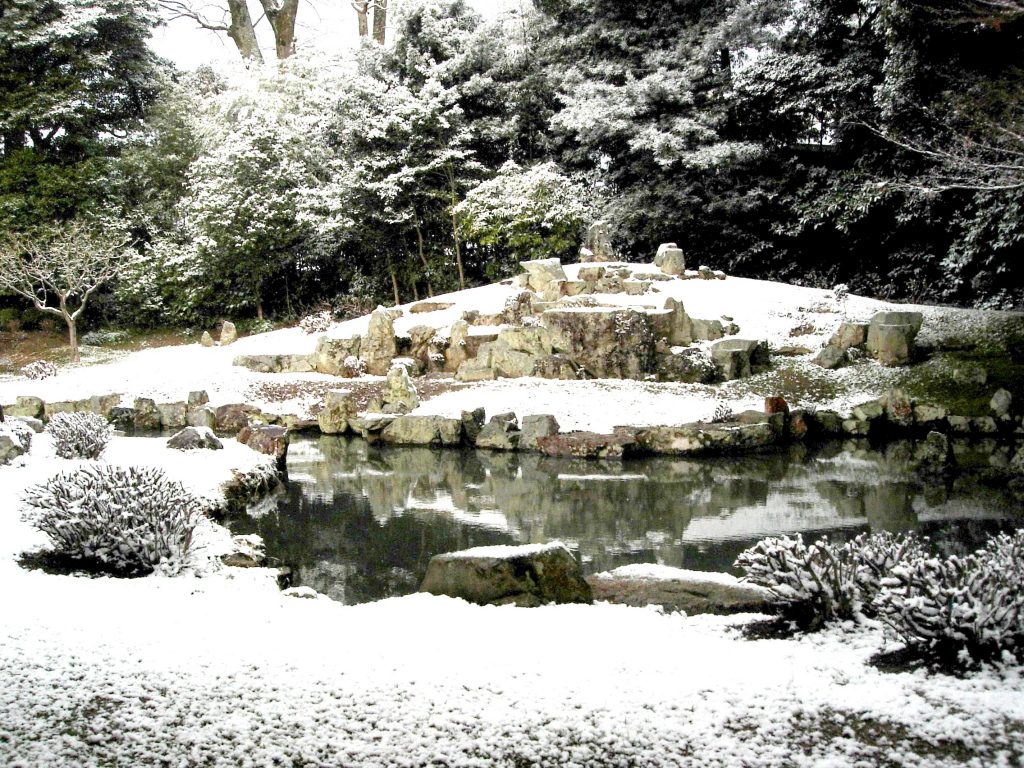
Manpuku-ji was originally founded as Anpuku-ji in the Heian Period, then moved to its current location in 1374 as Manpuku-ji. The garden is a “temple” style garden made by Sesshu in 1479. The pond in the front represents the Chinese character for “heart (kokoro).” A gently sloped Tsukiyama, and spiraling stone arrangements represent the world of Shumisen, of Buddhist cosmology.


cultural property : historic sites and places of scenic beauty as natural monuments 
type : places of scenic beauty, historic sites

25-33 Higashimachi, Masuda-shi, Shimane-ken 698-0004
Tel:0856-22-0302

Home page : manpukuji.server-shared.com/


The origin of Manpuku-ji was a temple called Anpuku-ji, which was built in the Heian Period. Anpuku-ji was washed away in large tsunami, rebuilt as a martial art practice hall, then transferred to the current location by the 11th lord, Masuda Nanao, in 1374 (the Muromachi Period).
Its garden is said to have been made by Sesshu in 1479. It is in a temple style with a pond in the front center representing the Chinese character “heart (kokoro).”  
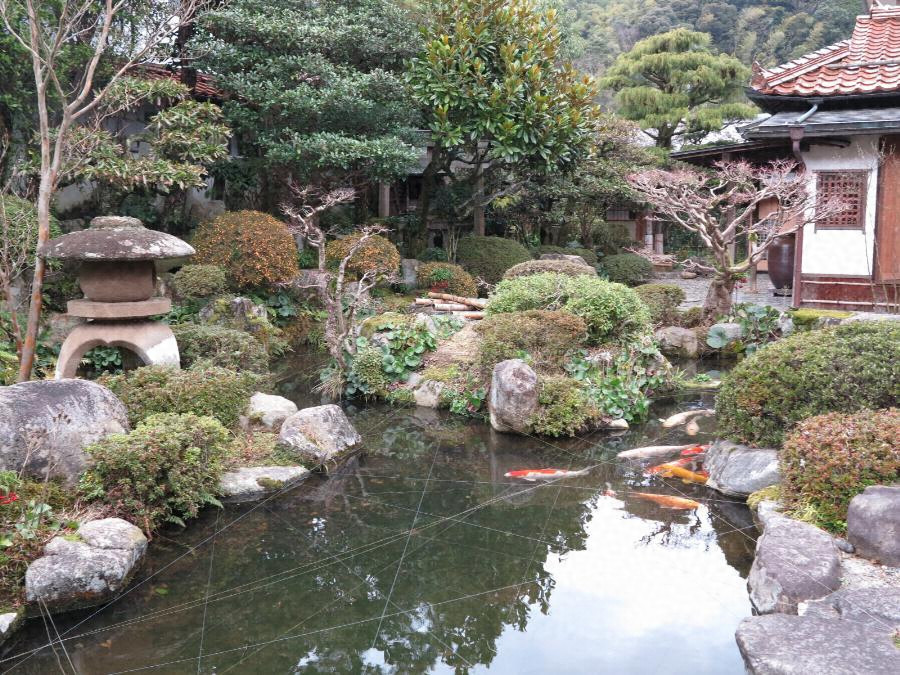
The right-hand section of the pond is under the shadow of tree branches that are extending from a forest behind the pond. A stone arrangement of a waterfall is placed on the other shore of the pond. A cape is placed in front, and a Horai stone is located to the left of the dry waterfall. A gently-sloped Tsukiyama can be seen at the center of the other side of the pond. A low-height Tateishi is placed on top of the Tsukiyama, and stones are arranged in a spairaling shape down the slope to represent the world of Shumisen, which is the Buddhism cosmology. The area from the left-hand section of the pond to the west side of the building represents a more open, bright world.
Iko-ji Garden

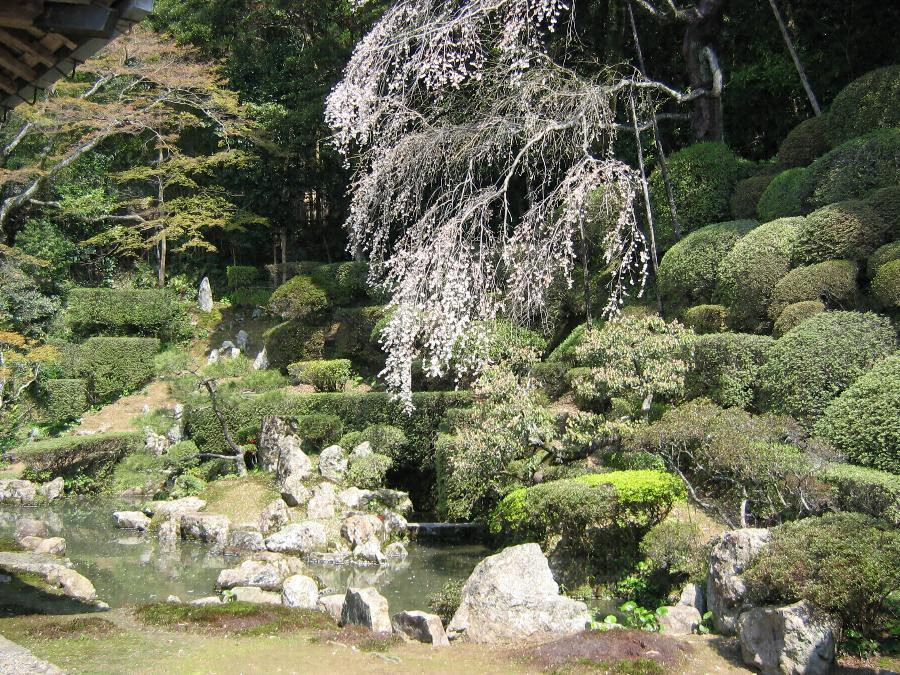
The 5th chief monk of Sukan-ji, the predecessor of the present Iko-ji, was Sesshu and he created a garden in one of the subordinate temples. Sukan-ji was dilapidated during the Warring States Period, but later combined with Iko-ji and remains to this day. This is a Horai-style garden with a crane-shaped pond and a turtle island, and it shows a variety of scenery from season to season.


cultural property : historic sites and places of scenic beauty as natural monuments 
type : places of scenic beauty, historic sites

4-29 Somebachō, Masuda-shi, Shimane-ken 698-0011
Tel:0856-22-1668


Iko-ji is a temple of the Tofuku-ji school of the Rinzai sect. Its predecessor was called Sukan-ji and it was founded during the Muromachi Period. Sukan-ji became dilapidated during the Warring States Period, but the 17th head of the Masuda Family, Munekane, restored the temple as Iko-ji.
The 5th chief monk of Sukan-ji was Sesshu, who was a famous ink painter, and created a garden in one of the subordinate temples which became the base of the current garden.
It is a Horai-style stroll and view garden with a pond. The pond is shaped like a crane and there is a turtle island in the pond. It is famous for its weeping cherry trees in the spring and azaleas in May. Various trees create cool shade in the summer, and large maple trees turn red in the fall. The snowscape in winter reminds visitors of the ink paintings by Sesshu. The garden has various appearances from season to season. There are also other things to see in the temple. An ash mound is believed to be the place where Sesshu was cremated. There is a grave of Masuda Munekane, the lord of the clan that governed this area for a long time, and historical statues such as arhat statues.

Kyu Garden of Mr. Hori

Old residence and garden of Hori consists of four areas, namely the front garden of the main building, Rakusan-en, Waraku-en and the outer garden of Hatagasako Hospital. It has a wide variety of landscaping elements with superb design and structures. It is also famous for its unique scenery which maximizes the local landscape such as the valley of the Shiraishi River and the land along the river.


cultural property : historic sites and places of scenic beauty as natural monuments 
type : places of scenic beauty

795 Muraki, Tsuwano-chō, Kanoashi-gun, Shimane-ken 699-5622
Tel:0856-72-0010


The Hori Family was one of the powerful clans in the Tsuwano area who managed the Sasagadani copper mine in the Iwami silver mine during the Edo Period. The garden consists of 4 areas: A dry landscape garden in the south of the main building, which was built along the Shiraishi River; the garden, Rakusan-en, for a Sukiya style building, Rakusan-so, which was built by Hori Tojuro Reizo, the 15th head of the clan, in 1900; the garden, Waraku-en, built on the slope of the riverbank of the Shiraishi River on the opposite side in 1915 and a fish-breeding pond; and the remains of the outer garden of the Hatagasako Hospital, which was built by the Hori Family for the employees and local residents who worked for the copper mine.  
The garden in the south of the main building and study is a simple and small dry landscape garden surrounded by mud walls, which exhibits the standard style of the Shoin-style front garden established in the Edo Period. Rakusan-en is famous for stone arrangements for a double-tier waterfall, lanterns for snow-scene viewing along stepping stones by the pond and stone buildings such as the Soto-style stone lanterns. The view of the garden from the main parlor includes a scenery of rice paddies by the Shiraishi River and Waraku-en on the opposite riverbank.  
Unique characteristics of the local geography are applied fully to Waraku-en with various designs. The entire valley along the Shiraishi River can be viewed from the lookout on the higher point of the garden. The Hatagasako Hospital was considered to be an important welfare and medical service facility related to the Hori Family. The garden is valuable because of the remains of the landscapes which were used for the hospitals in the recent modern times.

Garden of Mr. Okazaki

In a castle town of the former Tsuwano Domain, this garden was created in the residential area for the townspeople which prospered from the end of the Edo Period to the mid Meiji Era. It is in a style of Tori garden in which visitors can go through the garden from the front entrance to the back door. Although it is small, there is a courtyard, which shows some depth, along the veranda which connects the parlor to the warehouse in the middle. This garden demonstrates the development of the landscaping culture in the modern Tsuwano.


cultural property : registered monuments 
type : registered monuments

ro213 Ushiroda, Tsuwano-chō, Kanoashi-gun, Shimane-ken 699-5605
Tel:0856-72-0005


Okazaki Garden is one of about 20 residential gardens for the townspeople which remains until today in a castle town of the former Tsuwano Domain. The Okazaki Family was a purveyor to the Government founded in 1854 who dealt with fabrics made from cotton and flax, odd things and knickknacks. They built a house with a storefront under the name Sasaya, about half-way down the Honmachi street in the center of the castle town. The garden encloses the south and east of the building and its corner is at right angles. The south part of the house consists of the room where the family Buddhist altar is situated and the main parlor. The east part is the parlor in the warehouse. The landscape continues to the south of the veranda which is connected to the back parlor. It seems that the garden came to its current state after being renovated due to the great fire of 1853, although an actual date of landscaping is unknown.
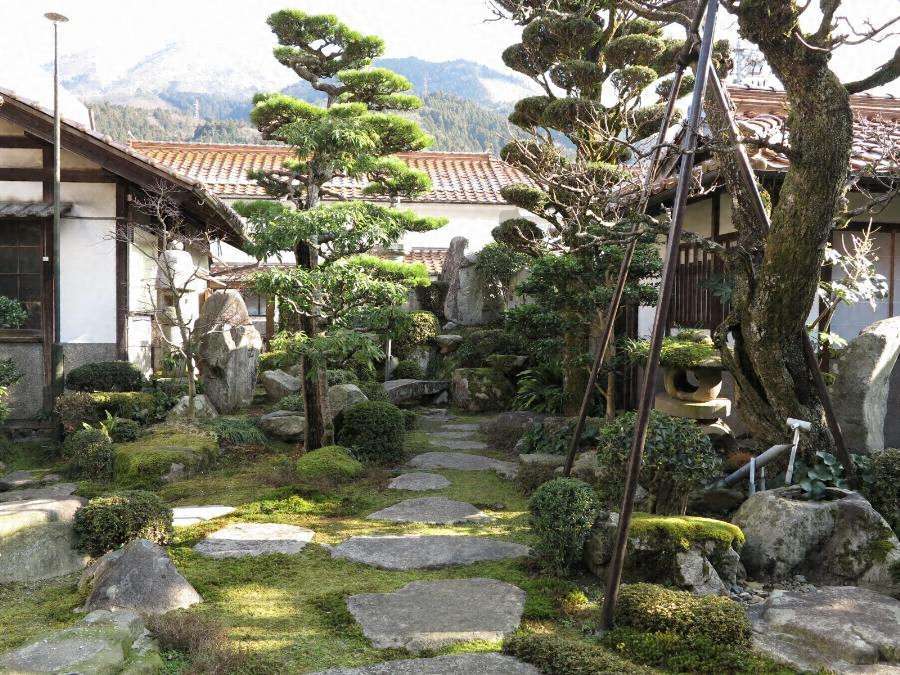
There is a dry waterfall with stones in a narrow strip of space between the adjacent pond and the wall, and to the south of that dry waterfall, there is also a Tsukiyama (artificial hill) with stone arrangements, pine and Japanese maple (Acer palmatum) trees. The artificial hill gets gradually higher as it goes to the back and there is a variation on the scenery due to the large standing stone and ornamental stones. The view of the dry stream and the artificial hill will unfold as visitors walk towards the veranda and their designs and appearances are full of ideas to make the small space look larger.

Garden of Mr. Zaima

In a castle town of the former Tsuwano Domain, this garden was created in the residential area for the townspeople which prospered from the end of the Edo Period to the mid-Meiji Era. There is a small front garden inside the front gate, which faces the street, and a main garden in the east of the main house. This garden demonstrates the development of the landscaping culture in the modern Tsuwano and it has a trace of a merchant’s house from the early modern period.


cultural property : registered monuments 
type : registered monuments

ha38 Ushiroda, Tsuwano-chō, Kanoashi-gun, Shimane-ken 699-5605
Tel:0856-72-2867


Zaima Garden is one of about 20 residential gardens for the townspeople which remains until today in a castle town of the former Tsuwano Domain. This is a typical traditional tradesman’s mansion in Tsuwano, which was built in 1899. It is believed that the foundation of the garden was created along with the store, where they sold alcoholic beverages, and the current main residence.
There are a front garden and the main garden. The front garden has a lantern and a pine tree inside the front gate. The stone arrangements with large stones around the pine tree create a conceptual space of emptiness. The path through the garden gate will take visitors to the small garden in front of the warehouse. The main garden is in the east of the back parlor, which is in the main building along with the room for the Buddhist altar. Two small basin-shaped ponds, garden stones, a lantern, a Tsukubai (a washing basin), etc. are arranged near the eaves and stepping stones are placed around them. More stepping stones are placed in the area from the shoe-removing stone of the back parlor to the back of the garden. They continue to go around two Tsukiyama (artificial hills), which are connected with a stone bridge. The view of the garden from the back parlor consists of a Kasuga lantern and several standing stones on top of the Tsukiyama in the innermost place, and they are connected to the scenery of Mt. Aono behind the garden in the distance.

Garden of Mr. Tanaka

In a castle town of the former Tsuwano Domain, this garden was created in the residential area for the townspeople which prospered from the end of the Edo Period to the mid-Meiji Era. This is a stroll garden with a pond which uses water from the irrigation channel along the street. It has common characteristics of other pond gardens in the castle town of Tsuwano. This garden demonstrates the development of the landscaping culture in the modern Tsuwano and it has a trace of a merchant’s house from the early modern period.


cultural property : registered monuments 
type : registered monuments

ro70 Ushiroda, Tsuwano-chō, Kanoashi-gun, Shimane-ken 699-5605
Tel:0856-72-1661


Tanaka Garden is one of about 20 residential gardens for the townspeople which remains until today in a castle town of the former Tsuwano Domain. It is believed that the garden was created when Miura Goroemon, who was a silk manufacturer, constructed the main house in 1886. The Tanaka Family, who created a fortune with silk textile manufacture, purchased the house in 1927 and the existing garden was created.
The garden is in the southwest of the store and the main house. It is a stroll garden around a pond so visitors can enjoy it not only by viewing it from the parlor but also by walking around the pond. There is a front gate to the garden between the store/main house on the street and a traditional storehouse with mud walls. After the front gate, there is a narrow front garden with stepping stones. The main house and the storehouse are connected with a connecting corridor and there is a small gate in the corridor. After going through the small gate, there is a lush pond garden with the mountain, where there are ruins of the Tsuwano Castle, in its background. There is a Tsukiyama (artificial hill) in the south shore of the pond. Standing stones on top and trees create an appearance of a secluded mountain. The stepping stones in the front garden are connected to the stepping stones from the shoe-removing stone in front of the main house. They will continue to go through an Inari shrine in the back of the garden and to the top of the artificial hill, and then around the pond. There are lanterns and garden stones here and there to make the scenery more enjoyable.

Garden of Mr. Tsubaki

In a castle town of the former Tsuwano Domain, this garden was created in the residential area for the townspeople which prospered from the end of the Edo Period to the mid-Meiji Era. As for the design and structures of the garden, there are some common characteristics with the small courtyards of the early modern times to recent modern times. This garden demonstrates the development of the landscaping culture in the modern Tsuwano and it has a trace of a merchant’s house from the early modern period.


cultural property : registered monuments
type : registered monuments

ro190 Ushiroda, Tsuwano-chō, Kanoashi-gun, Shimane-ken 699-5605
Tel:0856-72-0021


Fundo-ya (Tsubaki-ya) manufactured and sold Japanese candles, hair oil, rapeseed oil, camellia oil, etc. in the current location beginning in 1596, during the Keicho Era. (They shifted their business to petroleum energy in 1947.) According to “the drawing of the townscape of the Tsuwano Domain” which was created by the order of the Tokugawa Shogunate in 1703, Fundo-ya Hanbei already existed in the same location on the drawing. He was considered to be one of “the top eight fellows” of the Tsuwano Domain and, in recognition, he was given a brass flower bowl (Usubata) with a family crest of the trade name from the lord and it still remains until today.
The building was constructed shortly after the great fire of the castle town of Tsuwano in 1853. It was difficult to procure lumber because it was right after the fire, so they used recycled lumber and sills that were salvaged from the fire.
It appears to be crude, but a typical merchant’s house and Machiya-style from the Edo Period still remain intact even today and it is designated as a registered Tangible Cultural Property of Japan.
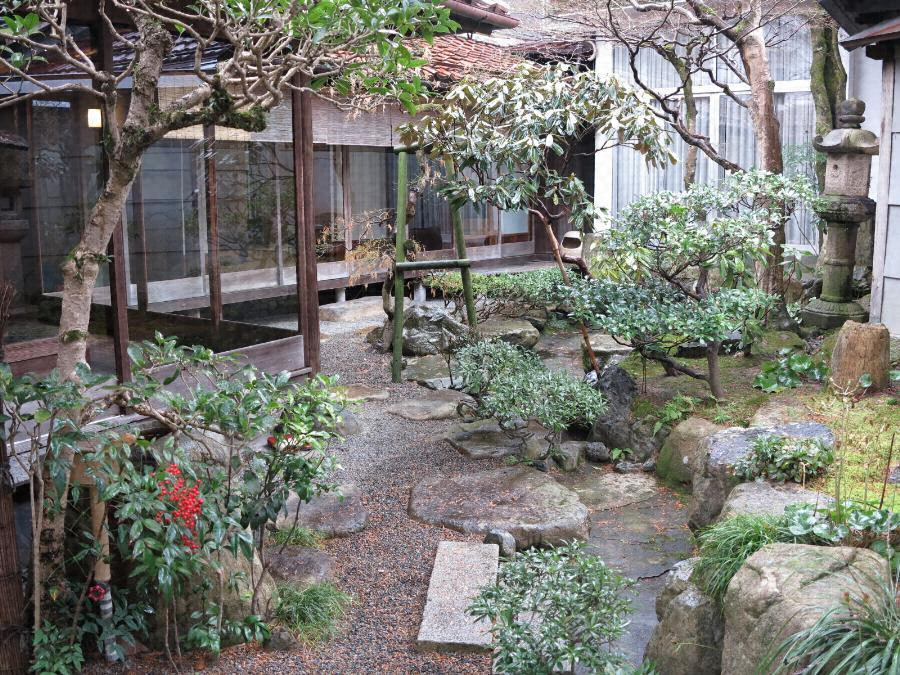
The courtyard (Tsubaki Garden) is designated as a Registered Monument. Although it is unknown exactly when during the Edo Period it was created, marks of the great fire of 1853 (the sixth year of the Kaei Era) such as burnt marks and cracks were found in the shoe-removing stone in the stone arrangements. The courtyard was very common in the Machiya-style architecture during the Edo Period because lighting was not enough and ventilation was necessary. Haircap moss (Polytrichum) covers the entire area between stepping stones. This garden is simple yet refined.