
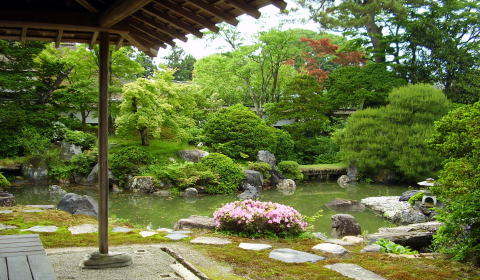
It is said that it was built around the mid-Edo Period, but an actual date is unknown. A gardener of the Enshu-ryu style was invited from Kyoto to participate in the landscaping. The landscape of the garden from the mid-Edo Period is very well preserved and there is a pond shaped like the character for “heart (Kokoro).” The garden has a beautiful arrangement of Tsukiyama (artificial hills), dry waterfall, sandy beach, and stone lanterns around the pond, as well as an enclosure of the well in the north.
cultural property : historic sites and places of scenic beauty as natural monuments
type : places of scenic beauty
904 Shimoseki, Sekikawa-mura, Iwafune-gun, Niigata-ken 959-3265
Tel:0254-64-1002
Home page : www.watanabetei.com
This was a garden in the residence of the Watanabe Family, who was a wealthy merchant, farmer and village headman in Echigo Shimonoseki. The garden is open to the east and there is a pond shaped like the character for “heart (Kokoro).” There is a writing with ink from 1769 on a ridge pole in the South Garden, thus it is presumed that the garden was made around that time. There are three Tsukiyama (artificial hills) in the west of the pond, named Ichinoyama (First Hill), Ninoyama (Second Hill) and Sannoyama (Third Hill). There is a stone of Fudo on Ichinoyama and it represents a dry waterfall. On the opposite side of the pond, in the east, there is a beach of round stones with numerous garden stones. Many stepping stones as well as some plants, that are liken to a crane and turtle, are also arranged. Visitors can enjoy views from season to season; white plum blossoms in spring, Japanese irises (Iris laevigata) in summer, Japanese maple in fall and a snowscape in winter.
The garden’s layout is the so-called Kyoto style as a stone lantern and enclosure of the well are tastefully arranged to add elegance to the garden.
The landscape of the garden from the mid-Edo Period is very well preserved and it is considered to be very important in the history of Japanese gardens as this is an example of the culture spreading from a large city to the countryside.