wakayama」タグアーカイブ

Tentoku-in Garden

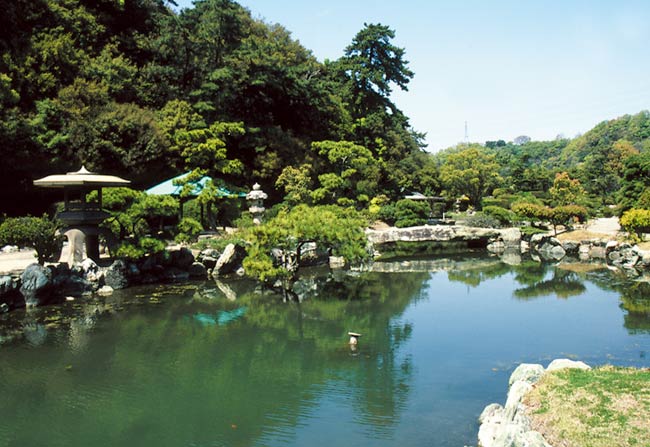
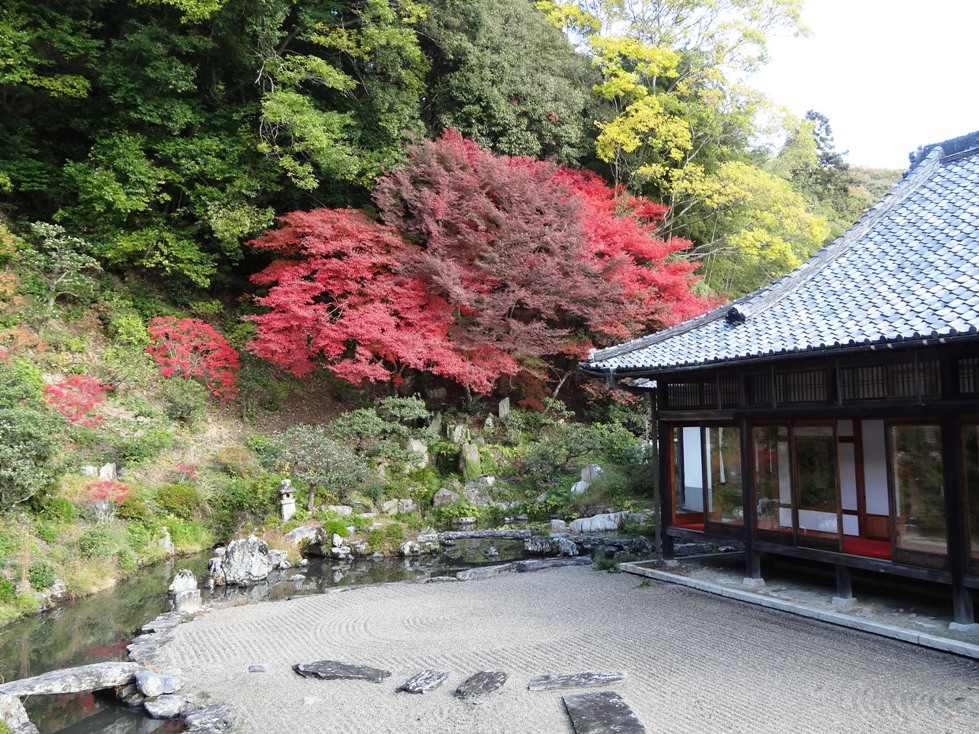
The garden is located at the south of the Tentoku-in Kyakuden (reception hall). It is designed to create a gentle and peaceful atmosphere with a pond at the center. A crane island and a turtle island are situated as central islands in the pond with stone bridges connecting them. The opposite side of the pond has a natural slope, which is used as a Tsukiyama. The main scenery of the garden is a stone arrangement at the shore to the left, representing a dry waterfall.


cultural property : historic sites and places of scenic beauty as natural monuments 
type : places of scenic beauty

370 Kōyasan, Kōya-chō, Ito-gun, Wakayama-ken 648-0211
Tel:0736-56-2714


Tentoku-in is said to have been built by the lord of Kaga, Maeda Toshitsune, in 1615 (the early Edo Period), and it is believed that the garden was also created around the same time. Although all the buildings on the premise were burnt down in 1864, in the late Tokugawa Shogunate, the land allotment and the stone arrangements still remain.
The garden is located at the south of Tentoku-in Kyakuden (a reception hall) and designed to create a gentle and peaceful atmosphere. A crane island and a turtle island are situated as central islands in the pond with stone bridges connecting them. The opposite side of the pond is a natural slope, which is used as a Tsukiyama. This Tsukiyama and a stone arrangement at the shore to the left, making up a dry waterfall, are the components of the garden’s main scenery. Tall conifers such as Japanese cedars (Cryptomeria japonica), pines, Sawara cypresses (Chamaecyparis pisifera), and Japanese yews (Taxus cuspidata) form clusters in the back. Japanese pierises (Pieris japonica), rhododendrons, Japanese hollies (Ilex crenata), and azaleas are planted and trimmed low in the area from the foothill to the pond.
The stone arrangements and such retain some degree of devastation, and there are no signs of repair in later years, so visitors can witness a record of the past.
Kokawadera Garden

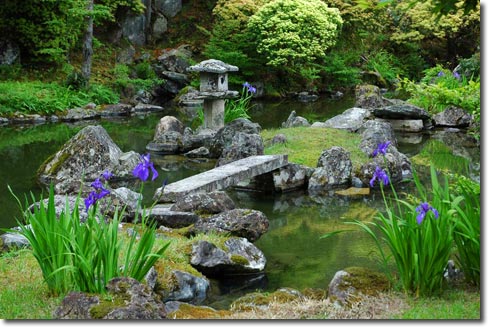
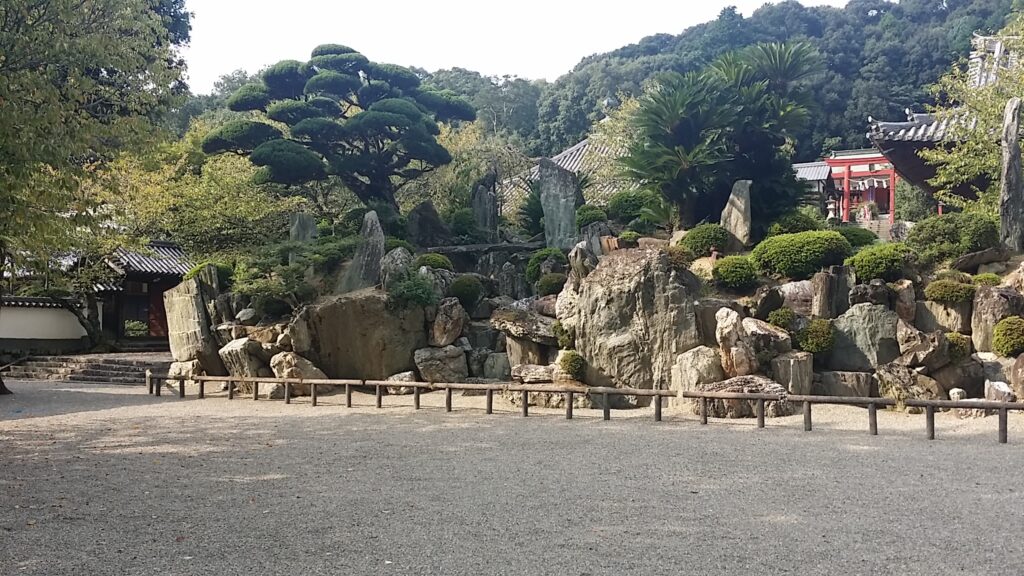
Unique stone arrangements can be seen as large rocks, mainly chlorite schist, are arranged in a strong yet elegant way utilizing a number of diverse techniques. Azaleas grow in the gaps between stones, and Chinese junipers (Juniperus chinensis), weeping cherries (Prunus spachiana), and sago palms (Cycas revoluta) are also planted throughout.


cultural property : historic sites and places of scenic beauty as natural monuments 
type : places of scenic beauty

2787 Kokawa, Kinokawa-shi, Wakayama-ken 649-6531
Tel:0736-73-4830

Home page : www.kokawadera.org


Kokawadera is known as one of the sacred sites of Saigoku Junrei (a pilgrimage of 33 temples in the Kinki/Tokai regions). The path for the pilgrimage is the oldest of this sort in Japan. It covers the sacred sites of Kan’non (the Goddess of Mercy) in 7 prefectures of the Kinki and Tokai regions.
The garden is a stone garden of the Momoyama Period. It is located between the main temple and the main gate, on the both sides of stone steps that link the main gate to the main temple, functioning as retaining stone walls. Enormous rocks, mainly of chlorite schist, are arranged in a strong yet elegant way utilizing diverse techniques. Trimmed azaleas are planted in the gaps between stones that are arranged in a diverse way, and Chinese junipers (Juniperus chinensis), weeping cherries (Prunus spachiana), and sago palms (Cycas revoluta) are also planted throughout. The composition of the stone arrangements as a whole has a focus to the left with a dry waterfall, a stone bridge, and crane and turtle islands.
The great diversity of stone arrangements make this a unique stone arrangement garden.

Negoro-ji Garden

The garden consists of a flat garden, which surrounds Okushoin (a study in the back of a residence) in the north, west, and south, and Shoten-ike in the south of Shoten-do. The area around Shoten-ike is planted with pines and maples, creating rich scenery. In 1800 (the Kansei Era of the Edo Period), the Kishu Tokugawa Family’s Fukiage Palace was relocated and its construction was completed in 1801. The garden was built during this period of construction.


cultural property : historic sites and places of scenic beauty as natural monuments 
type : places of scenic beauty

2286 Negoro, Iwade-shi, Wakayama-ken 649-6202
Tel:0736-62-1144

Home page : www.negoroji.org


The garden consists of a flat garden, which surrounds Okushoin (a study in the back of a residence) in the north, west, and south, and Shoten-ike in the south of Shoten-do. A section with a Tsukiyama (artificial hill) and a pond is located to the north and west of Okushoin. The pond is at the foot of the hill in the back with a waterfall arrangement at the north front. The water flows down three levels of the tall stone arrangement. There are two low islands, big and small, with two stone bridges. There is also an Ukishima (detached island), and the islands and the pond edges are protected by flat stones.
The south garden of Okushoin has Tateishi (standing stones) at the south-eastern corner. There are ornamental stones, Japanese red pine (Pinus densiflora) and azaleas all within in this flat garden.
Shoten-ike at the south of Shoten-do has an island at the center to worship Benzaiten (Saraswati). There are some stone arrangements nearby. Pines and maples are planted all around the pond, creating diverse scenery.

Yosui-en

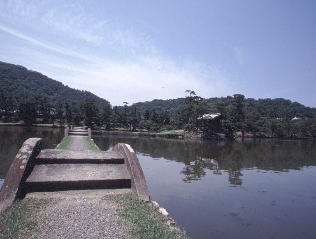
This is a villa of the 10th lord of Kishu, Tokugawa Harutomi, of the Bunsei Era. It occupies part of the Kishu’s Suiken territory next to the Oura Bay, south-west of Wakayama City. This is a Daimyo garden of approximately 33,000m2, with plantings of Japanese black pines (Pinus thunbergii) as well as Japanese red pines (Pinus densiflora), camelias, sweet olives (Osmanthus fragrans), black ridge oaks (Quercus phillyraeoides) and more. The garden has a pond that takes in seawater.


cultural property : historic sites and places of scenic beauty as natural monuments 
type : places of scenic beauty

1164 Nishihama, Wakayama-shi, Wakayama-ken 641-0036
Tel:073-444-1430

Home page : www2.odn.ne.jp/cap99810/index.htm


This is a villa of the 10th lord of Kishu, Tokugawa Harutomi, during the Bunsei Era. It occupies part of the Kishu’s Suiken territory next to the Oura Bay, southwest of Wakayama City. It encompasses 33,000m2 of land.  
The main feature of the garden is a large pond that stretches from east to west, and a Shoin and space for a tea ceremony are placed on the western side of the pond. The seawater pond curbs gently, and has Tateishi (standing stones) on the northwest corner as well as a central island in the center slightly toward east. The central island is dedicated for Benzaiten (Saraswati) and Inari (deity primarily known as the protector of rice cultivation), and is connected by a hook-shaped Saiko (West Lake in China)-style levee from the north shore, and an arched bridge from the south shore. There is a remnant of Shigure-tei on the south shore, while the western shore has remains of a Funagura (boat house), a Yachiyo-tei and a Baba (horseback riding ground). Behind the garden, there is an embankment that borders the garden and the Suiken River. The embankment has two sluice gates in order to draw seawater to the pond.  
The area around the garden is planted with Japanese black pines (Pinus thunbergii), as well as Japanese red pines (Pinus densiflora), camelias, sweet osmanthus (Osmanthus fragrans), and black ridge oaks (Quercus phillyraeoides), which links the garden scenery to outside nature such as Mt. Takozushi and Mt. Yake.

Wakayama Castle Nishinomaru Garden

The garden belongs to the Nishinomaru Palace and is located at the northwestern foot of the Wakayama Castle. The date of its creation is not known, but it is believed to be in the early Edo Period. Remnants of surrounding garden feature and a tea room were discovered during the renovation of 1970-1973. This is one of only a few remaining examples of a garden inside a castle.


cultural property : historic sites and places of scenic beauty as natural monuments
type : places of scenic beauty

3 Ichibanchō, Wakayama-shi, Wakayama-ken 640-8511
Tel:073-435-1044


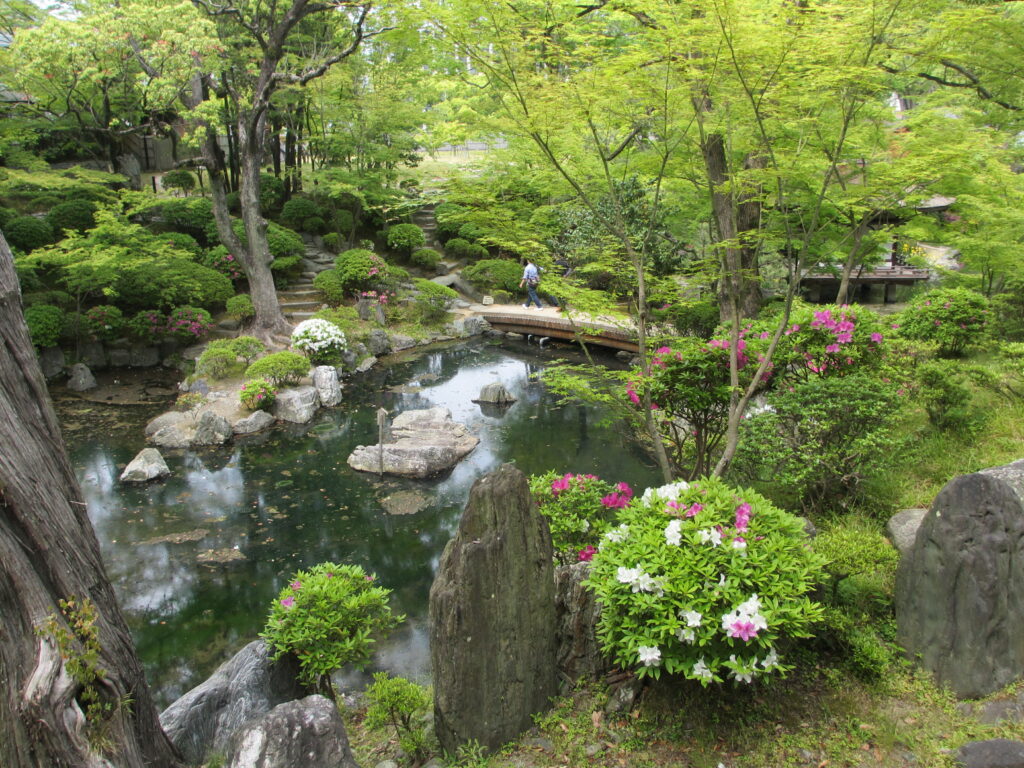
The garden belongs to the Nishinomaru Palace and is located at the northwestern foot of the Wakayama Castle. The date of its creation is not known, but it is believed to be in the early Edo Period. It is a stroll garden with a two-level pond and a waterfall utilizing the slope of Mt. Torafusu. A Tenshukaku, or castle tower, is situated on top of the mountain.  
The inner moat of the castle is extended to make it resemble a large pond, where “Willow Island” made of chlorite schist is placed. At the shore of the large pond, there is a building called “Engyo-kaku.” A smaller pond, “Ue-no-ike” (upper pond), is in the west of Engyo-kaku. A stone that resembles a boat with its bow raised is placed in the pond, and the stone is called “Ofuna-ishi.” The upper pond has many bridges including Momiji-bashi (“maple” bridge), an earthen bridge and a stone bridge. Since visitors can enjoy majestic fall colors, the garden is also called “Momiji-dani Garden (maple valley garden).”  
During the renovation of 1970-1973, the remnants of the surrounding garden feature and a tea room were discovered. The garden is one of the only few remaining examples of a garden inside a castle.

Kotonoura-onzanso-en

It is a stroll garden with a pond utilizing seawater and was made by Nitta Chojiro, a successful leather business owner, between the early Taisho Era and the beginning of the Showa Era. It has almost 6 ha of space, and the seawater pond features a unique design, composition, and decorative techniques using many imitation stones and woods.


cultural property : historic sites and places of scenic beauty as natural monuments 
type : places of scenic beauty

370 Funoo, Kainan-shi, Wakayama-ken 642-0001
Tel:073-482-0201

Home page : http://www.onzanso.or.jp


It is a stroll garden with a seawater pond. It was made by Nitta Chojiro, a successful leather business owner, between the early Taisho Era and the beginning of the Showa Era.  
When constructing the garden, an area between Ya-no-shima (an island) and the land was filled, and two ponds that draw seawater were built by burying a water main pipe to take in seawater. Therefore, as the pond surface goes up and down with the tide, shadows of stones and trees at the shore reflected upon the water surface, change in subtle ways.  
A tunnel from the garden to the beach was dug into the bedrock of Ya-no-shima to connect the landscape of an artificial pond in the east foothill and the natural beach scenery of the west foothill.  
The garden was made with a variety of ideas and by making the most of the location, including a unique technique that often uses concrete-made materials such as imitation rocks and woods, which were rare at the time. The design and technique for garden paths mixing stepping stones with Yori-ishi-jiki (stone pavement) of cement and mortar, are also found in many parts of the garden.