
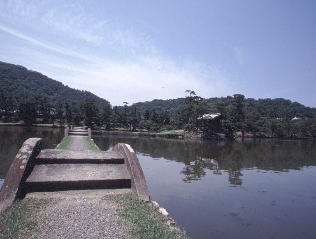
This is a villa of the 10th lord of Kishu, Tokugawa Harutomi, of the Bunsei Era. It occupies part of the Kishu’s Suiken territory next to the Oura Bay, south-west of Wakayama City. This is a Daimyo garden of approximately 33,000m2, with plantings of Japanese black pines (Pinus thunbergii) as well as Japanese red pines (Pinus densiflora), camelias, sweet olives (Osmanthus fragrans), black ridge oaks (Quercus phillyraeoides) and more. The garden has a pond that takes in seawater.
cultural property : historic sites and places of scenic beauty as natural monuments
type : places of scenic beauty
1164 Nishihama, Wakayama-shi, Wakayama-ken 641-0036
Tel:073-444-1430
Home page : www2.odn.ne.jp/cap99810/index.htm
This is a villa of the 10th lord of Kishu, Tokugawa Harutomi, during the Bunsei Era. It occupies part of the Kishu’s Suiken territory next to the Oura Bay, southwest of Wakayama City. It encompasses 33,000m2 of land.
The main feature of the garden is a large pond that stretches from east to west, and a Shoin and space for a tea ceremony are placed on the western side of the pond. The seawater pond curbs gently, and has Tateishi (standing stones) on the northwest corner as well as a central island in the center slightly toward east. The central island is dedicated for Benzaiten (Saraswati) and Inari (deity primarily known as the protector of rice cultivation), and is connected by a hook-shaped Saiko (West Lake in China)-style levee from the north shore, and an arched bridge from the south shore. There is a remnant of Shigure-tei on the south shore, while the western shore has remains of a Funagura (boat house), a Yachiyo-tei and a Baba (horseback riding ground). Behind the garden, there is an embankment that borders the garden and the Suiken River. The embankment has two sluice gates in order to draw seawater to the pond.
The area around the garden is planted with Japanese black pines (Pinus thunbergii), as well as Japanese red pines (Pinus densiflora), camelias, sweet osmanthus (Osmanthus fragrans), and black ridge oaks (Quercus phillyraeoides), which links the garden scenery to outside nature such as Mt. Takozushi and Mt. Yake.