
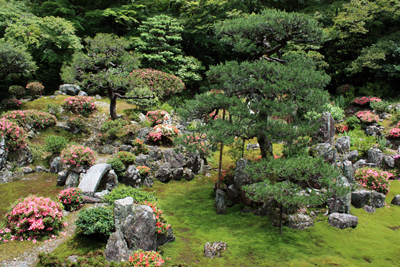
This garden is located at Seigan-ji, a temple of the Soto sect. It is believed that the third Kokin, a Buddhist monk, ordered the gardener, Katori, to make the garden in the early Edo Period. Katori is known for creating the Genkyu-en and Raku-raku-en of the Hikone Castle. The garden is set against a lush hill and is situated on its hillside at the back of the main temple.
cultural property : historic sites and places of scenic beauty as natural monuments
type : places of scenic beauty
669 Maihara, Maibara-shi, Shiga-ken 521-0012
Tel:0749-52-0463
Home page : www.seiganji.org/
This is a garden located at Seigan-ji, a temple of the Soto sect. The temple was founded as Beisen-ji by Sasaki Kyogoku Doyo of the Omi Genji Clan in the early period of the Northern and Southern Dynasties (the Enbun Era). He transcribed the eight volumes of the Lotus Sutra as an offering to the temple. Most of the temple building burned down in war fire during the Eisho Era, but after more than 150 years, in 1650, the temple was reconstructed and renamed Seigan-ji.
The garden is located in the back of the main temple and built on the hillside with a lush grove in the background. It is a stroll Karesansui (dry landscape) garden that utilizes the landform of Mt. Tao’s foothill, and includes a dry pond with a stone bridge and a Horai island as well as a dry waterfall on the far right. The stone lantern in front of Kuri (living quarters of monks) is a Yose-doro (a type of lantern that combines parts of different lanterns), a style popular among masters of the tea ceremony, adding elegant scenery to the garden. It is believed that the third Kokin, a Buddhist monk, ordered the gardener Katori to make the garden in the early Edo Period. Katori is known for creating Genkyu-en and Raku-raku-en of the Hikone Castle.
The Seigan-ji garden gives the illusion of flowing water using haircap moss (Polytrichum) instead of stones or sand. After it rains, water that has seeped into the moss springs out as underflow water, transforming the dry pond into a real one. The scenery after a rain is exceptional.