
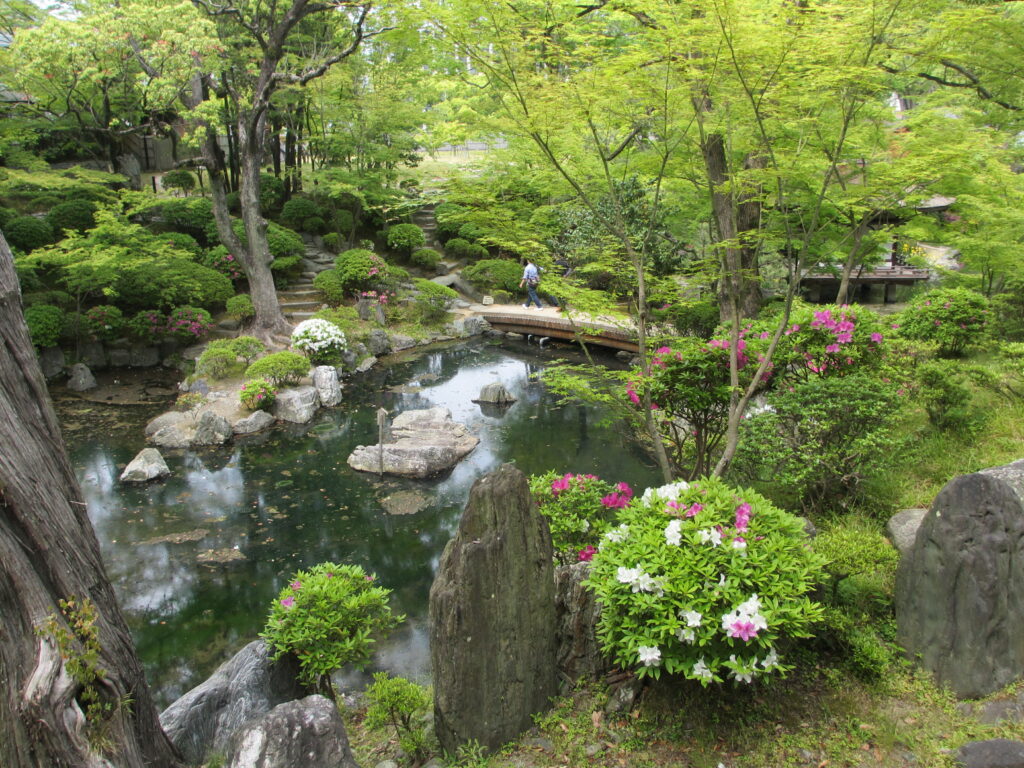
The garden belongs to the Nishinomaru Palace and is located at the northwestern foot of the Wakayama Castle. The date of its creation is not known, but it is believed to be in the early Edo Period. Remnants of surrounding garden feature and a tea room were discovered during the renovation of 1970-1973. This is one of only a few remaining examples of a garden inside a castle.
cultural property : historic sites and places of scenic beauty as natural monuments
type : places of scenic beauty
3 Ichibanchō, Wakayama-shi, Wakayama-ken 640-8511
Tel:073-435-1044
The garden belongs to the Nishinomaru Palace and is located at the northwestern foot of the Wakayama Castle. The date of its creation is not known, but it is believed to be in the early Edo Period. It is a stroll garden with a two-level pond and a waterfall utilizing the slope of Mt. Torafusu. A Tenshukaku, or castle tower, is situated on top of the mountain.
The inner moat of the castle is extended to make it resemble a large pond, where “Willow Island” made of chlorite schist is placed. At the shore of the large pond, there is a building called “Engyo-kaku.” A smaller pond, “Ue-no-ike” (upper pond), is in the west of Engyo-kaku. A stone that resembles a boat with its bow raised is placed in the pond, and the stone is called “Ofuna-ishi.” The upper pond has many bridges including Momiji-bashi (“maple” bridge), an earthen bridge and a stone bridge. Since visitors can enjoy majestic fall colors, the garden is also called “Momiji-dani Garden (maple valley garden).”
During the renovation of 1970-1973, the remnants of the surrounding garden feature and a tea room were discovered. The garden is one of the only few remaining examples of a garden inside a castle.