
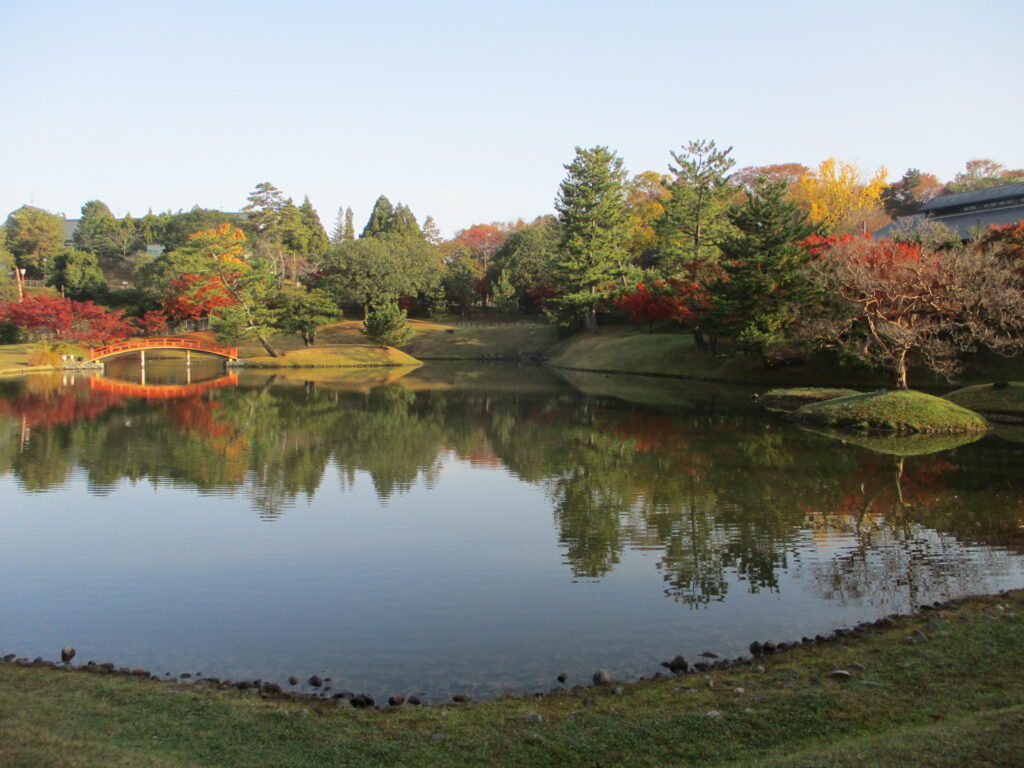
Its origin is thought to be in the Heian Period, but in the mid-Muromachi Period, a Monzeki (monk with a royal background who acceded the proper lineage of a temple) of Daijo-in, Jinson, ordered a gardener Zen’ami to repair the garden. Although the garden became dilapidated in the Meiji Era, the garden as a whole still preserves the land allotment from the Muromachi Period. This is the ruin of a garden made by Zen’ami, the best gardener of the Muromachi Period, when many outstanding gardens were created.
cultural property : historic sites and places of scenic beauty as natural monuments
type : places of scenic beauty
1083-1 Takabatakechō, Nara-shi, Nara-ken 630-8301
Tel:0742-24-0808
Home page : http://www.national-trust.or.jp/protection/index.php?c=protection_view&pk=1491202122
Daijo-in is a Monzeki temple of Kofuku-ji and believed to have been founded in the Heian Period. In the mid-Muromachi Period, Zen’ami and his son were invited by the Monzeki of Daijo-in, Jinson, to repair the garden devastated by Tokusei Ikki, an uprising demanding debt cancellation orders. It is believed that Zen’ami was one of Doboshu (those who were in charge of tea ceremonies, entertainment and miscellaneous duties for Shogun and Daimyo) for Shogun Ashikaga Yoshimasa, and was a master gardener.
In the past, the main allotment of the garden included a large pond in the east and a small pond in the west, with south and north central islands in the east pond. The garden fell into ruin in the Meiji Era, and the west pond and the south central island no longer exist. However, the garden preserves the allotment from the Muromachi Period as a whole, and flowering trees that bloom season by season still decorate the garden. This is the ruin of a garden made by Zen’ami, the best gardener of the Muromachi Period, when the garden was created. (Note: Zen’ami belonged to a social group called Senzui Kawaramono. “Kawaramono” means “people living at riverbeds” and those who were engaged in landscaping were called “Senzui (mountain-and-water) Kawaramono.