
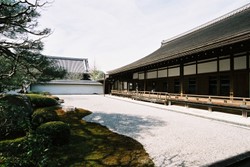
Nanzen-ji was built in 1291 during the Sho’o Era in the Kamakura Period. The garden belongs to a Hojo, where the chief monk resides. It is believed that the garden was created by Kobori Enshu at the beginning of the Edo Period. In contrast to other Japanese gardens that represent Buddhist cosmology with Tsukiyama and large stones, this garden has stones that are placed flat, a style called a flat Karesansui (dry landscape) garden, or more commonly, “young tigers crossing the river.
cultural property : historic sites and places of scenic beauty as natural monuments
type : places of scenic beauty
86 Nanzenji Fukuchicho, Sakyo Ward, Kyoto-shi, Kyoto-fu 606-8435
Tel:075-771-0365
Nanzen-ji is the head temple of the Nanzen-ji school (the Rinzai sect). The Hojo (the chief monk’s residence) is a former Empress’s palace relocated to Nanzen-ji in 1611. It is believed that the garden was created around the same time.
The garden is said to have been made by Kobori Enshu. It is an excellent example of a Karesansui (dry landscape) garden from the early Edo Period. It is a flat garden with white sand sectioned off by the Hojo and Tsuiji-bei (roofed mud wall) into an orderly rectangular shape. When seen from the Hojo, the garden has a principal stone placed in the back left, and a few stones to the right along the wall. The front and right of the Hojo is a spacious area with white sand. Between the ornamental stones, maples, pines, hollies, camelias, and dwarf azaleas trimmed into spheres are planted. The white sand, garden stones, garden trees, and the Tsuiji-bei create harmonious scenery together with pine forests and mountains in the background. The white surface of the Tsuiji-bei has five light-blue parallel lines called “Jogi-suji.” The Jogi-suji signifies that a temple is headed by a monk with a royal background (“Monzeki”), and the number of lines represents the rank of the temple, with five lines representing the highest rank.