
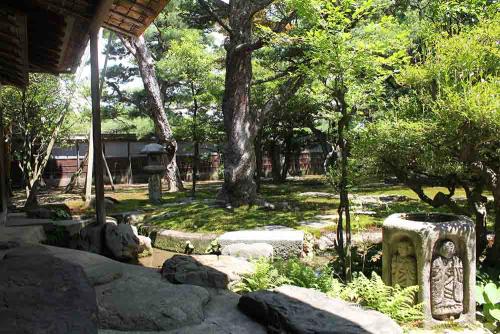
It was built at the south of Kenroku-en as the main garden of Tatsumi Palace in 1863 (the Bunkyu Era of the Edo Period). From the end of the Shogunate throughout the Meiji and Taisho Eras to the Showa Era, the garden continued to be improved by adding a Tsukiyama (artificial hill) and rebuilding the waterway. It is a flat garden that has outstanding harmony with a clean stream.
cultural property : historic sites and places of scenic beauty as natural monuments
type : places of scenic beauty
1-2 Kenrokumachi, Kanazawa-shi, Ishikawa-ken 920-0936
Tel:076-221-0580
Home page : www.seisonkaku.com
Seison-kaku Garden is adjacent to the south of Kenroku-en, a Special Place of Scenic Beauty. It originated in Tatsumi Palace and its main garden was built as a retirement villa for Shinryuin, mother of the 13th lord of the Kaga Domain, Maeda Nariyasu in 1863.
The main garden Hikaku-tei is a serene flat garden with a stream, facing Seika-ken with a study, a tea room and Mizuya (a washing place for a tea ceremony).
Tatsumi Palace was renamed to Seison-kaku in 1874. Around this time, water was drawn from the main garden to create a stream flowing through a courtyard facing the veranda of the “Corridor of Omoto (Japanese sacred lily),” and a Tsukiyama (artificial hill) was placed to create a serene landscape.
In 1909 (the Meiji Era), when Togu (Taisho Emperor) visited the Hokuriku area, a main gate, a carriage driveway, and an entrance were added to the front garden. Also, in the courtyard facing the veranda of the “Tsukushi-no Corridor,” the existing Noh stage was removed and the waterway from the main garden was changed from a straight line to a curve to create a simple landscape.
It is said that the current Seison-kaku layout consisting of the main garden, courtyard, and front yard was completed in 1949. It is a flat garden that has evolved over time to create outstanding harmony with a clean stream.