
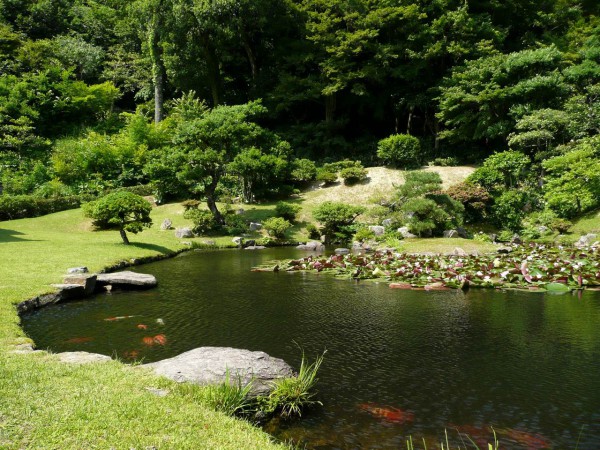
A Tsukiyama uses a natural slope from the south-east to the west of the Hojo. The pond at the bottom of the Tsukiyama occupies half of the garden. The waterfall arrangement, a central island, and garden trees create an elegant landscape. This is a good example of the localization of Kyoto-style gardens in the late Edo Period.
cultural property : historic sites and places of scenic beauty as natural monuments
type : places of scenic beauty
162 Uemachi, Tottori-shi, Tottori-ken 680-0015
Tel:0857-24-5641
Kan’non-in is one of the 8 prayer halls of the Ikeda Family of the Tottori Domain. It is told that the Lord, Ikeda Mitsunaka, completed the temple spending 10 years, and it is considered to be one of the localized Kyoto-style gardens in the late Edo Period.
A Tsukiyama arranges a natural slope from the south-east to west of the Hojo. The pond at the bottom of the Tsukiyama occupies half of the garden. When viewing the pond from the Hojo, visitors can see a forest expanding on the mountain slope behind a Tsukiyama (artificial hill), creating scenery with depth. The pond has stone arrangements of a crane island, a turtle island, and a waterfall, which remain the same as they were in the Genroku Era. The garden skillfully utilizes wild plants native to the area to create beautiful landscape. During spring when cherry trees blossom, the garden becomes a regional tourist destination.
“Sho-kanzeon-bosatu,” the principal image of the temple, is called “Shusse Kan’non (Kan’non of eminance) since it was moved to a bigger temple everytime its alter was changed.