
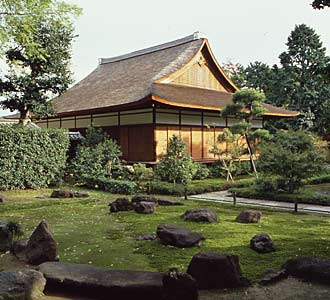
It is assumed that the garden was created as part of the improvement of the temple facilities during the Shoho Era, in the early Edo Period. This is a Karesansui (dry landscape) garden with a pond and borrowed scenery of Mt. Abu. It is believed that the garden was made by Gyokuen’nobo, an apprentice of Kobori Enshu. The garden is located at the northwestern side of a Hojo (the chief monk’s residence), and uses stone arrangements of Katsura Rikyu (Katsura Imperial Villa).
cultural property : historic sites and places of scenic beauty as natural monuments
type : places of scenic beauty
4-10-10 Tondachō, Takatsuki-shi, Ōsaka-fu 569-0814
Tel:072-694-2093
Fumon-ji is a Zen temple founded by the monk, Setsugen, of the Rankei Doryu school in 1390. The temple was transferred to the Myoshin-ji school in the Edo Period, and became a branch temple of Ryoan-ji in Kyoto. Due to the anti-Buddhist campaign in the Meiji Era and the emancipation of farm land after WWII, the premises that used to encompass the present day Honsho-ji, Miwa-jinja and the former Tonda Elementary School was reduced and the temple fell into ruin. The temple was restored at the end of the Showa Era by welcoming a new chief monk.
It is believed that the garden was created during the improvement of the temple facilities during the Shoho Era at the beginning of the Edo Period. It is a Karesansui (dry landscape) garden with a pond and borrowed scenery of Mt. Abu. It is believed that the garden was made by Gyokuen’nobo, an apprentice of Kobori Enshu.
The land of the garden has slight ups and downs. The lower section is viewed as water surface, while slightly higher sections are used as shores or islands. Stones are arranged at key points with stone bridges over them.