
hyougo」タグアーカイブ

Kyu Ako Castle Garden

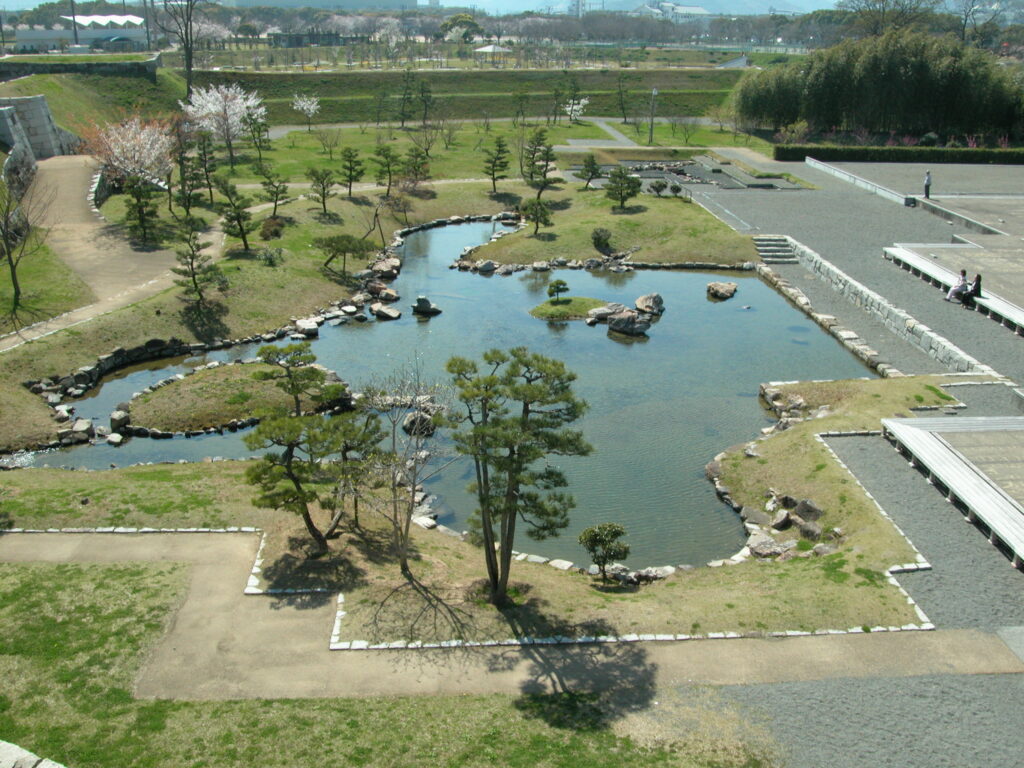
These are Daimyo gardens built in the Honmaru (inner citadel) and Ninomaru (outer citadel) of the Ako Castle. Both of them have ponds that use ample water from the waterworks of the Chikusa River. This is an important example in which the Honmaru and Ninomaru gardens, found during excavation, have been preserved as a whole. Reconstruction work is currently underway, repairing the excavated remnants.


cultural property : historic sites and places of scenic beauty as natural monuments 
type : places of scenic beauty

1 Kamikariya, Akō-shi, Hyōgo-ken 678-0235
Tel:0791-43-6962

Home page : www.ako-hyg.ed.jp/bunkazai/akojo/index.html


The gardens at the Ako-jo ruins are Daimyo gardens preserving Honmaru Garden and Ninomaru Garden as a whole. Honmaru Garden has a large pond at the south of Goten (palace), a small pond of a Tsuboniwa (inner garden) at Nakaoku (where Shogun worked and spent his daily life), and another pond at the north-western corner of the Honmaru. The large pond has a cape, an inlet, a central island, and ornamental stones, and its bottom is decorated with geometrically arranged stone slabs and roof tiles, gravel, etc. The small pond at the Nakaoku Tsuboniwa consists of two small water features aligned in east and west. The water from the small pond is connected to the large pond via a covered conduit. The pond in the north-western corner is oval and dug directly in the ground. Pebbles are laid along its shoreline. Ninomaru Garden is a large scale garden with a large pond. The section near the residence is a flow, while the southwestern section is a grand space where the water is deep and boats can be used.  
In Ako, water taken from the upper Chikusa River is supplied to the castle and houses in its town. This water was also supplied to the ponds in the castle.
Garden of Mr. Tabuchi

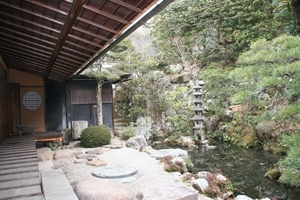
This is a residential garden of Mr. Tabuchi, who built a fortune mainly from the salt-making industry. The residence is located at the foot of Mt. Misaki in Ako Misaki, and the garden is on a hillside that continues behind the residence. The garden has Meien-ro in its upper section, Shun’insai in the middle, and a study and pond at the bottom.


cultural property : historic sites and places of scenic beauty as natural monuments 
type : places of scenic beauty

329-1 Misaki, Akō-shi, Hyōgo-ken 678-0215
Tel:0791-42-2225


This is a residential garden of Mr. Tabuchi, who built a fortune mainly from a salt making industry.  The residence is located at the foot of Mt. Misaki in Ako Misaki, and the garden is on the hillside that continues behind the residence.
The entry area from the front gate to the entrance of the main house is a Tuboniwa-style garden installed along stepping stones, and has a pond made by excavating the area behind the Shoin. Many Sago palms (Cycas revoluta) and sporadically planted Tsuwabuki (Farfugium japonicum) underneath them stand out among trees in the garden. They indicated that the garden is in a warm area. The opposite side of the pond is a slope, where a waterfall stone arrangement of about 4m is placed. To the right of the waterfall is a stone bridge, and visitors can reach the top of the slope by crossing the bridge. Two-story Mei’en-ro appears to the right around the section where the slope becomes gentle. Wooden fence facing Mei’en-ro has Nakakuguri (a low gate between an outer tea garden and an inner tea garden), and visitors can reach a tea room, Shun’insai and its inner tea garden.

Anyo-in Garden

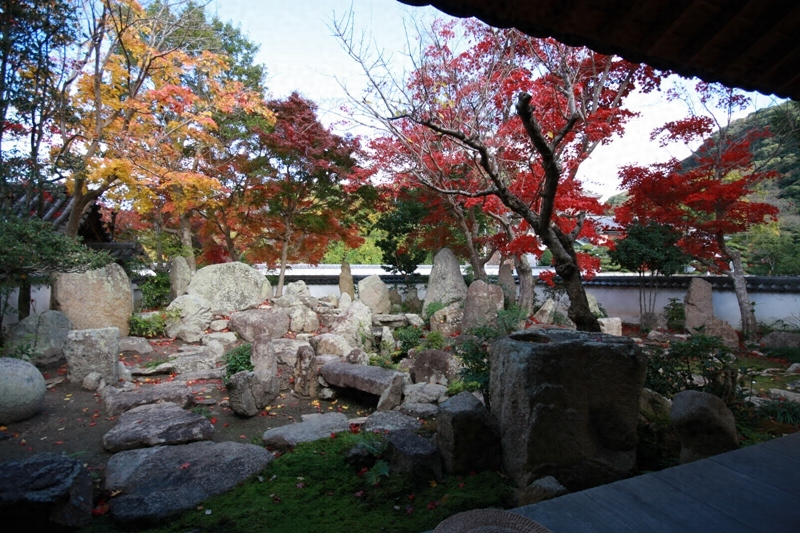
This is a garden made at the shoin of An’yo-in, a sub-temple of Taisan-ji (the Tendai sect). It is a magnificent, elegant garden that uses the old-growth forest of Taisan-ji as borrowed scenery. The landscaping style and the stone arrangement techniques clearly show the characteristics of the Momoyama Period. The old-growth forest of the borrowed scenery is designated as an important area (an ecosystem encapsulating the biological characteristics of a region).


cultural property : historic sites and places of scenic beauty as natural monuments 
type : places of scenic beauty

Zenkai-258 Ikawadanichō, Nishi-ku, Kōbe-shi, Hyōgo-ken 651-2108
Tel:078-974-0408


This is a garden at the study of An’yo-in, a sub-temple of Taisan-ji (the Tendai sect). It is a majestic and elegant Karesansui (dry landscape) garden with the old-growth forest of Taisan-ji as borrowed scenery.
Enormous rocks as triad stones are placed at the center, with crane and turtle island stone arrangements are at each side. Inbetween is a valley, and stone are arranged as a Mt. Horai in the back of the valley.
It is a Karesansui garden that uses many large rocks, but its atmosphere is different from sand gardens often seen at typical Karesansui gardens. Taisan-ji was built in the Heian Period, but fires damaged it many times and historical materials that could indicate the date and person who created An’yo-in has been lost. The style and stone arrangement techniques used in the garden are characterstics to the Momoyama Period, indicating that the garden was built in the Period.  
The old-growth forest of the borrowed scenery is designated as an important area (an ecosystem indicating the biological characteristics of a region).