
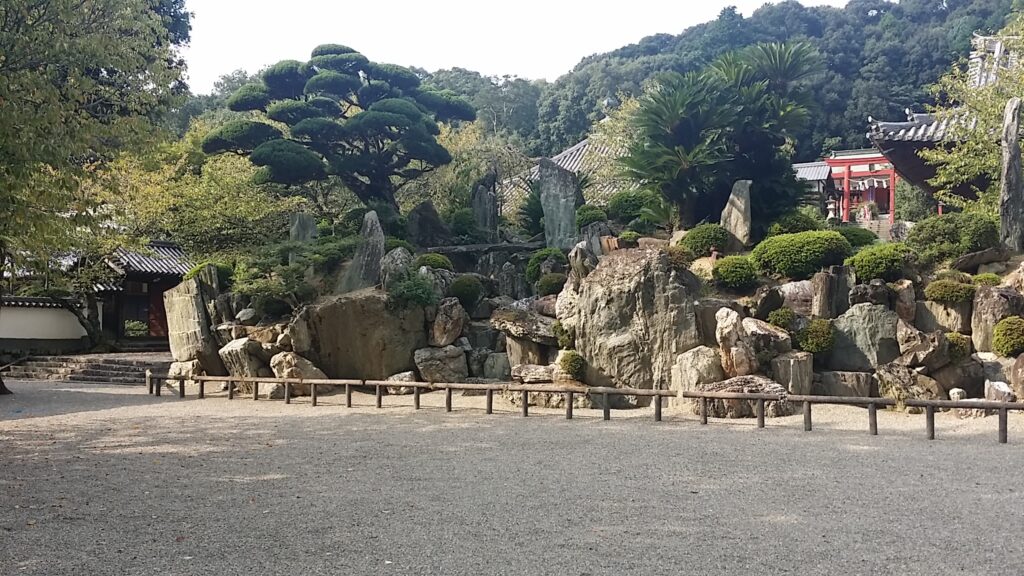
Unique stone arrangements can be seen as large rocks, mainly chlorite schist, are arranged in a strong yet elegant way utilizing a number of diverse techniques. Azaleas grow in the gaps between stones, and Chinese junipers (Juniperus chinensis), weeping cherries (Prunus spachiana), and sago palms (Cycas revoluta) are also planted throughout.
cultural property : historic sites and places of scenic beauty as natural monuments
type : places of scenic beauty
2787 Kokawa, Kinokawa-shi, Wakayama-ken 649-6531
Tel:0736-73-4830
Home page : www.kokawadera.org
Kokawadera is known as one of the sacred sites of Saigoku Junrei (a pilgrimage of 33 temples in the Kinki/Tokai regions). The path for the pilgrimage is the oldest of this sort in Japan. It covers the sacred sites of Kan’non (the Goddess of Mercy) in 7 prefectures of the Kinki and Tokai regions.
The garden is a stone garden of the Momoyama Period. It is located between the main temple and the main gate, on the both sides of stone steps that link the main gate to the main temple, functioning as retaining stone walls. Enormous rocks, mainly of chlorite schist, are arranged in a strong yet elegant way utilizing diverse techniques. Trimmed azaleas are planted in the gaps between stones that are arranged in a diverse way, and Chinese junipers (Juniperus chinensis), weeping cherries (Prunus spachiana), and sago palms (Cycas revoluta) are also planted throughout. The composition of the stone arrangements as a whole has a focus to the left with a dry waterfall, a stone bridge, and crane and turtle islands.
The great diversity of stone arrangements make this a unique stone arrangement garden.