
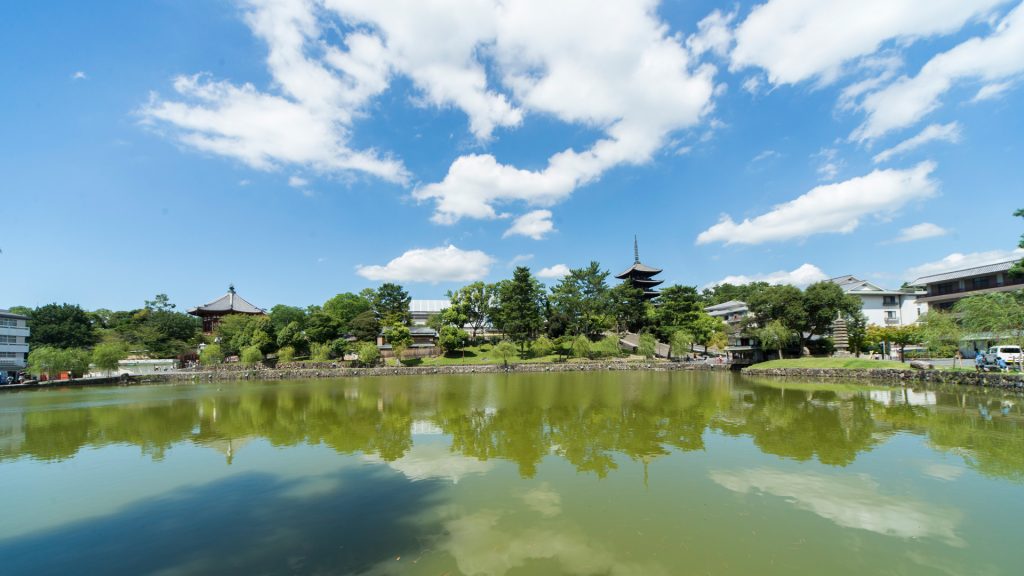
In 1880 (the Meiji Era), Nara Prefecture started managing the former precinct of Kofuku-ji and 14-hectares of the land of Kasuga Taisha as a park. Later, the surrounding forests and the princinct of the Tamukeyama Shrine at Todai-ji were incorporated, and private land necessary for improving the scenery was purchased, becoming the Nara Park. This park is also referred to as the “history” park.
cultural property : historic sites and places of scenic beauty as natural monuments
type : places of scenic beauty
543 Shibatsujichō, Nara-shi, Nara-ken 630-8114
Tel:0742-22-0375
Nara Park was established when the area of approximately 15 ha, including the precinct of Kofuku-ji and Kasugano, were designated as a park in 1880 (the Meiji Era) by a Notice of the Grand Council of State. Later, the park added Mt. Wakakusa and Mt. Kasuga, and was improved as a city park by Nara Prefecture. Nara Park was designated as a Place of Scenic Beauty in 1922 (the Taisho Era) by combining the Nara Prefectural City Park (including Sarusawa-ike, Sagi-ike, Kasugano and Mt. Wakakusa) and the precinct of Todai-ji and Kofuku-ji, which encompasses 524 ha altogether. In the park, there are 1,200 wild deer that are considered the divine messengers of Kasuga Taisha. They are protected as National Natural Monuments. The extensive lawn of Kasugano is a unique landscape sustained by deer grazing. Yamayaki (burning of a mountain) at Mt. Wakakusa every January is Nara’s traditional event that heralds the arrival of early spring. Beside Mt. Wakakusa, Mt. Kasuga is covered with a pristine forest that has not been cut since ancient times. The forest is designated as a Special Natural Monument called “Kasugayama Primeval Forest.” Everywhere in the park, visitors can enjoy landscapes that integrate history, culture and nature, such as Ukimi-do in Sagi-ike, Sarusawa-ike, the five-story pagoda of Kofuku-ji, etc.