
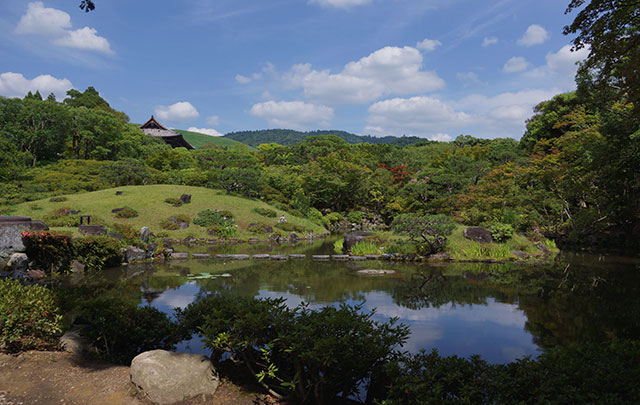
The front garden was made in the Edo Period (the Enpo Era) while the back garden was built in the Meiji Era. The two gardens with their different origins are connected with a stream, and together they are called “Isui-en.” It is an outstanding garden that incorporates the roof of the Todai-ji’s Nandai-mon (Great South Gate) and three mountains, Mt. Wakakusa, Mt. Kasuga and Mt. Mikasa, as borrowed scenery.
cultural property : historic sites and places of scenic beauty as natural monuments
type : places of scenic beauty
74 Suimonchō, Nara-shi, Nara-ken 630-8208
Tel:0742-25-0781
Home page : www.isuien.or.jp
It is located in the west of Nandai-mon (Great South Gate) and to the north of the Yoshiki River. The front garden was created in the Edo Period (the Enpo Era) and the back garden in the Meiji Era. The two gardens with their different origins are connected with a flow of water, and together they are called Isui-en.
The front garden was made by improving the remnant of Sanshu-en, which was a villa owned by a bleacher of the Kiyosumi Family, in Nara. The back garden was built when the site was owned by an affluent merchant, Sekito Jiro, in Nara. This garden uses Mt. Wakakusa, Nandai-mon of Todai-ji, Mt. Kasuga, and Mt. Mikasa as borrowed scenery. The garden also uses stepping stones, shore stepping stones, old temple stones and millstones, as well as plants such as dwarf azaleas and Okamezasa (Shibataea kumasaca), giving typical Meiji characteristics to the garden as a whole. Isui-en, consisting of two gardens, is a stroll garden with ponds and represents Nara Prefecture.
Also, there is the “Neiraku Museum” on the premise, which holds and displays bronzeware from ancient China, porcelain from Goryeo and Yi Dynasties of Korea, and Japanese tea ceremony utensils.