
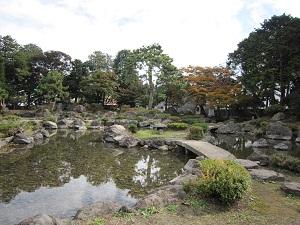
Kanehiranari-en is recognized as an important garden that perfectly conveys the unique style of the Oishi Bugaku gardening school that dominated the Tsugaru region from the end of the Edo Period (approx. 1750 – 1850) through modern times. The overall premises, including the main building and garden, are all preserved in good condition. The garden was designated as a Historic Site, Place of Scenic Beauty, and Natural Monument on January 26, 2006.
cultural property : historic sites and places of scenic beauty as natural monuments
type : places of scenic beauty
2−1, Uchimachi, Kuroishi-shi, Aomori-ken 036-0306
Tel:0172-52-2111
City of Kuroishi Board of education Cultural properties section
The third Takahashi Teizan was invited by Kato Uhei, a politician and business man, to create this garden in 1882. He died before completing the garden. His apprentices, Obata Teijyu and Ikeda Teigetsu, succeeded him in the work and completed the garden in 1902. The garden is also known as “Sawanari-en” because of the first trade name of “Sawaya Narinosuke” in the sake-brewing industry, which was Uhei’s family business.
“Kanehiranari-en” was started by Kato Uhei as one of his measures against unemployment. In the spirit of his belief that “money should be distributed to all people, leading to a peaceful society,” the garden was named “Kanehiranari-en (money peace-making garden).” The garden has a large pond located at the far back on the east side of the main building. The shape of the premises gives depth to this garden, with its three ponds whose shorelines are created with intricate stone arrangements, Tsukiyama behind the shorelines, and a dry waterfall created by dynamic stone arrangements. The style of the “Oishi Bugaku gardening school” can be seen in the unique usage of stones and detailed design. It is one of the great gardens that convey the unique style of the “Oishi Bugaku gardening school,” which dominated the Tsugaru region from the end of the Edo period (approx. 1750 – 1850) and modern times.