
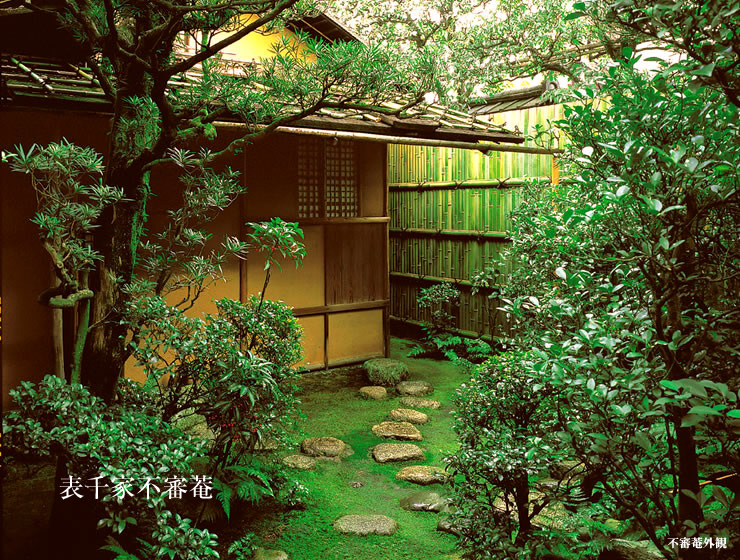
This is a tea garden (Roji) that belongs to Omotesenke, one of the Sansenke tea schools. It consists of an outer tea garden to the west, a tea garden in front of Zangetsu-tei, another in front of the Sodo (mausoleum), and an inner tea garden that belongs to Fushin-an. The inner tea garden of Fushin-an is located at the innermost part of the garden and can be reached by going through the Umemi-mon (plum viewing gate) from the spacious tea garden in front of the Sodo. Although rather small, Fushin-an’s garden recreates the serenity of a secluded mountain.
cultural property : historic sites and places of scenic beauty as natural monuments
type : places of scenic beauty
597 Honpojimae-cho,Ogawa Teranouchi agaru, Kamigyō-ku, Kyōto-shi, Kyōto-fu 602-006
Tel:075-432-2195
This is a tea garden (Roji) that belongs to Omotesenke, one of the Sansenke (three Sen Families) tea schools. It consists of an outer tea garden to the west, one in front of Zangetsu-tei, one in front of the Sodo (mausoleum), and an inner tea garden that belongs to Fushin-an.
A path goes through the outer tea garden on the west side, and through the garden entrance and the small Nakakuguri gate to the inner garden. Visitors will then see a thatched-roof gate to the right to enter Sodo, and stepping stones to the left that continue to Zangetsu-tei. In front of Sodo, there is a spacious tea garden with a Tsukubai (wash basin) and a dry moat.
The path of stepping stones that turns to the left in front of the thatched-roof gate leads to Zangetsu-tei. Visitors can see a well to the right, skillfully arranged stepping stones, Umemi-mon (plum viewing gate), and a tea garden with perfectly balanced plantings. Visitors will finally enter the inner tea garden of Fushin-an once they go through Umemi-mon. In the inner tea garden, there is a bench to the right. Suna Secchin (an ornamental toilet made of sand and stones), Tsukubai, and small stepping stones lead visitors to Nijiri-guchi (a crawl-through entrance). Although the area is small, the inner garden recreates the atmosphere of a secluded mountain, creating serene space.
As the site continued to be passed down over generations, buildings such as a tea room and a practice room were added from other locations or newly built. The tea garden was renovated each time, and resulted in a garden with a complex configuration.