
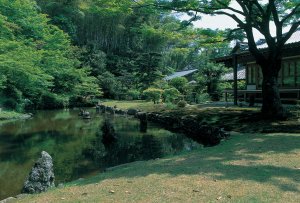
It is a garden with a Tsukiyama (artificial hill) and a pond. It is called Ryushin-tei and is located in the north of a Hojo (the chief monk’s residence) and faces towards the study for Sorin-ji, a temple of the Rinzai sect. There are standing stones on top of the hill which faces south, and these stones are the centerpiece of this garden. There is a dry waterfall towards the pond at the bottom of the hill. Eight medium-sized standing stones are arranged in two rows in the pond. Because of that particular design, it is believed that the original garden was created around the period of the Northern and Southern Dynasties.
cultural property : historic sites and places of scenic beauty as natural monuments
type : places of scenic beauty
210 Kogushi, Ube-shi, Yamaguchi-ken 755-0067
Tel:0836-21-1087
Fukubara Hirotoshi, a lord of Ube, built Sorin-ji in 1670 in order to hold memorial services for the repose of his father, Mototoshi’s soul. This Rinzai sect temple was established in the place where then dilapidated Fusai-ji was. It is believed that the old pond and garden of Fusai-ji were repaired and upgraded.
It is a garden with a Tsukiyama (artificial hill) and a pond. It is called Ryushin-tei and located in the north of a Hojo (the chief monk’s residence), facing towards the study. There are standing stones on top of the hill which faces south, and these stones are the centerpiece of this garden. There is a dry waterfall at the bottom of the hill and water falls to the pond. Eight standing stones are arranged in two rows in the pond in a Yodomari-style.
This type of landscaping can also be seen in Chion-in and Nanzen-ji in Kyoto which are believed to have been built in the 14th century (the period of the Northern and Southern Dynasties). The same style from the Shoin garden for the temples from that time period can be found everywhere in this garden, thus it is believed that the original garden goes back to the period of the Northern and Southern Dynasties. This is the oldest garden in the Yamaguchi Prefecture.