
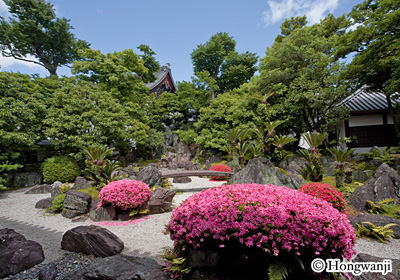
It is a Karesansui (dry landscape) garden of the inner court on the east side of the study, known as “Kokei-no-niwa.” Three central islands of different sizes are situated on white sand. The dry waterfall and rock arrangements are dynamic and strong, which is characteristic of gardens with groves and ponds in front of studies built during the Momoyama Period.
cultural property : historic sites and places of scenic beauty as natural monuments
type : places of special scenic beauty, historic sites
Hanayacho-sagaru, Horikawa-dori, Shimogyo-ku, Kyoto-fu, 600-8501
Tel:075-371-5181
This is the head temple of the Hongan-ji school (the Jodo Shinshu sect founded by Shinran Shonin). Daishoin Garden is a Karesansui (dry landscape) garden of the inner court on the east side of the study, known as “Kokei-no-niwa.”
The garden is flat with a Tsukiyama on the east side. There are many Tateishi (standing stones) and five lanterns. At the center, slightly to the north, there is a magnificent stone arrangement of a dry waterfall. A dry stream represented by cobble stones leads to the ground covered with white sand, recreating a swift current pouring into the ocean. Two central islands are protected by colorful stone edging, and an arched stone bridge and a small bridge made of natural stones connect the islands. Sago palms (Cycas revoluta) planted between stone arrangements are characteristic of study gardens with groves and ponds built in the Momoyama Period. The powerful and dignified stone arrangements and dry waterfall are also great examples of this Period.