
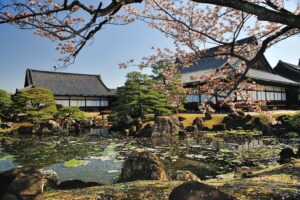
Ninomaru Garden was renovated to prepare for Emperor Gomizuno’o’s visit in 1626 under the instructions of Sakuji Bugyo (Commissioner of Works), Kobori Enshu. The pond in the garden has the Horai Island at the center and the Crane Island on one side and the Turtle island on the other. The pond can be enjoyed from three directions: The great hall of Ninomaru Palace, Kuro-shoin, and the remnant of the Gyoko Palace. The garden is said to be the best example of a garden with Tsukiyama (artificial hills) and ponds found at the currently existing castles.
cultural property : historic sites and places of scenic beauty as natural monuments
type : places of special scenic beauty
541 Nijo-jo-cho, Horikawa-nishi-iru, Nijo-jo-dori, Nakagyo-ku, Kyoto city, Kyoto-fu 604-8301
Tel:075-841-0096
Ninomaru Garden was renovated as a garden facing the palace for Emperor Gomizuno’o’s visit in 1626 under the instructions of the Shogunate’s Sakuji Bugyo (Commissioner of Works), Kobori Enshu. Later, the palace was removed and relocated, but the garden was carefully crafted and renovated so that it can be enjoyed from three directions – the great hall of the Ninomaru Palace, Kuro Shoin, and the remnant of the Gyoko Palace. The pond has curved edges with various characteristics, three central islands (the Horai Island, the Crane Island, the Turtle Island), four natural stone bridges, and a three-level waterfall in the north-western corner. There are also many stone arrangements along the pond edges and shore. The western section of the garden features a background of forests consisting of pines, Japanese nutmeg trees (Torreya nucifera), Kurogane hollies (Ilex rotunda), Japanese blue oaks (Quercus glauca), chinquapins (Castanopsis sieboldii), Japanese pittosporum (Pittosporum tobira), Muku trees (Aphananthe aspera), cherries, maples, etc. The southern part of the garden is a spacious lawn dotted with a well balanced number of pines. The stone arrangements in the garden create an open and bold atmosphere, and are said to be the best example among gardens with Tsukiyama (artificial hills) and ponds of the presently existing castles.